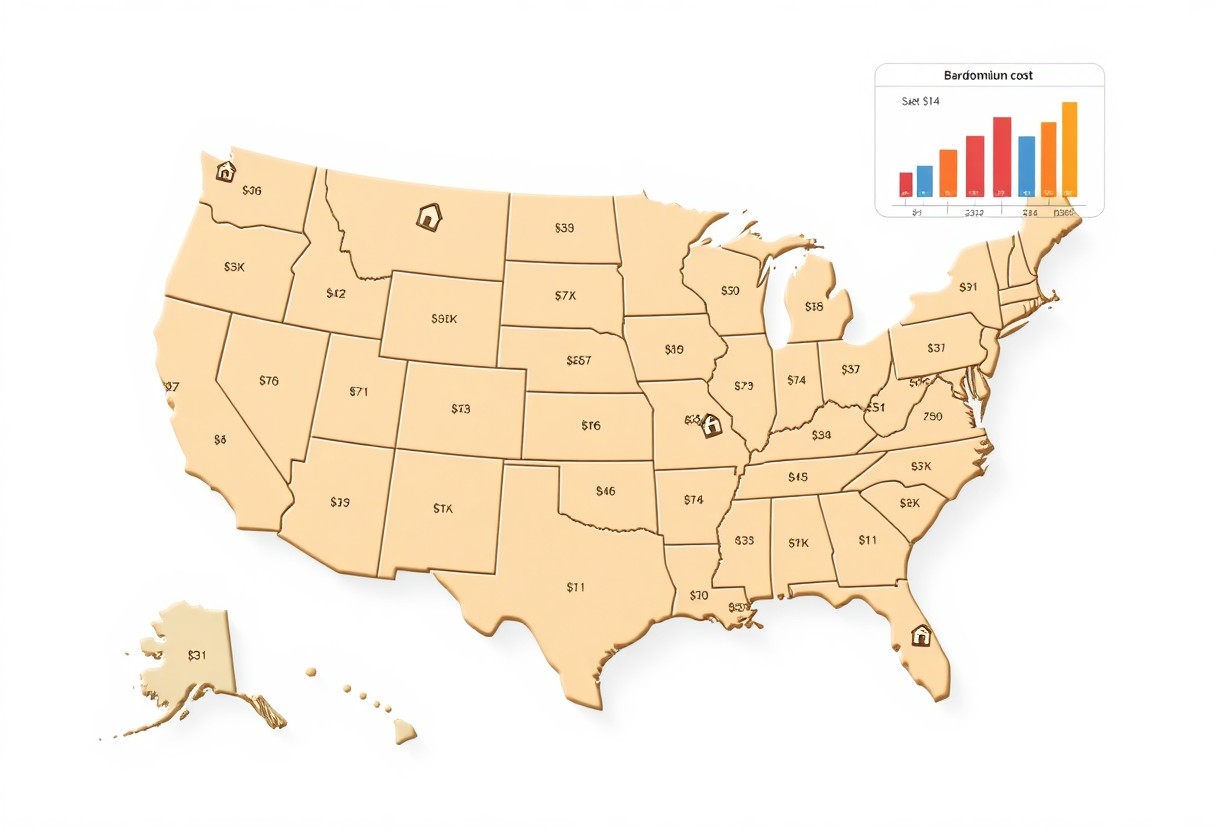
With regional labor, materials, and zoning differences affecting build costs, you need a clear state-by-state comparison to plan your barndominium budget. This guide presents average per-square-foot estimates, typical permitting and utility fees, and finish-level variations so you can gauge your potential investment, compare states side-by-side, and make informed decisions about location, design, and financing.
Key Takeaways:
- Costs vary widely by state-expect roughly $90-$200+ per sq ft depending on local labor rates, material prices, permitting, and climate-driven construction requirements; rural inland states tend to be cheaper, coastal and high-demand metros cost more.
- Primary cost drivers are land and site work, foundation type, interior finishes, local labor availability, and building-code or weatherproofing needs; these can shift overall price more than the basic metal shell.
- To lower or better predict costs, compare local builder quotes, consider barndominium kits or prefabrication, factor permitting and insurance into budgets, and check state-specific tax, zoning, and utility hookup expenses.
Overview of Barndominiums
Definition and Features
You’ll find barndominiums are typically metal or post-and-beam shells converted into living space with open, clear-span interiors that accommodate lofts, shops, or RV storage. Sizes often range from 1,200 to 3,000+ sq ft, with concrete slab foundations and options like spray-foam insulation, mezzanines, and oversized garage doors. Costs vary by finish level-basic shell kits can run $40-$70 per sq ft while fully finished homes commonly fall between $90-$200 per sq ft depending on region and materials.
Benefits of Barndominiums
You get faster build times and lower structural costs because metal shells reduce framing labor, often cutting construction time by weeks compared with stick-built homes. Durable metal exteriors and simple rooflines mean lower maintenance and longer service life-many metal claddings last 40-50 years. Combining living quarters with workspace also trims site and utility costs, so a 2,000 sq ft barndo can cost 10-30% less than a comparable conventional house when you factor in the shop.
For example, in several Texas case studies builders reported completing 2,400 sq ft barndominiums in 6-10 months for $120-$160 per sq ft, including attached shop space, versus $180-$220 per sq ft for similar stick-built homes. You should also expect easier customization-modular shell kits and open plans let you adapt layouts without major structural changes, which keeps renovation and expansion costs down.
Factors Influencing Barndominium Costs
Several variables shift your bottom line quickly; key drivers include:
- Labor: coastal CA rates often run $60-90/hour vs rural TX $30-45/hour.
- Site work & foundation: grading and a reinforced slab can add $5,000-25,000.
- Permits, impact fees & utility hookups: typically $1,500-10,000 depending on jurisdiction.
Thou should set a 10-20% contingency for code upgrades, unforeseen site conditions, and material price swings.
Location Variability
In high-demand states like California and parts of the Northeast, you’ll commonly see per‑square‑foot totals of $120-220, while in Midwest and rural Southern areas costs often fall to $70-100/sq ft; zoning, floodplain status, and distance from material suppliers can swing the final price by tens of thousands, so you should get localized bids and check county permit fees before budgeting.
Material and Design Choices
Choosing a steel shell with basic interiors typically puts the shell at $20-40/sq ft and interior build‑out at $40-100+/sq ft, so a 2,000 sq ft basic barndo might land near $120k-200k while high‑end finishes push beyond $300k; you should weigh metal versus wood framing, window counts, and roof pitch early to control costs.
For more detail, you should quantify options: spray‑foam insulation on a 2,000 sq ft envelope commonly adds $3,000-8,000, upgraded windows $8,000-20,000, and a poured perimeter foundation can exceed a slab by $10k-30k; open‑plan layouts reduce interior partition costs but add HVAC sizing needs, and custom millwork or masonry facades quickly raise the per‑square‑foot total.
State-wise Barndominium Cost Analysis
You’ll find stark contrasts when comparing states: labor and materials push prices from roughly $70/sq ft in low-cost rural areas to $300+/sq ft in high-regulation markets, with typical regional ranges-Northeast $120-$200, South $70-$140, Midwest $80-$130, West $150-$300-shaped by permitting, code upgrades, and local contractor availability that directly affect your final budget.
Northeastern States
In states like Massachusetts and New York you’ll pay more for labor and tight permitting-expect $120-$200 per square foot; seismic retrofits are rare but older urban lots often require costly site work, while insulation upgrades for cold climates add $3,000-$8,000 to typical builds, particularly if you pursue high-end finishes in commuter-friendly counties.
Southern States
Texas and Florida usually deliver the best price-per-square-foot, often $70-$140, yet hurricane zones force you to invest in reinforced roofs, impact windows, and elevated foundations, which can add $10,000-$50,000 depending on elevation and design choices.
When you build in the South, soil and flood considerations frequently alter foundation strategy: choose a slab-on-grade to save $5,000-$15,000 versus deep piers, but in FEMA flood zones you’ll likely face $10,000-$30,000 in elevation and drainage work plus higher insurance costs that affect long-term ownership expenses.
Midwestern States
Ohio, Indiana, and Iowa commonly offer competitive labor rates yielding $80-$130 per square foot; you’ll need robust insulation and heating systems for long winters, and frost depth drives foundation choices-standard foundations suffice in many counties, but deeper footings raise excavation costs by several thousand dollars.
Expect your Midwest build to save on material haul distances, yet face extra winterization costs: frost-protected shallow foundations or heated slabs can add $3,000-$8,000, and snow-load-rated roofs may increase framing and roofing expenses compared with southern builds.
Western States
In California and Colorado you’ll see the top end of the spectrum-$150-$300+/sq ft-because seismic engineering, stringent permitting, and wildfire-resistant materials like ember-proof vents and Class A roofing add both design fees and construction premiums to your budget.
Specifics to plan for include engineered shear walls and foundation tie-downs that can add $10,000-$40,000 in high-seismic zones, while wildfire mitigation-non-combustible siding, defensible space grading, and specialty windows-often contributes $5,000-$25,000 depending on lot exposure and local code requirements.
Cost Comparison of Barndominiums by Size
Cost ranges by size (national averages)
| Size | Typical Cost Range |
|---|---|
| Small (800-1,200 sq ft) | $80,000-$220,000 (~$100-$180/sq ft) |
| Medium (1,200-2,400 sq ft) | $144,000-$432,000 (~$120-$180/sq ft) |
| Large (2,400-5,000+ sq ft) | $288,000-$1,000,000+ (~$120-$300/sq ft) |
Small Barndominiums
If you opt for a small build (800-1,200 sq ft), expect roughly $100-$180 per square foot depending on finishes and region; a basic shell kit can drop per‑square‑foot costs into the $50-$90 range. You’ll save on foundation and HVAC complexity, and many buyers in the Midwest report completing livable small barndominiums for about $90k-$160k when choosing standard finishes and local labor.
Medium Barndominiums
For medium sizes (1,200-2,400 sq ft) you’ll typically pay $120-$180 per square foot, with total builds commonly falling between $144k and $432k; these layouts often include 2-3 bedrooms plus a workshop bay, balancing living space and utility. You’ll face moderate increases in electrical, plumbing, and insulation costs compared with small plans, and a midrange finish package usually pushes the price toward the upper half of that band.
As an example, a 1,800 sq ft midrange build at $150/sq ft runs about $270,000; upgrade the kitchen, add hardwood and higher‑R insulation and that same footprint can approach $350k-$400k. You should also factor regional variance-builds in Texas or Tennessee often run 10-20% below national averages, while California and the Northeast can be 20-40% higher due to labor and permitting.
Large Barndominiums
When you move into large builds (2,400+ sq ft), economies of scale can lower base per‑square‑foot costs, but typical ranges expand to $120-$300+/sq ft because of custom trusses, high‑end finishes, and added systems; total costs commonly start near $288k and can exceed $1M for bespoke estates that include workshops, apartments, or premium materials.
A concrete example: a 4,000 sq ft custom barndo at $200/sq ft is about $800,000; add zoned HVAC, commercial‑grade windows, and engineered mezzanines and you can easily exceed $900k-$1.1M. You should also budget for larger foundation work, more complex permitting, and potential utility extensions-these line items often add $20k-$80k on rural large builds.
Financing Options for Barndominiums
When arranging financing, you can choose from construction-to-perm loans, conventional mortgages, USDA and VA programs, or renovation-specific products; construction loans typically carry short-term interest about 0.5-2% above long-term mortgage rates, while permanent rates often fall in roughly 3.5-6.5% depending on credit and region. Lenders will review plans, contractor qualifications, and a detailed budget; you should plan for a 10-20% contingency and expect stricter appraisal and inspection requirements than for a standard home loan.
Loan Types and Rates
Construction-to-perm loans fund the build then convert to a mortgage, often priced 0.5-1.5% above prevailing mortgage rates; conventional loans usually require 10-25% down but offer competitive long-term rates. FHA 203(k) covers renovations with lower down payment but tighter appraisals, USDA supports rural builds with low/no down payment where eligible, and VA may apply for veterans if occupancy and appraisal rules are met.
- Construction-to-perm: short-term interest during build, single closing reduces fees.
- Conventional: better long-term rates if you can supply 10-25% down and strong credit.
- The lender will require detailed builder contracts, line-item budgets, draws schedule, and contractor licensing/insurance documentation.
| Construction-to-Perm | Typically 0.5-1.5% above mortgage; converts to permanent loan |
| Conventional | 10-25% down common; long-term rates ~3.5-6.5% |
| FHA 203(k) | Lower down payment; focused on rehab, strict appraisal rules |
| USDA Rural | 0-5% down in eligible rural areas; property must meet program criteria |
| VA Loan | 0% down for qualified veterans; occupancy and appraisal conditions apply |
Budgeting for Construction
You should split your budget roughly 50-60% for hard construction (shell, systems, finishes), 10-20% for soft costs (permits, design, inspections), and 10-20% contingency; for example, on a $250,000 project expect $125-$150k hard costs, $25-$50k soft costs, and $25-$50k reserved for changes or overruns. Site work can add $5k-$40k depending on grading and utilities.
Dig into line items: get contractor bids that separate shell, MEP, finishes, and site prep so you can value-engineer-switching from stick framing to a prefab metal shell can lower framing/labor by 15-25%, while upgrading insulation from R-19 to R-30 might add $2-4 per sq ft but cut energy bills long-term. Track change orders tightly, require draws tied to inspections, and keep a 10-20% unfinished-work reserve; doing so reduces lender pushback and helps you hit schedule and budget targets.
Tips for Reducing Barndominium Costs
Trim unnecessary complexity: simplify the footprint, choose a metal shell, and buy bulk materials to cut costs-many owners shave 10-25% off budgets this way. Use standard 4’x8′ modules to reduce waste, select off-the-shelf windows instead of custom sizes, and phase nonimperative finishes to spread expense. Consider sourcing reclaimed wood or discounted appliances to save $2,000-$8,000 on fixtures.
- Choose a rectangular plan and simple rooflines to lower framing and labor-savings can approach 15-20% on structural costs.
- Buy lumber and fasteners in bulk or through dealer auctions; a 2,000 sq ft build can save $3,000-$7,000 this way.
- Use prefab components like trusses and panelized walls to cut on-site time by weeks and labor costs by thousands.
- Recognizing local permitting, soil work, and utility hookups often add $3,000-$15,000, plan accordingly to avoid last-minute premium charges.
Cost-effective Design Strategies
Favor a compact, modular layout: keeping your barndominium close to 1-1.5 stories and using a 24-36 foot bay spacing reduces steel and roof costs by up to 20%. Specify off-the-shelf doors and windows, use exposed metal ceilings where acceptable, and select energy-efficient HVAC right-sized to the envelope-investing an extra $1,500 in insulation can lower annual heating/cooling bills by 15-30%.
DIY vs. Hiring Contractors
Doing some work yourself can cut total costs 10-30%-painting, interior trim, and landscaping are typical DIY tasks that save labor fees. If you have carpentry experience, installing siding or nonstructural partitions may save $5,000-$15,000 on a modest build. Weigh time, skill, and the potential cost of correcting mistakes when deciding which tasks to take on.
For systems tied to safety and code-electrical, plumbing, structural connections-hire licensed pros: electricians average $50-100/hr and plumbers $45-90/hr, but their work prevents failures that can cost $5,000-$30,000 in fixes or delays. Use a hybrid approach: plan to DIY finishes while contracting inspections and critical installs to protect your timeline and resale value.
Summing up
Conclusively, state-by-state barndominium prices vary significantly, so you should compare regional averages, local labor and material costs, permitting and land expenses, and climate-driven design needs to set realistic expectations. Use multiple contractor bids, factor in code compliance and site prep, and allocate a contingency to ensure your budget covers unforeseen local variations.
FAQ
Q: What drives differences in barndominium costs from state to state?
A: Several interrelated factors create wide state-to-state variation. Local labor rates and contractor availability are often the largest drivers – states with higher wages and unionized labor push per-square-foot costs up. Building codes and required energy or seismic standards (California, Alaska, parts of the Mountain West) increase structural, insulation, and foundation expenses. Material transport and availability matter: remote or island states raise delivery and import costs. Site conditions (rocky ground, steep slopes, flood zones) raise site-prep and foundation costs, while permit, impact fee, and inspection regimes add variable administrative costs. Property taxes, insurance rates, and local contractor markup also shift totals. Finally, chosen finish level (shell-only vs. fully finished interior) multiplies base structural cost by large factors, making two identical shells in different states end up with very different final prices.
Q: Which states tend to be the most and least expensive for building a barndominium, and what are typical per-square-foot ranges?
A: Rough national ranges (all-in finished home) typically fall between about $70-$300+ per square foot depending on state and finish level. States often on the lower end include Mississippi, Arkansas, Oklahoma, Kentucky, and some rural parts of Texas and the Midwest, where typical finished costs commonly run $70-$115/ft². Mid-range states include large parts of Texas, Georgia, Tennessee, Ohio, and North Carolina with $90-$160/ft². High-cost states include California, New York (especially metro areas), Massachusetts, Hawaii, and Alaska where finished costs frequently fall in the $150-$300+/ft² range. Urban vs. rural within each state matters: metropolitan counties add premiums for labor, incentives, and permitting. Example totals: a 2,000 ft² barndominium might cost roughly $140k-$230k in lower-to-mid states and $300k-$600k+ in high-cost states depending on finishes and site conditions.
Q: How do I estimate the total cost for a specific state and what practical steps reduce expenses?
A: Estimation steps: 1) Choose target finished-per-square-foot range for that state (use local builders or recent local builds for reference). 2) Multiply by planned conditioned square footage. 3) Add site-prep and foundation allowances (typical $5k-$50k depending on soil and slope). 4) Add utility hookup, septic/well, and driveway costs ($3k-$30k+). 5) Factor permits, impact fees, and inspections ($1k-$10k). 6) Add contingency of 10-20% for overruns. Formula: Total ≈ (sqft × local $/ft²) + site prep + foundation + utilities + permits + contingency. Cost-reduction tactics: pick a simpler rectangular footprint and single-level design, locate where access and deliveries are easy, buy a pre-engineered kit or standardized plan, lock materials early to avoid market spikes, use local contractors with fixed bids, phase nonnecessary interior finishes, and perform permitted owner-contractor work where legal and safe. Obtain three local bids and check recent comparable builds to refine the per-square-foot assumption for that state and county.