With smart layouts and durable materials, 2 Bedroom Barndominium Plans – Perfect Designs for Small Families show how you can maximize living space without sacrificing comfort; you’ll find open-concept common areas, efficient storage solutions, flexible floorplans for guests or a home office, and cost-effective construction methods that keep your budget and energy bills low while delivering rugged, modern style.
Key Takeaways:
- Open, multifunctional layouts maximize usable space by combining kitchen, dining, and living areas and adding flexible storage and room uses.
- Simple, metal-based construction and compact footprints lower building and maintenance costs while enabling energy-efficient systems for small-family budgets.
- Designs prioritize customization and indoor-outdoor living-easy additions like porches, adaptable bedroom placement, and a small home office/guest nook.
Overview of Barndominiums
Combining barn-style post-frame construction with residential finishes, barndominiums usually span 1,000-2,000 sq ft and employ steel or timber shells with insulated panels. You get clear-span interiors, high ceilings, and faster builds-often weeks rather than months-while average costs commonly range $70-$120 per sq ft, making them a practical choice for compact, flexible family homes.
Definition and Features
When you choose a barndominium, expect a metal- or wood-clad exterior, concrete slab or crawlspace foundation, and open-plan interiors that often allow clear spans of 40-60 ft without load-bearing walls. Features include exposed beams, mezzanines or lofts, integrated garages or workshops, and straightforward HVAC and insulation upgrades for energy efficiency.
Advantages for Small Families
For small families, barndominiums deliver efficient two-bedroom layouts with flexible living space, lower construction costs, and easy expansion: you can add a 300-800 sq ft shop or future bedroom without major structural changes. You’ll also benefit from durable materials, simplified maintenance, and adaptable floor plans that support home offices or play areas.
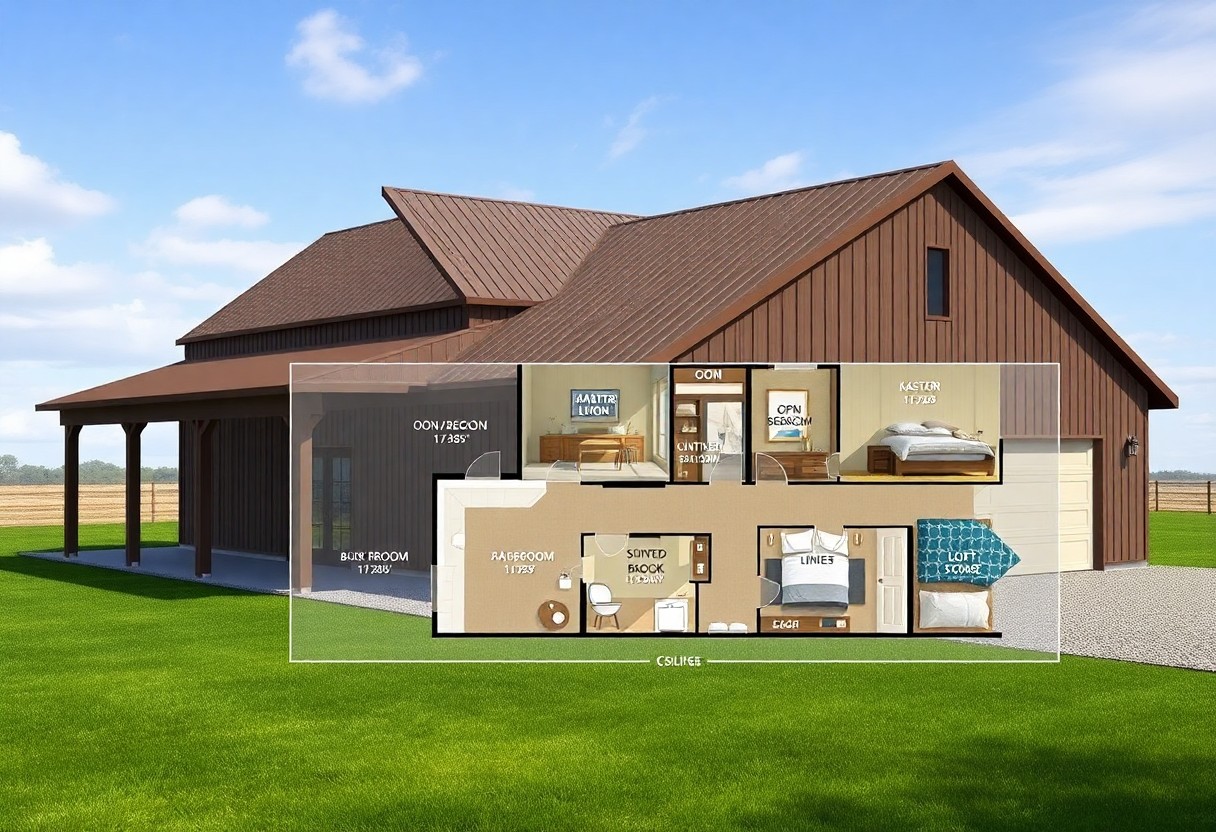
More specifically, a typical 1,200-1,600 sq ft two-bedroom barndo can allocate 500-800 sq ft to an open kitchen/living/dining zone, with bedrooms separated for privacy and a 1-2 bath configuration optimized for family use. You can include built-in storage, a mudroom, and a 400-600 sq ft attached shop for hobbies or storage, plus options for solar panels and high-R insulation to reduce operating costs further.
Key Considerations in Designing a Barndominium
When designing your two-bedroom barndominium, prioritize zoning, storage, and mechanical placement to maximize livability within 1,000-1,600 sq ft. Allocate about 55-65% of the footprint to shared living (living/kitchen/dining), group wet walls to cut plumbing runs by up to 20%, and plan 3‑ft circulation paths so furniture layout flows without dead zones.
Space Optimization
You can reclaim square footage with built-ins, lofted storage, and multipurpose furniture; for example, a 6-8 ft kitchen island can serve as prep, dining and storage, saving around 40-60 sq ft. Use an 11×12 master and a 10×11 guest bedroom, stack laundry to free 12-16 sq ft, and prefer sliding barn doors to save 6-8 sq ft per room.
Functionality and Flow
Position public spaces where natural light is strongest and bedrooms on the quiet side to control noise. Keep the kitchen’s work triangle within 4-9 ft and locate laundry within 10-15 ft of bedrooms for efficient daily routines. Maintain 36‑inch hallways and 42‑inch main walkways so movement stays smooth and furniture clears easily.
If you plan a 1,300 sq ft layout, you can reduce plumbing materials and labor by roughly 18-20% by placing the kitchen (12×10) and bathroom back-to-back on a single wet wall; a 14×18 living area with a 6-8 ft island preserves open sightlines. Include a 6×7 mudroom with bench and closet to contain entry traffic, test sightlines from entry to backyard, and keep 36-42 inches clearance around seating to support comfortable circulation and furniture placement.
Popular Layouts for 2 Bedroom Barndominiums
You’ll find two dominant approaches: open-plan living where the kitchen, dining and living areas share a 400-700 sq ft footprint for flexible family time, and traditional layouts that separate functions into rooms for privacy and noise control; designers commonly fit 2-bedroom plans into 900-1,600 sq ft, balancing shared space with two private bedrooms and one to two baths.
Open Concept Designs
In open designs you get a combined kitchen-living-dining area often anchored by a 7-10 ft island and 12-16 ft vaulted ceilings to enhance light and sightlines; this layout suits families who want visibility for kids, supports a 400-700 sq ft communal zone, and typically places bedrooms off a short corridor to keep private spaces distinct.
Traditional Layouts
Traditional plans separate the kitchen, dining and living rooms-kitchens commonly sized 120-180 sq ft and living rooms 150-250 sq ft-so you gain dedicated rooms for entertaining and quieter bedrooms, often configured as a 2-bed, 1-2 bath package with a foyer or hallway to improve circulation and storage placement.
You can arrange traditional layouts to maximize privacy and function: place the master on one side (12×14 ft typical) and the secondary bedroom opposite, add a 5×7 mudroom/laundry near the entry, and use interior partitions to create a formal dining room or home office; post-frame construction lets you relocate walls without major structural changes, making future reconfiguration straightforward.
Interior Design Ideas for Barndominiums
You’ll maximize a 1,000-1,500 sq ft two-bedroom barndominium by embracing open-plan living, 12-16 ft vaulted ceilings, and a mezzanine for storage or a reading nook. Place the kitchen along a south wall with a 10-12 ft island and a 6-8 ft sliding barn door to separate bedrooms. Use large 6-8 ft windows to boost daylight, and zone areas with 5×7 rugs and low-profile furniture to keep sightlines clear.
Rustic and Modern Styles
You can combine reclaimed wood, exposed 2×10 trusses, and a farmhouse sink with matte-black steel, polished concrete floors, and minimalist cabinetry. Aim for a 60/40 wood-to-metal ratio for warmth and edge. For example, pair a 6×8 reclaimed beam over the island with a black steel staircase and 18-20 inch industrial pendants to create cohesive rustic-modern contrast.
Color Schemes and Materials
Start with a 70/30 neutral-to-accent split: 70% warm neutrals like SW Repose Gray or BM White Dove on walls and large furniture, and 30% accents in deep navy, forest green, or rust. Use engineered oak 6-8 inch planks for flooring, 3cm quartz counters, and corrugated metal or shiplap as accent walls to balance texture and maintenance.
Select finishes that age well: matte or low-sheen paints hide wear, wire-brushed oak resists scratches, and honed quartz minimizes reflections. Choose 3-4 metal finishes max-matte black for hardware, aged brass for lighting, and stainless for appliances-to avoid visual clutter. South-facing rooms benefit from warmer pigments; north exposures take cooler undertones.
Budgeting for Your Barndominium
Budgeting for your barndominium demands a line-item approach: allocate 40-50% of your build budget to shell and structure, 20-30% to interior finishes, 10-15% to MEP (mechanical, electrical, plumbing), and 5-15% for site work and permitting. Add a 10-15% contingency; for example, a 1,200 sq ft build at $120/sq ft ($144,000) plus 12% contingency and $8,000 site work pushes the total near $170,000.
Cost Estimation
When estimating costs, use $90-200 per sq ft as a realistic range: basic finishes land near $90-110/sq ft, mid-range $110-150, and high-end $150-200+. Break bids into hard costs (materials, labor) and soft costs (permits, design, utility hookups). Get three contractor quotes; a 1,300 sq ft two-bedroom at $130/sq ft would be about $169,000 before contingency and site fees.
Financing Options
You can fund your build with construction-to-permanent loans (typical down 20-25%), conventional mortgages after completion, FHA loans with 3.5% down, USDA rural loans with 0% down in eligible areas, or VA loans for veterans with no down payment. Alternatives include HELOCs, cash-out refinance, or personal savings. Lenders will require plans, itemized budgets, and contractor bids to underwrite the loan.
Construction loans usually offer interest-only payments during the build and convert to a permanent mortgage; expect a 6-12 month construction term, a draw schedule with inspections every 30-60 days, and higher interim interest-often 0.5-1.5% above permanent rates. You should provide detailed plans, contractor licenses, and contingency reserves, and shop lenders experienced with barndominiums to avoid appraisal or classification issues.
Building Process and Timeline
Expect a typical build to take 4-6 months for a 1,200 sq ft two-bedroom barndominium with a contractor-led crew; owner-builder projects often run 6-12 months. Foundation and slab work usually occupy 1-3 weeks, steel framing and shell erection 2-4 weeks, and interior finishes 6-10 weeks. Weather, permitting delays, and custom finishes can add 10-20% to the schedule, so budget contingency weeks rather than days.
Permits and Regulations
You’ll apply for a building permit, septic or sewer hookup approval, and any well or electrical service permits; requirements vary by county. Typical turnaround ranges from 2-12 weeks-rural counties may process permits in 2-4 weeks while coastal or high-density jurisdictions can take 8-12 weeks. Fees commonly range $500-$5,000; submit engineered plans for steel buildings to minimize review rejections.
Construction Phases
First, you clear and grade the site, then pour a concrete slab or pier foundation; site prep and foundation take 1-3 weeks. Next, framing and metal shell erection proceed in 2-4 weeks, followed by rough-in of plumbing, electrical and HVAC over 1-3 weeks. Finally, insulation, drywall, finishes and inspections typically span 6-10 weeks before occupancy.
Coordinate lead times-steel kits and custom windows commonly ship in 3-8 weeks and garage doors 2-6 weeks-so order materials during permitting. Schedule inspections after foundation, rough-in and final stages; failing a rough-in can delay finishes by weeks. Sequence subcontractors carefully (HVAC rough-in before insulation, drywall after) and add a 10-20% timeline buffer for weather and supply delays.
To wrap up
With these considerations, you can select 2-bedroom barndominium plans that balance efficient living, flexible open layouts, and durable, low-maintenance materials to suit a small family. Prioritize smart storage, multifunctional rooms, and energy-efficient systems to lower costs and increase comfort. By aligning your lifestyle, budget, and site constraints, you’ll create a practical, stylish home that adapts as your family’s needs evolve.
FAQ
Q: What layout features make 2-bedroom barndominium plans ideal for small families?
A: A successful 2-bedroom barndominium balances open living with private bedroom zones. Common layouts place an open kitchen/dining/living core for flexible family space, a master suite with closet and easy bathroom access, and a second bedroom sized for a child, guest or home office. Include a dedicated laundry near bedrooms, a mudroom or entry drop zone, and built-in storage/cubby solutions to maximize compact footprints (typical effective sizes range from 800-1,200 sq ft). Options such as a loft, bonus room over a garage, or a connected workshop provide future flexibility while keeping the main living area efficient and easy to heat/cool.
Q: How can I control construction and operating costs without sacrificing comfort or durability?
A: Reduce build and operating costs by prioritizing a simple rectangular footprint and a single roof plane, using a pre-engineered metal shell for the exterior, and investing in a high-performance envelope (insulated metal panels, spray foam or high-R batt insulation, quality windows) to cut HVAC size and energy bills. Choose off-the-shelf components (standard window sizes, prefab trusses), consider a slab-on-grade foundation where appropriate, and phase interior finishes if needed. Shop barndominium kits or contractor packages for labor savings. Typical cost ranges vary widely by region and finish level, commonly $80-$150 per sq ft as a planning estimate; focus spending on structure, insulation, and efficient mechanicals for best long-term value.
Q: What site, permitting, and mechanical issues should I address before finalizing a plan?
A: Verify zoning, setbacks, allowable uses, and required permits with local authorities; confirm septic or sewer and well or municipal water availability; assess soil bearing capacity and drainage to select an appropriate foundation. Check local wind, snow and seismic requirements that affect roof and framing design. Plan utility hookups (electric service size, gas or propane, telecom) and locate HVAC equipment and mechanical closets for efficient duct runs. Ensure egress windows, smoke/carbon monoxide detectors, and energy-code insulation/ventilation standards are met. Engage a local architect or engineer for site-specific structural or code issues and factor permit timelines and inspection steps into the schedule and budget.