Tag: Build

  • “Breaking Down Barndominium Costs – How To Budget For Every Stage Of Your Build”

    Build a realistic barndominium budget by breaking costs into land, shell, systems, finishes, and contingencies so you can plan each phase with confidence; this guide shows how to estimate expenses, prioritize spending, track change orders, and allocate contingency funds to avoid surprises, helping you make informed trade-offs and keep your project on schedule and within scope.

    Key Takeaways:

    • Break the project into stages (land/site prep, shell, utilities & insulation, interior finishes) and budget line-by-line using per‑sq‑ft benchmarks for each phase.
    • Include a contingency (typically 10-20%) and budget separately for permits, utility hookups, grading/septic and other common hidden expenses.
    • Reduce costs by comparing contractor quotes, using prefabricated components or kits, standardizing dimensions and doing selective DIY, while hiring pros for structural and MEP work.

    Understanding Barndominium Costs

    Initial Cost Factors

    You’ll face land, site prep, shell, utilities and permit costs up front; typical build costs run $90-$180/ft² (a 2,000 ft² barndo at $120/ft² = $240,000). Common line-items include:

    • Land purchase and access ($30k-$100k+ depending on region)
    • Site prep and foundation ($10k-$40k)
    • Shell/framing and exterior (varies widely by materials)
    • Utilities, septic/well, and permits ($5k-$30k)

    The shell and finishes often consume 50-70% of your build budget.

    Ongoing Expenses

    Expect utilities, HVAC, insurance, property taxes and routine upkeep after move-in; energy costs commonly run $150-$400/month, insurance $800-$2,500/year, and property tax often 0.5-2% of assessed value. You should budget an annual maintenance reserve of 1-2% of your home’s value to cover repairs and replacements.

    Digging deeper, your metal shell reduces exterior repainting but increases focus on insulation (aim for R-30+ in cold climates) and condensation control; inadequate insulation can raise heating bills by 20-40%. Plan for HVAC replacement every 15-20 years ($5k-$12k), septic or well service ($500-$3k routine; $3k-$10k for major repairs), and roof-related work-metal roofs last 40-70 years but fasteners and flashings may need attention every 10-20 years. Using the $240k example, a 1.5% maintenance reserve equals $3,600/year, which covers periodic systems maintenance, small structural repairs, and emergency funds so you don’t erode your build investment over time.
    Budgeting for Land Acquisition

    You should allocate roughly 10-20% of your total barndominium budget to land acquisition and immediate expenses; for a $300,000 build plan $30,000-$60,000. Include purchase price, 2-5% closing costs, boundary and topographic surveys, and initial site work like clearing, driveway access, and erosion control. Urban-edge lots command premiums, while rural acreage lowers per-acre cost but raises utility extension and roadwork expenses.

    Evaluating Potential Locations

    Assess zoning, floodplain status, setback requirements, and proximity to utilities before bidding. Order a soil perc test ($300-$700) and a topographic survey ($500-$2,000) to confirm septic and grading needs; a failed perc can eliminate a site. Also factor commute times, school districts, and planned nearby development since those influence resale value and long-term costs.

    Land Purchase Costs

    Expect wide price ranges: many rural acres run $2,000-$15,000/acre, suburban fringe $50,000+/acre, and finished lots $30,000-$150,000 depending on region. Add closing costs (2-5% of purchase), title insurance, recording fees, and any HOA or special assessment charges when setting your allocation.

    Plan for site-specific add-ons that often exceed the purchase price: septic systems $3,000-$10,000, drilled wells $4,000-$15,000, grading and driveway work $2,000-$25,000, and utility hook-up or extension fees $1,000-$20,000. Note land loans usually demand 20-50% down and higher interest than construction loans, so consider seller financing, land-home packages, or combining loans to lower carrying costs.

    Planning Your Build

    When planning, break your budget into stages: site prep and foundation (15-25%), shell and envelope (35-45%), interior finishes and systems (30-40%), and soft costs like permits and design (5-10%). Expect 6-12 months for a typical 1,800-2,400 sq ft barndominium from permit to move-in, and budget a 10-15% contingency for material price swings and schedule delays. You should also sequence purchases-order long-lead items like trusses and windows early to avoid bottlenecks.

    Choosing the Right Design

    Start with the footprint and workflow: a 1,500 sq ft single-level reduces foundation and HVAC costs versus a 2,500 sq ft two-story. You’ll save by choosing a simple gable roof, standard bay sizes (24×36, 30×40), and an open-plan interior; complex rooflines, extensive glazing, or second-floor mezzanines can increase design and framing costs by 10-30%. Factor in local climate-insulation and snow-load requirements affect truss design and cost.

    Factors Influencing Design Costs

    Design fees depend on complexity, who prepares plans, and site constraints: stock plans run $500-$3,000, while architects charge $3,000-$25,000 or 5-12% of construction. Site work for slope, soils, or septic can add $1,500-$20,000 for reports, grading, and engineering. Local permitting and energy-code compliance often add $200-$2,000 and can require additional structural or mechanical design changes that raise costs.

    • Complexity: multiple rooflines, extensive glazing, and custom trusses increase drafting time and fees.
    • Scale: per-square-foot design fees drop with larger projects, but total design cost rises with size.
    • Site constraints: steep sites or poor soils typically require geotech reports and engineered foundations.
    • Any custom features-built-in millwork, clerestory glazing, or exposed timber framing-commonly add 10-30% to design and engineering costs.

    In practice, converting a $1,200 stock plan with $800 of local revisions usually stays under $2,500, whereas an architect at 8% on a $300,000 build would be about $24,000. Pre-engineered metal shell kits cost roughly $8-$12 per sq ft for the shell and can cut framing time by weeks, but they limit some layout options. Also plan for permit review windows of 2-8 weeks and energy compliance testing that can run $500-$2,500.

    • Purchase stock plans and budget modest local revisions to save several thousand dollars versus full custom design.
    • Use pre-engineered metal shells to reduce shell labor and shorten schedules, accepting some layout constraints.
    • Schedule design and permitting early to avoid financing or subcontractor hold costs from extended plan review.
    • Any post-permit change orders typically incur higher rates and material markups, often adding 15-40% to affected line items.

    Construction Costs Breakdown

    When tallying construction costs for a barndominium, expect wide ranges: typical builds run roughly $80-$200 per sq ft, with shell/envelope and interior finishes taking the largest shares. You should budget by category-foundation, structural steel, roofing, windows, utilities-and assign percentages to each stage to match your design. For a mid‑range 2,000 sq ft project at $120/ft², anticipate around $240,000 total before hidden fees.

    Labor and Material Expenses

    Labor typically consumes 30-50% of your total build cost, while materials account for 40-60%; exact splits depend on prefabrication and owner‑installed work. You’ll pay more for specialized trades-steel erectors, HVAC, and electricians-where hourly rates commonly run $50-$120. On a $200,000 job, plan for $60k-$100k in labor and a similar range in materials, with high‑end finishes pushing material costs upward.

    Hidden Costs to Consider

    Permit, hookup and site service fees can add $500-$10,000; septic systems often cost $3,000-$12,000 and utility hookups vary $2,000-$15,000. You also face engineering and stamped plans ($1,000-$5,000), delivery/crane charges ($500-$2,500/day), sales tax on materials, and storage or temporary utilities while you build. Set aside a contingency of 10-15% to cover these predictable extras.

    For example, a 2,000 sq ft barndo estimated at $120/ft² ($240k) can incur $12k-$36k in hidden expenses (5-15%), plus change orders that commonly add another 10-20% if scope shifts. You should request line‑item bids for hookups, get firm prices for specialty work, and track allowances so change orders are minimized; a dedicated 10-15% contingency plus a separate $5k-$10k buffer for site surprises keeps your budget realistic.

    Financing Options

    Types of Loans Available

    For barndominium projects you’ll typically choose construction-to-permanent, FHA 203(k) or renovation loans, USDA rural loans where eligible, VA renovation loans for veterans, or a conventional mortgage after framing; construction loan interest often runs 3.5-6% during the build and down payments commonly range from 5-20% depending on lender experience with post-frame builds.

    • Construction-to-permanent: single close, staged draws, converts to mortgage when complete.
    • FHA 203(k): bundles rehab into mortgage, lower credit thresholds but loan caps apply.
    • USDA Rural: 0% down in qualifying rural areas, subject to income and location limits.
    • VA Renovation: no down payment for eligible veterans, requires appraisal and entitlement.
    • Any lender you choose should demonstrate prior barndominium or pole-frame appraisals to avoid funding delays.
    Loan Type Key Features
    Construction-to-Permanent Single close, draw schedule, converts post-construction
    FHA 203(k) Renovation financing, lower credit bar, loan limits
    USDA 0% down for eligible rural properties, income caps
    VA Renovation No down payment for qualified veterans, entitlement required

    Tips for Securing Financing

    You should present a full build package-site plan, licensed contractor bid, materials list-and target a credit score above 680 for best terms; aim for 10-20% reserves, secure multiple preapprovals, and ask lenders about their experience with mixed-use or post-frame appraisals.

    • Assemble a detailed budget and contractor contract to validate the scope and timeline.
    • Clear or reduce high-interest debt and correct credit errors before applying.
    • Compare APR, origination fees, and rate lock periods across at least three lenders.
    • This demonstrates to lenders you have contingency funds and reduces perceived risk.

    If you can show a 15% down payment plus a six-month cash reserve and a fixed-price contract from a licensed builder, lenders commonly offer better terms (often 0.25-0.5% lower rate); you should also include a 5-10% contingency line item in your budget for site surprises and material price swings.

    • Collect written subcontractor quotes and a detailed materials list to support cost estimates.
    • Provide soil, perk, and site survey reports to shorten underwriting and reduce surprises.
    • Keep organized bank statements covering 2-3 months as proof of reserves and liquidity.
    • This level of documentation frequently speeds underwriting and improves approval odds.

    Cost-Saving Tips

    You can shave 10-30% off total costs by prioritizing high-impact savings early: selecting standard-sized trusses, buying materials in bulk, and scheduling trades to avoid downtime. If you opt for used or surplus steel, you might cut shell costs 5-15%; choosing energy-efficient windows can lower long-term utility expenses. Perceiving trade-offs between upfront savings and maintenance needs helps you avoid false economies.

    • Buy standard-dimension materials to reduce waste and cut costs 8-12%.
    • Source surplus steel or reclaimed siding to lower shell expenses 5-15%.
    • Phase finishes so necessarys are done first and upgrades are deferred.
    • Bundle trades or offer flexible scheduling to negotiate 5-10% discounts.
    • Invest in efficient systems (e.g., 95% AFUE furnace) to reduce operating costs.

    DIY Options

    You can save 15-40% on finishing labor by doing painting, trim, flooring installation, and basic landscaping; for example, painting 1,800 sq ft can save $1,500-$3,000 versus hired crews. Focus on non-permitted tasks and kit assemblies, and outsource licensed work like structural welding or electrical to avoid fines and rework.

    Negotiating with Contractors

    Get three itemized bids and compare line-by-line, push for a fixed-price contract to limit surprises, and offer timing flexibility to reduce labor premiums-these tactics commonly yield 5-15% savings. Request supplier invoices to verify markups and propose small early-payment discounts (2-3%).

    Insist on an itemized scope, set a payment schedule (example: 10% deposit, 40% at shell completion, 40% at systems/insulation, 10% retainage), cap change-order markups (e.g., 10%), require lien waivers on payments, and include liquidated damages for delays (such as $100-$500/day). Verify licenses, insurance, and references before signing and keep a 5-10% contingency for negotiated extras.

    Summing up

    Taking this into account, you can confidently budget for every stage of your barndominium by mapping costs to design, site prep, shell, interiors, utilities, and finishing; build a realistic contingency, get multiple bids, schedule payments to match milestones, and track expenditures closely so scope changes don’t derail your plan. Working with experienced contractors and prioritizing must-haves lets you balance quality and cost while keeping your timeline and finances under control.

    FAQ

    Q: What is the typical cost per square foot for a barndominium and what factors drive that range?

    A: Typical costs range from about $80 to $200+ per sq ft depending on finish level and location. A basic shell (steel frame and exterior) can be $30-70/sq ft; foundation and slab $8-20/sq ft; mechanical, electrical and plumbing (MEP) $10-30/sq ft; insulation and envelope upgrades $5-25/sq ft; interior finishes and cabinetry $20-80+/sq ft. Land, site work, permits and utilities are extra. For example, a 2,000 sq ft build can be roughly $160,000 at $80/sq ft for a no-frills build, $300,000-$400,000 for mid-range, and $400,000+ for high-end finishes or difficult sites.

    Q: How should I budget for land acquisition and site-preparation costs?

    A: Treat land and site prep as a separate line item equal to a significant percentage of total project cost, because ranges vary widely. Land price depends on region; site prep typically runs $3,000-$50,000+: clearing and grading $1,000-$15,000, driveway $2,000-$20,000, septic $3,000-$10,000, well drilling $3,000-$15,000, erosion control and retaining work more if slope is steep. Also budget utility hookups and permit or impact fees ($500-$10,000+). Mitigation steps: get a survey and soil test before purchase, choose flatter lots to reduce excavation, verify utility access and septic suitability to avoid surprise costs.

    Q: How do I allocate my budget across the build stages so I don’t overspend in one area?

    A: Use staged percentage targets: planning and permits 5-10% (design, engineering, permit fees); shell/exterior (steel structure, roofing, exterior doors) 25-40%; foundation and slab 8-15%; MEP (HVAC, plumbing, electrical) 15-25%; insulation and weatherproofing 5-15%; interior finishes, cabinetry and flooring 15-30%; landscaping and final site work 2-8%; contingency 5-15%. Example for a $300,000 build: $15k-$30k planning, $75k-$120k shell, $24k-$45k MEP, $45k-$90k finishes, plus $15k-$45k contingency and site costs. Track spend by stage and hold back contingency until late-stage overruns or change orders.

    Q: What soft costs and permits should I include in my budget that owners often overlook?

    A: Include architectural/engineer fees (3-8% of construction cost), permit fees (varies by jurisdiction), impact or connection fees, plan review fees, utility hookup deposits, inspection fees, and insurance during construction. Also account for surveying, soil reports, and any required environmental or wetlands studies. If using a contractor, include construction management or general contractor markup and allowances for change orders. Unexpected delays can add financing interest and storage costs for materials-factor those into the soft-cost contingency.

    Q: How much contingency and what financing approach should I plan for to cover surprises during the build?

    A: Set contingency at 10-15% for custom barndominiums; increase to 15-20% if site conditions or scope uncertainty are high. Use a construction loan with draws tied to inspections to control cash flow, or a fixed-price contract for defined scopes to shift some risk to the contractor. Compare options: self-funding gives flexibility, construction-to-permanent loans simplify closing but require thorough draw management, and government renovation loans have specific rules and limits. Require written change-order procedures, schedule payments by milestones, and prioritize purchasing long-lead items early to avoid price escalation.
  • Build vs Buy Barndominium – Which Option Fits You Best

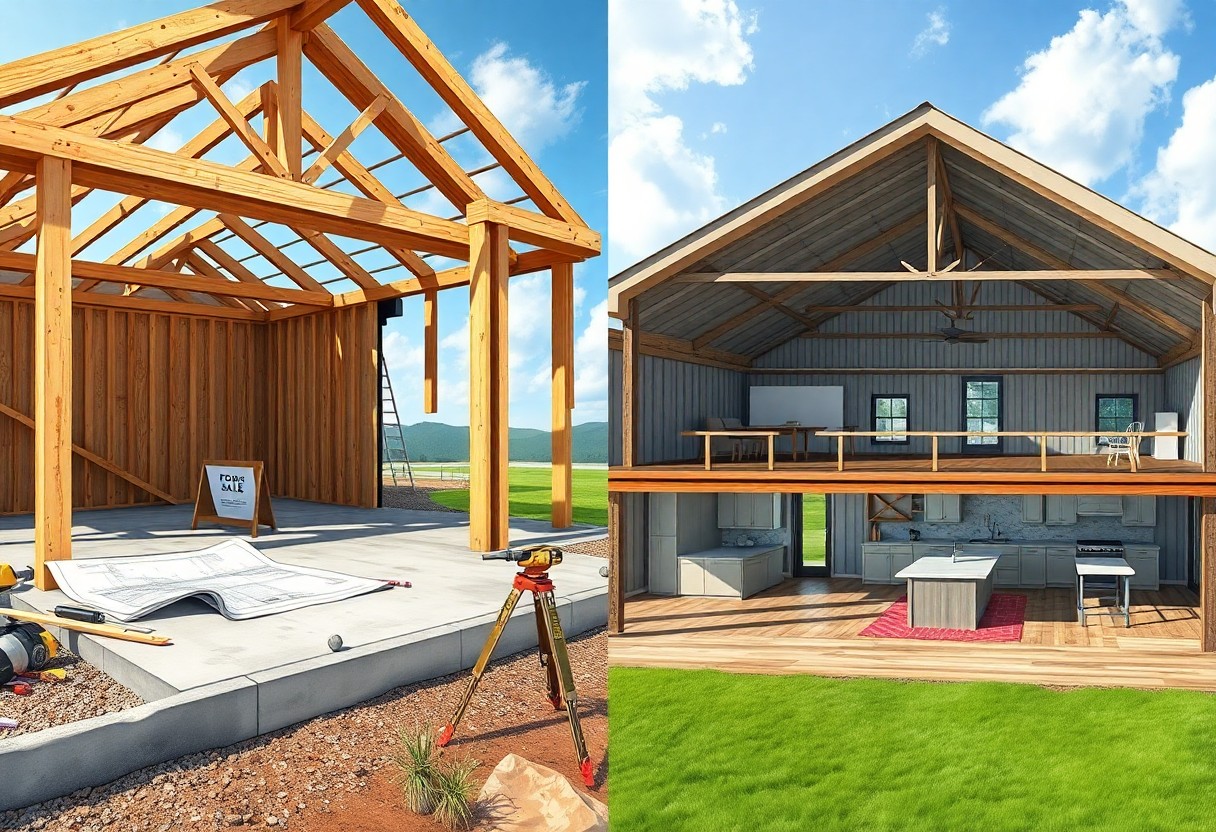
    You face a practical choice when considering a barndominium: build from the ground up or buy an existing structure, and this guide helps you evaluate cost, customization, timeline, maintenance, and resale to match your priorities. By comparing upfront expenses, long-term value, zoning and contractor selection, you’ll be able to determine whether hands-on customization or quicker occupancy suits your lifestyle and budget.

    Key Takeaways:

    • Assess budget, timeline, and desired customization – building lets you tailor layout and materials and can save long-term costs but demands more time, permits, and project management.
    • Buying an existing barndominium offers faster move-in and clearer short-term costs but limits design control and may need renovations or repairs.
    • Decide by priorities: choose build for full customization and potential value growth if you can manage time/risks; choose buy for speed, convenience, and lower immediate effort.

    Understanding Barndominiums

    What is a Barndominium?

    You’ll find a barndominium blends a barn’s metal or post-frame shell with full-time living space, often delivering open-plan layouts and integrated shop areas; typical home sizes range from 1,200 to 3,000 sq ft with attached shops from 600 to 4,800 sq ft, and shell construction frequently costs $90-$150 per sq ft, allowing many builds to finish in roughly 3-6 months versus longer stick-built timelines.

    Key Features and Benefits

    You gain high clear-span interiors (often 40-60 ft), durable metal siding and roofing, and flexibility to combine workshop, storage, and living areas; these structures usually reduce shell labor costs, simplify foundation needs with slab-on-grade options, and let you prioritize finishes where they matter most for resale or daily use.

    • Post-frame or steel shell delivers strength with fewer interior load walls, enabling open-concept plans and mezzanines.
    • Clear-span bays of 40-60 ft let you place a 1,500 sq ft living area beside a 2,400 sq ft workshop without interior columns.
    • Typical shell cost ranges $90-$150 per sq ft; finished interiors vary widely based on materials and systems.
    • Construction timelines commonly fall between 3-6 months for basic builds, shortening compared with many custom stick-built homes.
    • Metal exteriors cut maintenance and insurance exposure, and you can add spray foam or SIPs for improved thermal performance.
    • Garage, equipment storage, and hobby shop integration is straightforward, often lowering the total footprint compared with separate buildings.
    • Recognizing their modular nature, you can phase finishes-livable shell first, higher-end interiors later-to spread costs and move in sooner.

    You should evaluate insulation strategy (spray foam, fiberglass cavity, or SIPs) and HVAC sizing early-many builders use closed-cell spray foam to convert a 2,500 sq ft shell into an energy-efficient home with simpler ducting-and check local zoning or fire codes that can affect window egress, mezzanine height, or shop ventilation requirements.

    • Flexible floor plans let you prioritize a 1,200-2,000 sq ft primary living suite while allocating 2,000+ sq ft to a shop or rental unit.
    • Foundation options (slab-on-grade is common) reduce excavation and costs versus full basements in many regions.
    • Metal roofing systems deliver 30-50 year lifespans with low upkeep and can accommodate solar arrays easily on south-facing slopes.
    • Integration of mechanicals is simpler in open shells, but you should plan for sound control between shop and living areas.
    • Resale in rural and exurban markets tends to be strong when interiors match regional expectations-high-end finishes can push per-square-foot value above traditional builds.
    • Recognizing these factors helps you align budget, timeline, and intended use so the barndominium fulfills both practical needs and lifestyle goals.

    The Build Option

    Advantages of Building Your Barndominium

    You gain complete control over layout, materials and finishes, allowing you to prioritize open-plan living, commodity-grade steel shells or high-end timber accents. Prefabricated metal kits can shorten framing time to 4-8 weeks and often reduce framing costs by roughly 20-30% compared with stick-built homes. You can also optimize insulation and HVAC for long-term energy savings-spray-foam or double-stud walls can push whole-house R-values high enough to cut heating bills substantially.

    Considerations and Challenges

    You should plan for site preparation, foundation work and utility hookups, which commonly add tens of thousands to the budget; permits and inspections can take 2-12 weeks depending on local rules. Contractor selection matters: experience with metal-to-wood transitions, condensation control and proper vapor barriers prevents costly fixes. Expect schedules to shift and contingencies of 10-20% for unforeseen issues like soil remediation or supply delays.

    Costs vary widely: build prices typically range $100-$200 per sq ft, so a 2,000 sq ft barndominium can fall between about $200,000 and $400,000 before land. Financing often requires a construction loan with staged draws and interest-only payments during construction. You’ll also need to address thermal bridging in metal shells-installing a continuous thermal break or interior insulation strategy and hiring a contractor experienced in metal building details reduces risk of condensation and long-term maintenance problems.

    The Buy Option

    Opting to buy a finished barndominium gets you into a completed home far faster: closings commonly take 30-45 days versus 6-12 months to build, and you can evaluate finishes, layout and landscaping in person. You avoid construction delays, temporary housing costs and many selection decisions, allowing immediate occupancy or rental income with predictable short-term expenses.

    Benefits of Purchasing an Existing Barndominium

    You benefit from seeing real-world performance-how insulation, roof overhangs and metal siding hold up-before buying, and you can often negotiate price or request seller credits; in many rural markets finished units range roughly $150k-$400k depending on size and finishes. You also inherit installed systems, appliances and matured landscaping, cutting initial setup time and expense.

    Possible Drawbacks and Limitations

    You sacrifice full customization and may face hidden maintenance: older HVAC, wiring, roof or foundation issues can require significant investment. Budget an inspection and a contingency-upgrades and repairs commonly run 5-20% of purchase price-and accept that layouts or ceiling heights may not match your ideal design without costly remodeling.

    Dig deeper with targeted due diligence: order a home inspection ($300-$600), a pest/moisture report, and consider a structural engineer review ($400-$1,000) if there are metal-frame modifications or visible settlement. Get contractor estimates for likely repairs-roof replacement ($5k-$15k), HVAC overhaul ($4k-$10k)-so you can compare true buy-versus-build cost and avoid surprises.

    Cost Comparisons

    Compare line-item costs directly: materials, site work, permits and finishes can push a custom build into about $70-$130 per sq ft, while buying a finished barndominium typically lists at $90-$200 per sq ft. For a 2,000 sq ft example, expect a build of $140k-$260k versus a purchase of $180k-$400k, with land, utility hookups and site prep adding $10k-$50k depending on terrain.

    Cost Snapshot (per 2,000 sq ft example)

    Build (custom) Buy (finished)
    Estimated cost: $140k-$260k Estimated sale price: $180k-$400k
    Site work & permits: $10k-$40k Closing + inspections: 2-5% of price
    Timeline: 6-12 months Move-in: 30-45 days
    Customization: low-to-mid incremental cost High upfront cost for desired changes
    Financing: construction loan (interest during build) Conventional mortgage (rates typically lower)
    Typical resale upside: depends on finishes & land Price reflects current market and improvements

    Building vs. Buying: Financial Breakdown

    You should weigh construction carrying costs against purchase premiums: a 12‑month build drawing an average $200k at 5.5% interest can cost roughly $11k in interest during construction, while buying avoids that but often requires a higher purchase price and immediate closing costs (2-5%). Factor in upgrades-adding high-end finishes can add $30-$70 per sq ft during build but will often cost 20-40% more to retrofit after purchase.

    Long-term Investment Analysis

    You need to evaluate lifecycle costs and resale potential: metal shells commonly last 40-60 years, reducing major exterior replacement costs, and a well-insulated barndo can lower annual heating/cooling by 20-40% versus older homes. Markets with acreage premiums often see better appreciation, so a $220k custom build on 2-5 acres may outperform a comparable in-town purchase over 5-10 years.

    Delving deeper, calculate total cost of ownership: include maintenance, energy, insurance and property taxes. For example, a metal-roofed barndo avoids asphalt reroofing every 20 years, saving $8k-$20k over 30 years; meanwhile energy upgrades (R‑value, spray foam) might add $8k-$15k up front but reduce bills substantially. If you plan to rent, expect cap rates to vary-rural barndominiums often yield higher rental premiums per acre. Use local comps: if similar barndos sold for 15-30% above conventional homes in your county, building to match those finishes can be a clear investment; if not, buying existing inventory may limit downside and shorten exposure to market swings.

    Customization Opportunities

    When you choose how to outfit your barndominium, you can specify measurable performance and layout details: 12-14 ft interior ceiling heights, 40-60 ft clearspans with steel frames, R-20 wall assemblies or R-38 roof insulation, and slab-on-grade with 2″ XPS under 4-6″ concrete for radiant heat. You can plan a 3-4 bedroom floor plan, add a detached garage, or integrate a 600-1,000 sq ft mother-in-law suite, with shell kits typically running $25-50/sq ft and full custom builds $80-150/sq ft.

    Tailoring Your Design When Building

    You can orient glazing for passive solar, choose 2×6 studs at 24″ o.c. or SIPs for tighter envelopes, and place plumbing stacks to minimize runs – keeping main bathrooms within 20-30 ft of the central stack saves thousands. Structural options like engineered trusses, clearspan steel, or prefabricated loft systems let you create a 20-30 ft wide loft or a 24×24 garage bay without interior posts, and SIPs can cut heating loads by roughly 30-50% versus conventional framing.

    Limitations of Existing Structures

    Existing shells often fix column spacing, roof pitch and utility locations, so you may be constrained to 8-10 ft clear bays or interior posts every 8-12 ft; moving load-bearing posts or changing roof geometry typically requires engineered beams and permits. Electrical service may be 100A, forcing a 200A/400A upgrade for modern HVAC and EV charging (commonly $1,500-4,000), while relocating main plumbing stacks can cost $3,000-10,000 depending on slab work.

    For example, converting a 50×60 pole barn into living space often means paying for structural reinforcement – removing eight interior posts and installing two engineered steel I-beams can run $12,000-25,000 – plus insulation upgrades ($5,000-12,000) and HVAC resizing ($4,000-10,000). You should expect renovation totals that approach 40-70% of a new custom build when significant rework of structure, utilities and insulation is required.

    Making the Right Choice

    Assessing Your Needs and Goals

    You should define how you’ll use the barndominium-full-time family home, rental, or mixed workshop/living-since that drives size and systems. Expect 1,200-2,400 sq ft for a typical family layout; build costs commonly range $120-$220 per sq ft depending on finishes. Timelines matter: custom builds may take 9-15 months, kits or conversions 3-6 months, and permitting or utility hookups can add weeks to your schedule.

    Factors to Consider in Your Decision

    Focus on budget, timeline, and resale potential when choosing build vs buy. Buying a finished barndo can shave 10-25% off time and sometimes 5-15% off overall cost versus a full custom build, yet limits personalization. Building lets you pick structural type-steel, pole, or timber-which affects durability, insulation needs, and long-term maintenance costs, so verify local zoning and insurance implications early.

    • Cost: upfront construction, finish level, and expected resale value.
    • Timeline: custom 9-15 months versus kit 3-6 months and immediate purchase.
    • Zoning and permits: setback, agricultural exemptions, and septic requirements.
    • Financing: construction loans vs traditional mortgages and lender requirements.
    • Perceiving how each factor shifts your budget, timeline, and ROI.

    You should weigh technical details: steel frames often cut framing cost by 10-20% and resist pests, while wood gives interior warmth. Target insulation of R-13-R-21 for walls and R-30-R-49 for roofs in many climates; one 1,800 sq ft Texas barndo reported a 20% HVAC reduction after upgrading to R-38 roof insulation. Also estimate site prep (grading, septic, driveway) and factor long-term maintenance into your cash flow.

    • Structural choice: durability, aesthetic, and framing cost differences.
    • Insulation and HVAC: R-values, heat load, and equipment sizing.
    • Site costs: grading, septic installation, and driveway per 100 ft estimates.
    • Maintenance and lifespan: metal roofs 30-50 years vs shingles 20-30 years.
    • Perceiving these specifics lets you prioritize must-haves versus nice-to-haves.

    Conclusion

    So you should weigh upfront cost, timeline, customization, resale potential, and maintenance to decide whether to build or buy a barndominium: choose to build if you value maximal design control and long-term value despite higher oversight and potential delays; choose to buy if you need speed, predictable costs, and less hands-on management. Your priorities and budget determine the best fit.

    FAQ

    Q: What are the main advantages and disadvantages of building a barndominium versus buying an existing one?

    A: Building lets you customize layout, materials, energy systems and future-proofing; you can optimize floorplan, insulation and mechanicals for long-term savings. Disadvantages include longer timelines, permitting and construction management, risk of cost overruns and the need for a construction loan. Buying existing offers speed, a predictable purchase price, and immediate occupancy; trade-offs are limited layout options, possible retrofit costs for modern systems and the potential for hidden maintenance or code issues.

    Q: How do total costs and timelines typically compare between building and buying?

    A: Building often has higher up-front soft costs (design, permits, site work, utility hookups) and variable construction costs that depend on finish level, local labor and land conditions; total timeline commonly spans 6-18 months. Hidden build costs include soil work, septic/utility extensions, driveway and grading. Buying converts many unknowns to a single purchase price and closing timeline (weeks to a few months), but you may incur immediate renovation, upgrade or compliance costs. Financing differs: construction loans carry interest during build and usually larger down payments; mortgages for existing homes are simpler and cheaper to close.

    Q: Which option fits different buyer profiles and property situations?

    A: Choose build if you want a custom plan, have flexible time, can manage a project or hire a good contractor, and own suitable land (or want to buy it). Building suits owner-occupiers seeking specific layouts, energy performance or unique features. Choose buy if you need quick occupancy, have a fixed budget, prefer predictable costs, or want an income property with minimal initial work. For remote or challenging sites, building can be much more expensive; in established subdivisions or areas with available inventory, buying is often the more practical choice. Engage an architect, contractor and lender early to match the option to your timeline, budget and lifestyle goals.