Curb appeal transforms your barndominium into a statement – you can combine classic barn elements with modern finishes, select complementary siding and trim colors, add strategic lighting, and design low-maintenance landscaping to frame your entrance; these targeted exterior choices boost value, convey style, and make your home unmistakably yours.
Key Takeaways:
- Choose cohesive materials and colors-combine barn-style elements (board-and-batten, metal roof, reclaimed wood) with modern trim and durable finishes to reinforce character and longevity.
- Design functional curb features-a defined entry, covered porch, oversized barn doors and clear walkways create a strong focal point and improve usability.
- Use landscaping and lighting to define scale and highlight architecture-layered plantings, structured driveways and well-placed exterior lighting enhance visual impact day and night.
Understanding Curb Appeal
You can shape how people judge your barndominium by balancing scale, color, and function-replace a plain garage door with a carriage-style one ($800-$2,500), add layered lighting (3-5 fixtures), and define walkways with a 3-foot-wide path to create instant polish; these changes often cost less than a full remodel yet dramatically alter perceived value and photo-ready presentation.
Importance of First Impressions
You have mere seconds-studies show buyers form an opinion in about 8-10 seconds-so a clean roofline, fresh paint on trim, and a neatly staged entry can sway perception immediately; for example, swapping faded house numbers and a worn doormat for brass numbers and a premium welcome mat often yields a clearer, higher-quality impression before anyone steps inside.
Factors Influencing Curb Appeal
You must consider materials, color palette, landscape composition, and lighting: metal or standing-seam roofs read modern, board-and-batten siding gives vertical emphasis, and an accent door color (think deep navy or barn red) anchors the facade; combine with 2-4 focal plants and low-voltage path lights to guide the eye and improve safety at night.
- Siding type and texture-board-and-batten, corrugated metal, or horizontal lap each set a different tone.
- Roof color and profile-standing-seam metal reads modern and lasts 40-70 years vs. shingles at 20-30 years.
- Entry composition-door color, hardware, and a 3-foot-wide walkway create a clear focal point.
- Landscaping-use 2-4 specimen plants, mulch beds, and simple symmetry for low-maintenance impact.
- Lighting-3-5 layered fixtures (path, accent, porch) increase usability after dark.
- After staging the entrance, photograph from street level to evaluate sightlines and proportion.
You can refine these factors by prioritizing high-visibility elements: a front door swap ($300-$1,200 installed), a fresh trim paint job (roughly $1-$3 per sq ft), and two path lights ($150-$400 each) often deliver the highest visual return; implement changes in phases-start with paint and lighting, then add hardscape or specimen trees to extend impact over 6-12 months.
- Prioritize interventions by sightline: door, trim, roof edge, then planting beds.
- Budget examples: door swap $300-$1,200, trim paint $1-$3/sq ft, path lights $150-$400 each.
- Maintenance plan: quarterly mulch and annual trim extend curb appeal longevity.
- Staging tip: remove clutter and use two matching planters for symmetry.
- After completing upgrades, walk the property at dusk to confirm lighting balance and adjust as needed.
Choosing the Right Exterior Materials
Select materials that balance longevity, look, and upkeep so your barndominium reads as intentional from the street. Combine board-and-batten or reclaimed barn wood for warmth with vertical metal panels for weather resistance; expect installed costs roughly $5-10/ft² for wood and $3-8/ft² for metal, with lifespans of about 20-40 years (wood) versus 40-70 years (metal) when properly maintained. Use accents strategically to reduce long-term maintenance without sacrificing character.
Wood vs. Metal
Weigh wood’s tactile, textured appeal against metal’s durability: wood gives rich grain and can be stained or painted but typically needs staining or repainting every 3-7 years and may last 20-40 years; metal is non-combustible, resists rot and pests, and with PVDF or Kynar coatings carries 20-30 year warranties and 40-70 year lifespans. You can mix both-use wood as a 20-40% accent and metal as primary cladding for lower upkeep and strong curb presence.
Color Selections and Maintenance
Choose a 60-30-10 palette (primary, secondary, accent) and test samples on 4×4-foot panels to view color at noon and golden hour; dark siding can be 20-30°F hotter in sun, so pair darker colors with reflective roof finishes or added insulation. Expect to repaint quality acrylic finishes every 7-15 years, restain wood every 3-5 years, and increase frequency in coastal or high-UV areas-plan maintenance into your budget when selecting dramatic tones.
For metal, prioritize coil coatings like PVDF/Kynar for color retention-manufacturers often guarantee 20-30 years against fading; measure potential fade with Delta E expectations when available. Schedule an annual exterior inspection, pressure-wash cladding every 1-2 years, and recaulk joints every 5-10 years. Keep a touch-up kit of original paint/stain and store color codes; small, timely repairs preserve sharp contrasts (black trim, light siding, cedar accents) that make your barndo stand out.
Landscaping Ideas for Barn Homes
Use landscape to reinforce your barndo’s rustic-modern aesthetic: plant long, low bands of native grasses and perennials (little bluestem, echinacea, black-eyed Susan) in 3-4 ft beds along the facade, target 60-80% native coverage to cut irrigation and maintenance, mulch beds 2-3 in deep, add stone terraces on slopes to prevent erosion, and place shade trees 20-30 ft from the building to frame views without crowding the roofline.
Native Plants and Hardscaping
Select natives like switchgrass, yarrow, salvia, and sedges for seasonal color and pollinator value; combine them with hardscape elements such as decomposed granite paths, reclaimed barnstone retaining walls, and corten steel planters for texture contrast. Use a 3-4 in compacted gravel base under paths, 2-3 in river rock in dry creek beds to manage runoff, and permeable pavers where you want driveway durability without increasing stormwater speed.
Adding Pathways and Outdoor Spaces
Dimension paths for real use: make single-walk routes 3 ft wide and main circulation 5-6 ft, space stepping stones 18-24 in for natural gait, and choose materials-gravel, pavers, or poured concrete-based on maintenance and budget. Place small seating pockets and a 10-12 ft patio for casual seating or a 12-20 ft area for dining; include low 12V or solar 3000K lighting for safety and ambience.
Think about alignment and function when detailing pathways: run primary walks to connect driveway, garage, and main entries in the shortest comfortable lines, allow gentle curves to soften sightlines, grade surfaces for 1-2% drainage away from the barn, and anchor spaces with planting swaths or a 6-8 ft radius fire pit to create focal outdoor rooms that feel intentional and low-maintenance.
Unique Architectural Features
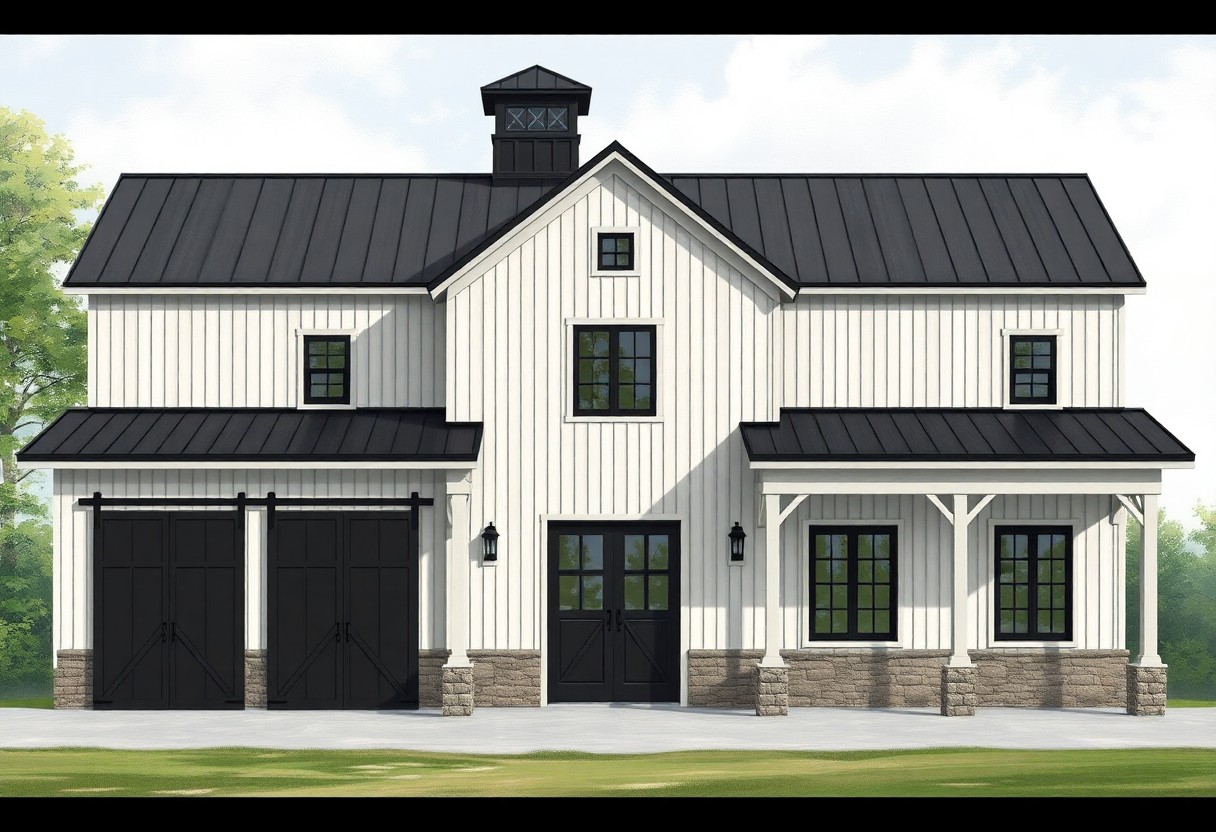
Emphasize signature elements like exposed timber trusses, board-and-batten siding, and steel-clad lean-tos to give your barndominium character. Integrate functional touches – a 10-foot covered porch, a cupola for passive ventilation, or a 6-inch foundation reveal – to break large façades into human-scaled bays. Combine reclaimed wood with standing-seam metal and repeat vertical rhythms so a 30-40 foot barn reads as deliberate architecture rather than an industrial shell.
Roof Designs and Overhangs
Choose gable, gambrel, shed, or hip profiles based on loft needs and site exposure: a 5:12 pitch balances loft headroom and water shedding while gambrels maximize hayloft-style volume. Specify overhangs from minimal 6-12 inches for a modern edge to 2-6 feet for porches and solar shading; wider eaves protect walls and reduce siding maintenance. Pair standing-seam metal roofs with exposed rafter tails or boxed eaves and plan gutters where roof runoff exceeds 2,000 sq ft to avoid erosion.
Windows and Door Styles
Prioritize proportion and performance by using double- or triple-pane, Low-E glazing (aim for U-factor ≤0.30 in cold climates) and steel or black-clad frames for that industrial-barn aesthetic. Mix tall vertical casements, large picture windows, and 3-4 ft-wide entry doors to create focal points; consider 8-foot custom entry doors for drama or insulated glass garage doors to turn bays into light-filled living zones. Hardware in matte black or oil-rubbed bronze reinforces the look.
Place windows to frame views and control daylight: clerestory bands 6-8 ft above the floor admit light without sacrificing privacy, while grouped 3×5-foot picture windows create intentional vistas. Use operable awnings or casements under overhangs for cross-ventilation, and align heads and sills across bays to maintain rhythm – a consistent 6-12 inch reveal at window surrounds ties mixed materials together and simplifies flashing details for long-term weather performance.
Lighting for Enhanced Curb Appeal
Strategic lighting elevates your barndominium’s silhouette after dark – uplight exposed timber trusses with 400-800 lumen spot fixtures, wash board-and-batten siding with soft 2700K LEDs, and edge pathways with 100-300 lumen bollards for safe navigation. You can highlight a metal roof with linear LED strips and use warm-toned sconces flanking the entry to balance rustic texture with modern clarity.
Functional vs. Decorative Lighting
Functional fixtures provide safety and task illumination – think motion-activated floodlights at 1,200-2,000 lumens, 12V path lights, and well-placed step lighting. Decorative pieces add character: vintage barn lanterns or oversized pendants in the 400-800 lumen range create silhouette and depth. You should layer both types, placing functional lights first and then adding decorative accents to define scale and warmth.
Energy-Efficient Options
LEDs use roughly 75% less energy than incandescent bulbs and last 25,000-50,000 hours, making them the pragmatic choice for exterior lighting; choose IP65-rated fixtures for wet locations. Low-voltage 12V landscape systems reduce installation cost, while solar path lights with 10-20W panels simplify wiring. You can further cut runtime with motion sensors, photocells, and smart scheduling.
Select LEDs with CRI ≥80 and a 2700-3000K color temperature to keep wood tones rich; target about 400 lumens for a porch, 800-1,200 lumens for security floods. Specify dimmable drivers and photocell controls, and consider marine-grade stainless fixtures for coastal exposure. Typical LED payback ranges 2-5 years depending on hours used and local electricity rates.
Personalizing Your Barn Home
Customize your exterior by picking 2-3 signature touches that repeat across the façade-think a reclaimed-wood porch beam, matte-black hardware, and a deep forest-green accent door. Use a limited palette of 2 accent colors to maintain cohesion, size elements to human scale (e.g., 36″ porch swing, 24″ planter boxes), and place focal pieces at eye level so passersby instantly read your design intent.
Custom Signage and Address Markers
Choose durable materials like Corten steel, powder-coated aluminum, or reclaimed barnwood and size signs 18-36″ wide so they’re legible from 50-100 ft. Mount 6-8″ address numerals with 12V LED backlighting or halo mounts for night visibility, and use bold, high-contrast fonts. You can add a GPS-friendly line (road name, unit) and standoff mounts to cast shadow and add dimensionality.
Seasonal Decorations for Impact
Swap three focal elements-door wreath, porch planters, and mailbox vignette-each season to refresh curb appeal without clutter. In spring use tulips and pastel ribbons in galvanized tubs; summer favors mixed herbs and hanging baskets; fall brings mums, 3-5 grouped pumpkins, and warm 2700K string lights; winter leans to cedar swags and warm white LEDs. Keep palettes simple and weatherproof materials.
Plan timing and storage: rotate decorations every 6-8 weeks for spring/summer and set fall displays by early October, switching to holiday lighting mid-December. Use UV-resistant fabrics, galvanized or stainless fasteners, and sealed battery- or low-voltage LED fixtures to avoid corrosion. Store fragile items in stackable plastic bins labeled by season and inspect attachments after storms so your displays stay polished season after season.
Final Words
So prioritize durable siding, layered lighting, and a welcoming entry to amplify your barndominium’s personality; combine metal accents with warm wood, add native plantings and clear pathways, and use contrasting trim and large windows to create depth. By coordinating materials, scale, and landscaping, you’ll ensure your barn home stands out on the road and delights visitors while holding long-term value.
FAQ
Q: How do I choose exterior materials for a barn home that balance authenticity with low maintenance?
A: Use durable cladding like standing-seam metal for roofs and accents, and board-and-batten or engineered wood/fiber-cement siding for walls to preserve the barn aesthetic while resisting rot and pests. Combine reclaimed wood or natural cedar in small focal areas-porches, gable ends, or entry surrounds-to add warmth without high upkeep. Choose high-quality finishes and sealed joints, specify corrosion-resistant fasteners for metal, and consider a vapor-permeable house wrap beneath siding to manage moisture. For longevity, prioritize materials rated for your climate and specify finishes designed for UV and salt if applicable.
Q: What color palettes and trim choices make a barndominium stand out without looking trendy?
A: Timeless schemes include classic red with white trim for a traditional barn look, charcoal or black with natural-wood accents for modern contrast, and warm greys or sage with cream trim for a farmhouse-modern blend. Use a darker roof to ground the structure and lighter trim to frame doors, windows, and eaves. Reserve bright or saturated colors for focal elements-front door, garage doors, or shutters-to create visual interest. Test paint samples on different elevations and view them at multiple times of day to ensure cohesive curb appeal across seasons and lighting conditions.
Q: What entry and porch features enhance curb appeal and make the home more inviting?
A: A covered entry or wrap porch scaled to the façade creates depth and human scale; use larger posts or simple metal columns for a barn-appropriate feel. Install a prominent front door or sliding barn door in a contrasting color, flank it with sidelights or windows, and add substantial hardware to reinforce the style. Wide, level steps or a defined landing with textured pavers, planters, and a clear path from the driveway increase usability and presence. Integrate seating, hanging lights, or a porch swing to signal a welcoming outdoor living zone.
Q: How should landscaping and hardscaping be planned around a barn home to complement its form and scale?
A: Use layered plantings that step down from the building-structural shrubs at the base, mixed perennials for seasonal color, and native grasses for texture-so the landscape reads proportionally against large barn walls. Keep beds simple and structural near the main façade; add specimen trees or a grove to anchor long elevations. Hardscape elements like a gravel drive, concrete ribbon driveway, or stabilized turf complement rural character; balance them with stone retaining walls, low fences, or timber edging to define zones. Design paths and sightlines that lead the eye to the entry and outdoor living spaces rather than the long, uninterrupted siding.
Q: Which exterior lighting and accent details amplify curb appeal and safety for barndominiums?
A: Layer lighting with porch sconces for task and entry illumination, downlighting on eaves for even façade wash, and low-voltage path lights for circulation. Use uplighting to highlight gables or specimen trees and accent fixtures with barn-style finishes to match the aesthetic. Select warm color temperatures (2700-3000K) for a welcoming glow and choose fixtures rated for exterior exposure. Complement lighting with durable hardware-metal house numbers, a prominent mailbox, and coordinated garage door hardware-and thoughtful seasonal or landscape accents like window boxes or a simple pergola to add texture without cluttering the barn silhouette.