Blog

  • “The Ultimate Guide To Barndominium Floor Plans – Designing A Space That Fits Your Lifestyle”

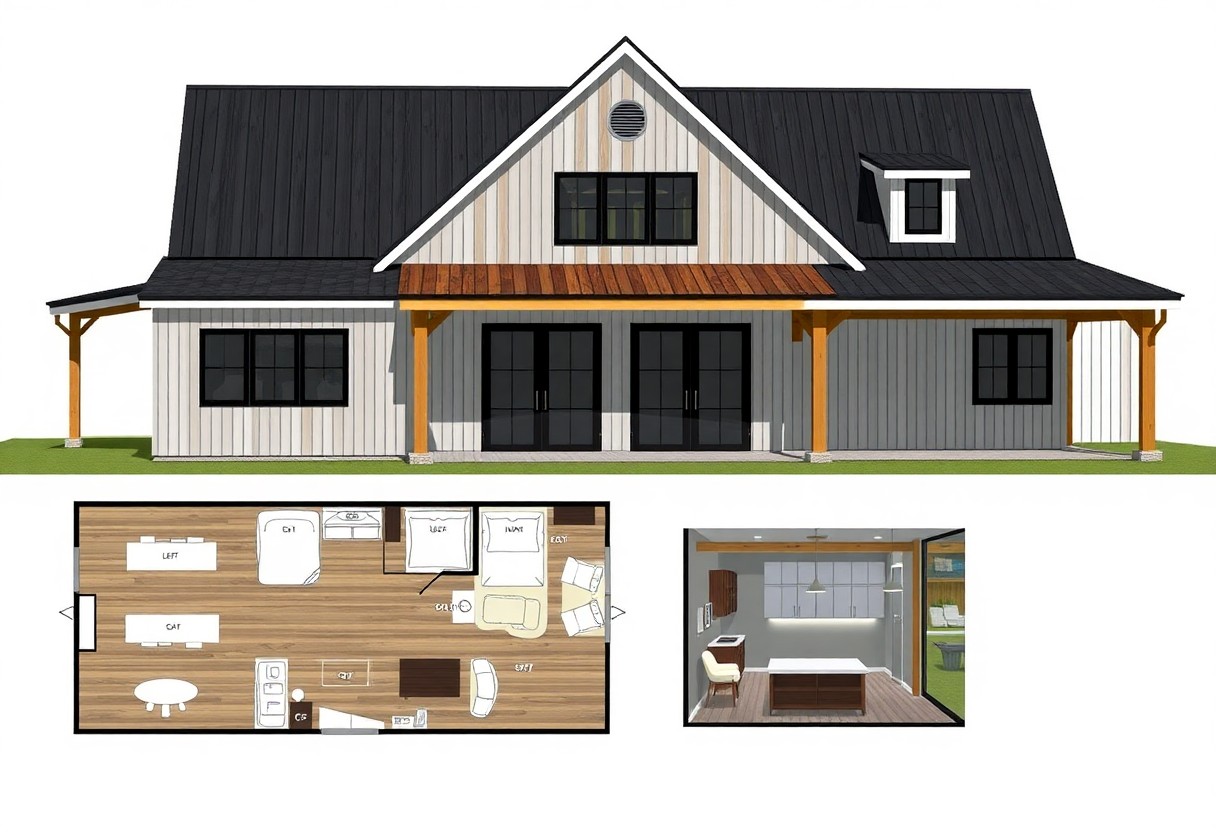
    Barndominium floor plans balance barn-style openness with residential comfort, and this guide gives you practical strategies to design a layout that fits your lifestyle. You’ll learn how to prioritize functional zones, optimize circulation and storage, configure flexible living and workspaces, and plan for insulation, natural light, and future expansion. Use these design principles to make informed choices about room placement, materials, and budget so your barndominium performs beautifully for years.

    Key Takeaways:

    • Design around how you live: define clear zones (living, work, sleep), plan circulation, and use flexible rooms to support daily routines.
    • Leverage the barndominium’s structure: optimize open layouts, lofts, and ceiling heights while coordinating insulation, utilities, and budget-driven construction choices.
    • Personalize for longevity: incorporate garage/workshop space, accessibility features, energy-efficient systems, and adaptable layouts for future needs.
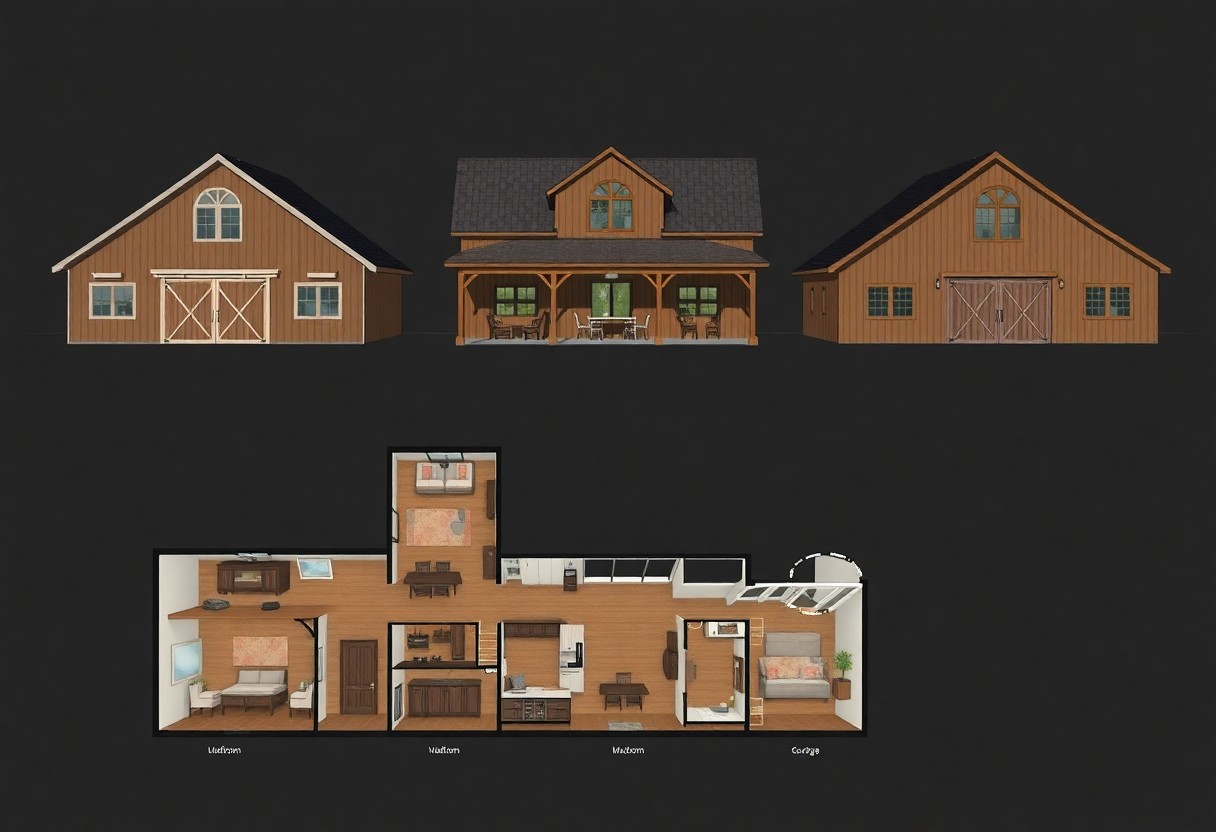
    Understanding Barndominium Types

    When evaluating types, you should match structure to use: living-first, shop-first, or mixed-use layouts each shift square footage and budget priorities. For example, living-focused plans often run 1,200-2,400 sq ft with 9-12 ft vaulted ceilings, while shop-first builds allocate 40-60% of the footprint to workspace. Cost per square foot typically ranges $70-$160 depending on finishes and site work. You can reduce long-term energy bills by choosing higher R-value insulation and strategic glazing.

    Traditional Barndominium Open post-frame, exposed timber, 1,200-2,400 sq ft, economical shell
    Modern Barndominium Metal/glass facades, flat or low-pitch roofs, 1,500-3,000 sq ft, high-efficiency systems
    Hybrid (Residential + Shop) Split-floor plans, 30-60% shop area, drive-through bays, concrete floors
    Workshop/Commercial-First Heavy-gauge steel frames, 12-24 ft clear heights, crane-ready options
    Luxury/Custom High-end finishes, 2,000+ sq ft, HVAC zoned, integrated smart home systems
    • Traditional Barndominiums – classic timber or metal shells with open interiors
    • Modern Barndominiums – sleek materials, minimalist layouts, energy focus
    • Hybrid Layouts – combined living and significant shop/garage space
    • Workshop-First Builds – engineered for heavy-duty operations and storage
    • Luxury/Custom – designer finishes, multiple zones, higher per‑sq‑ft cost

    Traditional Barndominiums

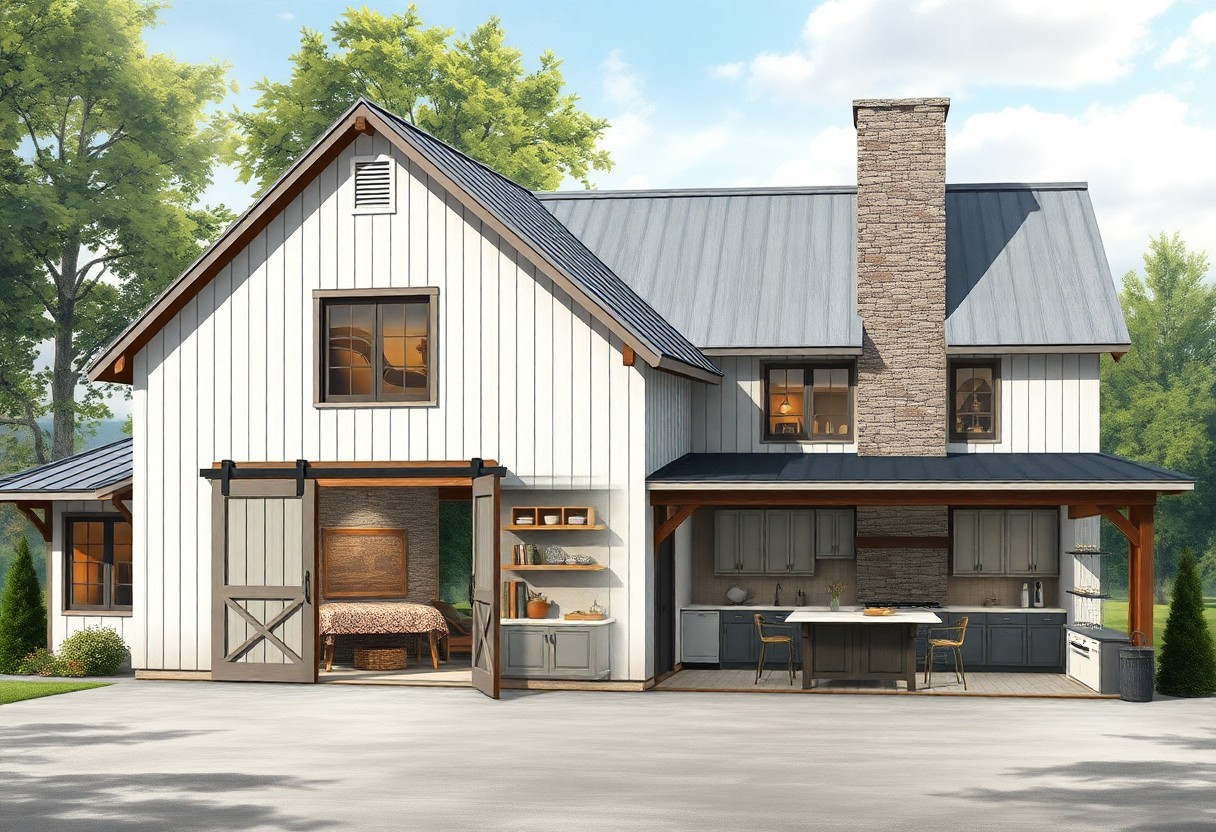
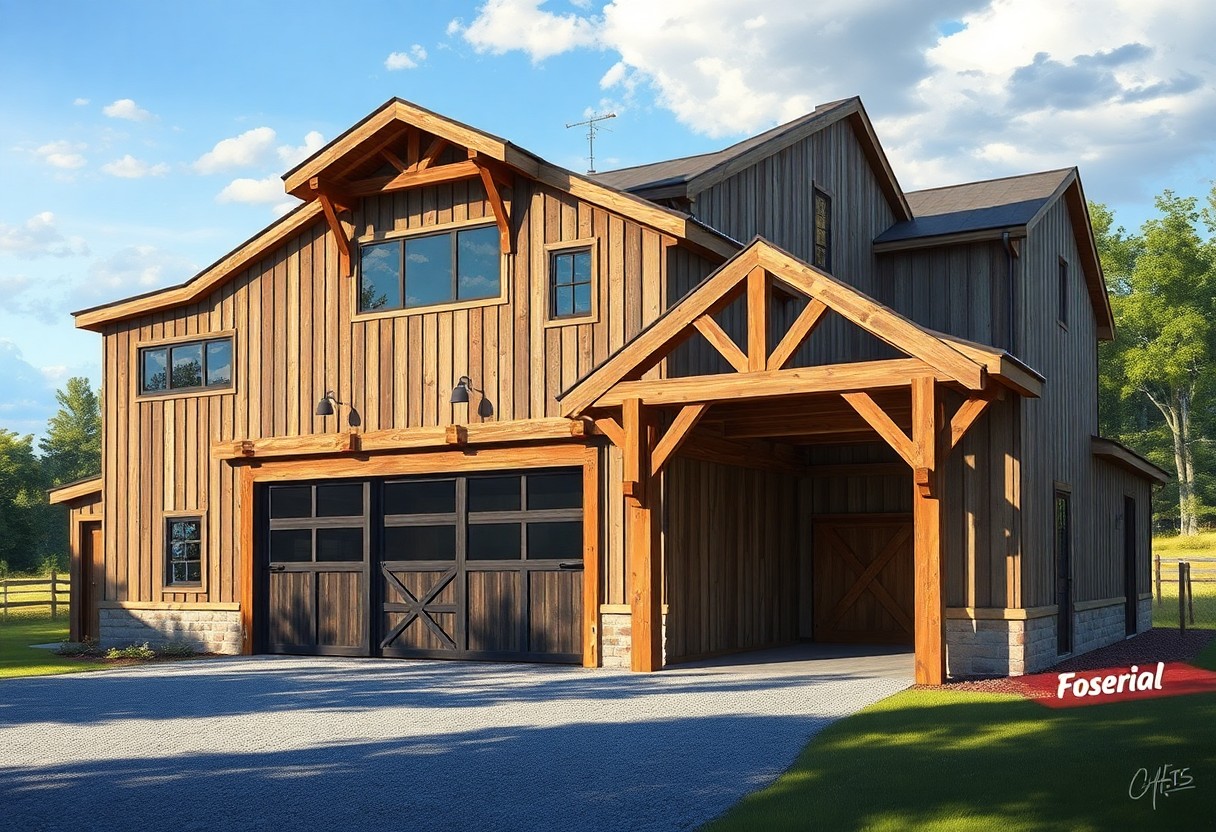
    You’ll find traditional barndominiums emphasize exposed post-and-beam character with wide open spans and minimal interior partitions, often in the 1,200-2,400 sq ft range. Many owners choose galvanized metal roofing and board-and-batten siding for durability, and use simple 24×36 or 30×40 footprints to keep costs near the lower end of the $70-$100 per sq ft spectrum when finishes stay basic.

    Modern Barndominium Designs

    You can adopt modern designs that blend metal shell efficiency with large glazed facades, flat or low-pitch roofs, and clean-lined interiors; typical modern builds fall between 1,500 and 3,000 sq ft. These plans often prioritize insulation upgrades (R-30 to R-50 walls), mechanical zoning, and features like open kitchen islands and clerestory windows to bring daylight deep into the plan.

    In practice, a contemporary project might use structural insulated panels (SIPs) to achieve airtightness and R-values that cut heating demand by 20-40% compared with conventional framing; owners frequently pair triple-glazed windows and heat-pump HVAC to reach net-zero-ready performance. You should budget an extra 10-25% for premium glazing and facade details versus a basic metal-shell build, but you gain resale appeal and lower operating costs. Knowing how materials, insulation, and window placement affect energy use lets you optimize cost and comfort.

    Key Factors to Consider

    When planning your barndominium, weigh practical items that shape layout, budget, and long-term use:

    • Budget & timeline – construction typically $100-$200/ft² depending on finishes
    • Site & soil – septic/well can run $3k-$15k; slope affects foundation
    • Utilities & distance – power/water extensions often add $10k-$30k
    • Zoning, permits & setbacks – county rules and HOA covenants vary
    • Layout & future needs – workshop, garage, or multi‑gen space
    • Climate & insulation – R‑values and roofing affect energy use
    • Resale & function – flexible spaces improve marketability

    This helps you prioritize tradeoffs and avoid expensive post-build changes.

    Budget and Cost Estimation

    You should set a budget using per‑square‑foot benchmarks – typically $100-$200/ft²; for example, a 2,000 ft² barndo at $120/ft² equals $240,000. Add 10-20% for soft costs (design, permits, engineering) and a 10-15% contingency for site surprises. Factor specialty items – oversized HVAC, exposed steel, or high-end finishes – which can push costs toward the upper range. Get at least three line‑item bids to compare labor, materials, and allowances.

    Location and Site Selection

    You’ll need to verify zoning, floodplain designation, and utility access before buying; county permit turnaround can be 4-12 weeks. A failed perc test usually forces a mound system, adding $5k-$20k, while well drilling commonly costs $5k-$15k. If power runs more than ~200 ft, expect $10k-$30k to extend service, and driveway grading or culverts can add several thousand dollars.

    Order a topographic survey and soil/perc tests early – high clay, shallow bedrock, or poor bearing capacity raises foundation costs and may require piers or a deep footing, and steep lots often demand grading or retaining walls that can add $10k-$50k. Confirm heavy‑equipment access to avoid mobilization surcharges, check FEMA flood maps for insurance implications, and review HOA or county material restrictions that could affect exterior finishes and placement.

    Essential Tips for Designing Your Space

    Evaluate flow by mapping daily routes-kitchen to entry, mudroom to garage-and keep hallways at least 36 inches wide; zone noisy activities away from sleeping areas. Use a central vaulted volume of 12-16 feet to increase daylight and allow loft storage access with a 6-8 foot ladder. Assume that you allocate 20-30% of your build budget for mechanicals and finishes to avoid late compromises.

    • Map traffic flows so you maintain comfortable 36″ circulation paths.
    • Consolidate wet walls to reduce plumbing runs and save 10-20%.
    • Plan lofts and built-ins to add 100-400 sq ft of usable space without expanding the footprint.

    Maximizing Space and Functionality

    When you maximize space, prioritize multifunctional elements: a 4’x8′ island with built-in pantry, a 10′ mudroom with lockers, and under-stair storage that adds 40-80 sq ft of usable area. Use sliding doors to save 3-4 sq ft per doorway and align work zones within 10-15 feet of each other; consider 12-16 ft communal ceilings to allow lofted storage and bring natural light deep into a 1,200-2,500 sq ft plan.

    Choosing the Right Materials

    Select durable exteriors like 26-24 gauge galvalume or painted steel and a standing-seam roof for 30-50 year service life; pair with a 4-6 inch, 4,000 psi concrete slab and R-20-R-30 wall insulation to meet energy targets. Use engineered beams for long spans and stainless fasteners in coastal climates to prevent corrosion.

    You should compare life-cycle costs: metal siding may run roughly $3-6 per sq ft while standing‑seam roofing commands a higher upfront price but lowers maintenance; closed‑cell spray foam offers higher R‑value per inch and air-sealing benefits, whereas batt insulation reduces initial expense. Specify breathable wall assemblies in humid areas, detail thermal-bridge mitigation, and pick finishes backed by 20-50 year warranties when possible.

    Step-by-Step Guide to Create a Floor Plan

    Initial Planning and Drafting

    Start by sketching a bubble diagram of functions and select a footprint-common barndo sizes are 30×40 or 40×60. You should allocate square footage (example: 35-45% living/kitchen, 25-35% shop/garage, 20-30% bedrooms) and set target room dimensions (bedrooms 120-150 sq ft, master 200-250 sq ft). Use graph paper or SketchUp to test flow, and place plumbing stacks within ~20 feet to lower plumbing costs.

    Finalizing Your Design

    Coordinate final drawings with a structural engineer and builder, and confirm code items like egress, fire separation, and ADA clearances if needed. You should specify mechanicals (200-amp service typical, HVAC sizing ~3-4 tons for 1,800-2,400 sq ft), insulation targets (walls R-20, roof R-38), and realistic cost ranges-$80-$150 per sq ft depending on finishes-before submitting permit-ready plans.

    Initial Planning and Drafting

    When you draft, prioritize a centerline for circulation and position the shop near an exterior bay-common shop depths are 24-36 feet to fit vehicles or equipment. You should draw at least three iterations: compact (1,200-1,500 sq ft), mid (1,800-2,400 sq ft), and expanded (2,500+ sq ft), then test sunlight, prevailing winds, and roof overhangs; these iterations reveal trade-offs between open-plan living and private bedrooms.

    Finalizing Your Design

    Before permits, have your builder produce a materials schedule and load calculations for post spacing (often 8-12 feet) and roof snow/wind loads specific to your county; those numbers drive beam sizes and truss specifications. You should lock in window/door sizes, slab thickness (4″ for living areas, 6″ for heavy-shop areas), and a 10-15% contingency for subcontractor estimates to avoid budget overruns.

    In final coordination you must sequence lead times and inspections: order specialty items (HVAC, custom doors, trusses) 6-12 weeks out, schedule footing and slab inspections early, and confirm local permit timelines (often 2-6 weeks). You should also finalize exterior grading and drainage elevations, verify utility hookups, and create a two-week critical-path schedule for foundation-to-framing to minimize downtime and contractor hold-ups.

    Pros and Cons of Barndominium Living

    You’ll gain faster builds and lower shell costs-many barndominium shells go up in days and finished builds commonly range $100-$200 per sq ft-but you may face financing quirks, insurance nuances, and market acceptance issues depending on location and finish level.

    Pros Cons
    Lower initial shell cost – metal framing and panelized systems often reduce structural expenses by 20-40% versus comparable stick-frame shells. Financing complexity – some lenders treat barndominiums as non‑standard homes, requiring higher down payments or specialty construction loans.
    Faster construction – pre‑engineered shells can be erected in days; typical complete builds finish in 3-9 months depending on finishes. Finish costs add up – high-end interiors, custom kitchens, and HVAC for large open spaces can push per‑square‑foot costs above traditional homes.
    Flexible layouts – open spans let you combine a 1,500-3,000 sq ft shop with living quarters or convert space as needs change. Resale variability – local buyers may prefer conventional homes, so resale value depends heavily on neighborhood and finish quality.
    Durability and low maintenance – steel shells resist rot and pests better than wood framing in many climates. Thermal and acoustic challenges – metal shells require proper insulation and thermal breaks; without them you’ll face condensation and noise issues.
    Cost-effective for mixed use – if you need workshop/storage, combining functions often saves compared to separate buildings. Zoning and code hurdles – some rural or suburban zones restrict mixed-use or have building code interpretations that complicate permits.
    Design freedom – large clear spans support unique mezzanines, vaulted spaces, and custom garage layouts. Trade familiarity – some contractors and subcontractors have limited barndo experience, which can affect quality and timelines.
    Energy performance potential – with proper insulation (spray foam or high‑R batts) you can achieve efficiency comparable to framed homes. HVAC sizing complexity – large open volumes often require zoned systems and higher upfront HVAC investment for comfort control.

    Advantages of Barndominiums

    You can merge living and workspace efficiently, often fitting a 1,200-2,500 sq ft residence with a 1,500+ sq ft shop on one footprint, which reduces site prep and utility runs; plus steel shells cut framing time dramatically and lower long‑term maintenance compared with wood structures.

    Disadvantages and Challenges

    You’ll need to plan carefully for insulation, condensation control, and sound treatment-improper detailing leads to moisture, high heating/cooling loads, and echo; also expect lender and insurance scrutiny that can add upfront hurdles.

    To mitigate these issues you should specify continuous insulation, thermal breaks, and targeted ventilation: aim for wall and roof assemblies equivalent to R‑30+ walls and R‑38+ ceilings, use closed‑cell spray foam or a warm‑roof system in cold climates, and install mechanical ventilation with dehumidification in humid regions. Investigate local lenders experienced with metal‑building residential projects and get multiple insurance quotes-doing so often saves time and prevents costly retrofit fixes later.

    Additional Resources for Planning

    Gather targeted resources to streamline permits, budgeting, and design decisions: consult your local building department for zoning and permit timelines (often 2-12 weeks), use online cost estimators to benchmark per-square-foot costs, and join owner forums where builders share case studies of 1,200-2,500 sq ft barndominiums to see real budgets, timelines, and common pitfalls.

    Floor Plan Software Recommendations

    Use SketchUp (free web version and paid Pro) for quick 3D massing, Chief Architect or Revit for permit-ready construction documents, and RoomSketcher or Floorplanner for fast furniture layouts; AutoCAD LT works for precise 2D CAD drafting if you need DWG exports. For example, modeling a 1,800 sq ft mixed-use barndo in SketchUp revealed roof overhang conflicts before framing, saving change orders.

    Professionals to Consult

    You should hire an architect or designer for code-compliant plans, a structural engineer to verify snow/wind loads and steel connections, and a contractor experienced with metal shell systems; add an MEP (mechanical/electrical/plumbing) consultant and an HVAC specialist for efficient systems. Architects often charge 5-15% of construction cost, while engineering and MEP fees vary by project complexity.

    Vet prospects by asking for 3-5 barndominium or metal-building references, proof of licensing and insurance, and examples of stamped structural drawings for your county. Confirm they’ve worked with local inspectors and can produce energy calculations or Blower Door results if you pursue insulation upgrades; expect design to take 4-8 weeks and engineering 2-6 weeks once site data is provided.

    Final Words

    Drawing together the principles and examples in this guide, you can confidently choose and tailor a barndominium floor plan that aligns with your lifestyle and budget. Focus on circulation, multifunctional rooms, and long-term adaptability, evaluate structural and code requirements, and plan systems early so your design supports daily routines, entertaining, and future needs without compromising comfort or resale value.

    FAQ

    Q: What is a barndominium and what are common floor plan layouts?

    A: A barndominium is a metal- or wood-framed building that combines living quarters with open shop or storage space. Common layouts include single-level open plans with combined kitchen/living/dining, loft-style sleeping areas above a shop, split-plan designs that separate a finished living wing from a workshop, and attached or detached garage/workshop configurations. Each layout emphasizes flexibility, durable finishes, and often higher ceilings or mezzanines for storage and work areas.

    Q: How do I choose a floor plan that fits my daily lifestyle and future needs?

    A: Start by listing primary activities (workshop, entertaining, remote work, multi-generational living) and the number of bedrooms and bathrooms needed now and later. Prioritize flow: place public spaces together and bedrooms apart for privacy, allocate dedicated zones for noisy or dusty activities, and design multipurpose rooms that can convert as needs change. Consider site orientation, natural light, access to utilities, and whether easy expansion or modular additions will be required.

    Q: What design considerations are important when combining a workshop or garage with living space?

    A: Ensure physical and acoustic separation between shop and living areas with insulated walls, solid fire-rated doors, and separate HVAC systems or zoning. Plan for ventilation, dust control, durable flooring, adequate lighting, heavy-duty electrical service, and proper drainage and slopes for vehicle washes. Add transition zones such as mudrooms or utility corridors to keep contaminants out of living spaces and to provide storage for tools and gear.

    Q: How can open-plan barndominiums be made energy-efficient and comfortable year-round?

    A: Use a continuous thermal envelope: high R-value insulation in walls and roof, sealed vapor barriers, and thermal breaks at framing connections. Install appropriate HVAC sizing with zoning or ductless mini-splits for large-volume spaces, add ceiling fans and operable windows for passive cooling, and include insulated doors and storm-rated windows. Consider radiant barriers or spray foam for metal roofs and use interior partitions, curtains, or sliding doors to reduce conditioned volume when needed.

    Q: What customization options and cost drivers should I plan for when designing a barndominium floor plan?

    A: Popular customizations include mezzanines or lofts, oversized porches, shop mezzanine storage, upgraded insulation, high-end kitchens and baths, and specialty garage lifts or hoists. Major cost drivers are building footprint and height, foundation/site preparation, insulation and HVAC upgrades, utility hookups, structural modifications for large openings, and finish selection. Prioritize foundation, envelope, and mechanical reliability before luxury finishes to protect long-term value and performance.
  • “Barndominium Legal Zoning 101 – What You Must Know Before You Build”

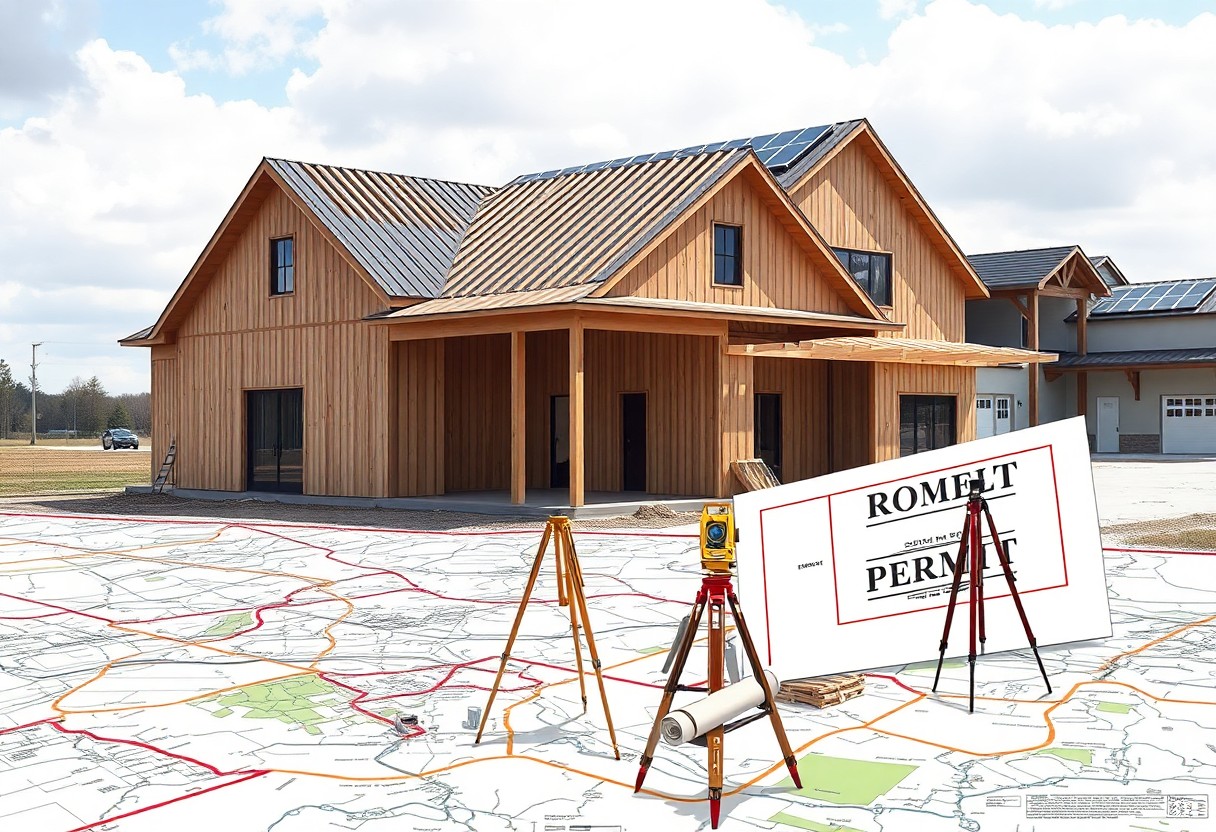
    Over the course of planning your build, you must verify local zoning designations, permitted uses, setbacks, height limits, required permits, inspections and any HOA or county restrictions so your barndominium complies from foundation to occupancy; consult zoning maps, speak with planning staff, and apply for variances early to prevent costly delays.

    Key Takeaways:

    • Verify zoning and land‑use designation for your parcel-confirm barndominiums are permitted or pursue rezoning, variances, or conditional‑use permits; check setbacks, height limits, lot coverage, and permit requirements before purchasing or building.
    • Confirm applicable building codes and structural requirements for metal/post‑frame construction, secure required engineering plans and inspections, and plan for utility connections, septic/drainage rules, and fire/energy compliance.
    • Review HOA covenants, easements, and local ordinances; evaluate financing and insurance options for nontraditional dwellings and budget for permit fees, impact fees, and potential site‑improvement costs and delays.

    Understanding Zoning Laws

    When assessing your parcel, zoning maps and local code sections determine whether a barndominium is allowed, what uses are permitted, and what limitations apply – typical setbacks range 20-50 feet, minimum lot sizes often span 1-5 acres, and height caps commonly sit between 35-45 feet; you must check both zoning designation and any overlay districts or recorded covenants that can add extra restrictions.

    Definition of Zoning

    Zoning is your municipality’s tool for dividing land into categories (for example, R for residential, A for agricultural, C for commercial, M for industrial) and specifying permitted uses, density, setbacks, and lot coverage; you consult the zoning ordinance to see if a barndominium is explicitly allowed, allowed with conditions, or prohibited.

    Types of Zoning Designations

    Common designations affecting barndominiums include Agricultural (A‑1) which often permits farm residences and accessory structures, Rural Residential or RR for larger-lot single-family uses, R‑1 for conventional single-family with stricter aesthetics, C zones that usually restrict residential uses, and M or industrial that sometimes allow metal buildings but impose commercial standards.

    • Check A‑1 and RR zones first if you want minimal design restrictions and farm-use allowances.
    • Expect R‑1 to impose design, material, and lot coverage limits that can block metal-clad exterior finishes.
    • Investigate C or M zoning only if you plan mixed commercial/residential use or can rezone.
    • After you identify the designation, confirm setbacks, height limits, and accessory building rules in the ordinance.
    Designation Typical Uses / Notes
    A‑1 (Agricultural) Allows farm dwellings, accessory buildings; often permits metal structures with fewer design controls.
    RR (Rural Residential) Large-lot single-family; may allow hobby farms and detached workshops subject to acreage minimums.
    R‑1 (Residential Single‑Family) Strict aesthetics, setbacks, and materials; metal exteriors often restricted without variance.
    C / Commercial Primarily business use; residential may require conditional use permit or rezoning.

    Digging deeper, you should note that A‑1 often requires less than 1-5 acres for accessory dwellings while some R‑1 zones mandate minimum lot widths (e.g., 60-100 ft) and limit accessory structure footprints to a percentage of the lot; you’ll typically see permitting timelines of 30-120 days for simple permits and 60-180 days if variances or rezonings are needed, with fees ranging roughly $200-$2,000 depending on jurisdiction.

    • Gather plats, zoning map, and the specific ordinance section before applying for permits.
    • Consult the planning department for interpretation and any historic or overlay district rules.
    • Budget time for public hearings if you pursue rezoning or a variance; fees and notice periods vary.
    • After you confirm code language, file the appropriate permit, variance, or conditional-use application.
    Requirement Typical Range / Example
    Setbacks Front: 20-50 ft; side: 5-20 ft; rear: 20-40 ft.
    Minimum Lot Size Urban R‑1: 6,000-10,000 sq ft; Rural/A‑1: 1-5 acres.
    Height Limits Residential: 30-40 ft; Rural can allow 45+ ft with exceptions.
    Lot Coverage / Accessory Limits Coverage 25-40%; accessory building area often capped at 50% of primary footprint or a fixed sq ft.

    Barndominiums and Zoning Regulations

    Zoning maps, land‑use codes, and overlay districts determine whether your barndominium is allowed: agricultural (A) or rural residential (RR) zones commonly permit them, while suburban R‑1 or planned unit developments often restrict them. You must check setbacks (typically 20-50 ft), maximum lot coverage (often 25-40%), height limits (35-45 ft), and septic/well siting rules (50-100 ft separations); floodplain or conservation overlays can add elevation or foundation requirements that change project feasibility.

    Common Zoning Issues for Barndominiums

    You frequently run into permitted‑use conflicts, HOA covenants, minimum lot size requirements (0.5-5 acres in many jurisdictions), driveway/access standards, and septic or well permitting. Fire district or road‑maintenance requirements can force upgrades; for example, a county may require a minimum all‑weather access and turnouts for structures over 3,000 sq ft. Variances, conditional use permits, or rezoning are typical solutions but add time and public hearings.

    Permitted Uses and Restrictions

    Permitted uses vary: some jurisdictions treat barndominiums as primary dwellings if you finish interior living space, while others allow only agricultural or accessory uses on the same structure. You may see limits on home‑based businesses, short‑term rentals, or on‑site commercial activity; an A‑zone might allow a workshop and occasional farm sales, but an R‑1 zone could ban any nonresidential use without a conditional permit.

    When pursuing approval, expect a process: submit a site plan, floor plans, engineered foundation details, septic design, and a survey; public notice and a planning commission hearing often take 30-90 days. Fees commonly range $200-$2,000 depending on rezoning or variance scope. Also confirm which code applies-local officials may require IRC compliance for residential finishes or IBC standards for metal‑framed sections-so coordinate code classification early to avoid rework.

    Building Codes and Regulations

    Overview of Building Codes

    You’ll follow the IRC for one- and two-family dwellings (up to three stories) and the IBC for commercial or mixed-use barndominiums, while energy requirements come from the IECC. Codes cover foundation, structural framing, roof snow/wind loads, electrical, plumbing, mechanical systems, fire separation and egress. Local jurisdictions routinely adopt amendments and different code years, so verify county or city requirements, permit timelines and required inspections before finalizing your plans.

    Importance of Compliance

    If you skip code compliance you risk fines, stop-work orders, forced demolition and insurance or mortgage complications; insurers and lenders often require a certificate of occupancy before paying claims or closing loans. Inspectors verify structural, electrical and egress safety to protect occupants. Being compliant preserves resale value and limits liability-documented permits and approved inspections make your barndominium financeable and insurable.

    Insist on engineer-stamped plans for nonstandard spans or loads-open bays over about 20-30 feet often need engineered trusses and calculations. Hire licensed electricians and plumbers, schedule foundation, framing and final inspections, and keep inspection reports plus the final certificate of occupancy. Expect special inspections for concrete (28-day strength tests), welding and gas-line pressure testing in many jurisdictions; those records are often decisive in insurance disputes, lender reviews and title transfers.

    Assessing Property for Barndominium Construction

    You need to audit zoning district, minimum lot size (many rural zones allow barndominiums on 0.5-2 acres), setbacks, easements and access to utilities before buying. Check slope – grades over 15% can add 10-30% to foundation and grading costs – and verify permit timelines (county review often 30-90 days). Confirm floodplain status (FEMA Zone AE/A adds elevation requirements) and whether the parcel lies in an HOA or conservation overlay that limits exterior materials or footprint.

    Factors to Consider

    Prioritize items that directly affect buildability and cost: lot coverage limits, septic/well feasibility, road maintenance responsibility, and potential firewise vegetation requirements. You should obtain a soils report and a site plan early to avoid surprises from setbacks or utility extensions that can add $10k-$50k.

    • Zoning designation and permitted uses (AG, R‑R, R‑1) – confirm accessory dwelling rules.
    • Setbacks, easements, floodplain and FEMA map status (Zones A, AE, VE require different elevations).
    • Soil perc test results and bedrock depth; engineered foundations cost more on shallow bedrock.
    • Utility access: distance to power transformer, sewer vs septic feasibility, and well yield (gallons per minute).
    • Road access and county maintenance vs private road agreements; culvert or driveway permits can be required.
    • Thou must verify septic capacity and watershed protections, since some counties mandate 50-100 ft septic setbacks and riparian buffers.

    Land Use and Environmental Impact

    You must evaluate wetlands, endangered species habitat, and local stormwater rules early: Clean Water Act Section 404 and state permits can block fills in wetlands, and buffers commonly range 25-100 ft. Expect engineered stormwater controls when disturbed area exceeds 1 acre, and be aware that mitigation fees or on‑site restoration may be required.

    For example, a Central Texas county required a wetland delineation and 120‑day mitigation plan that added $8,000 in fees and native plant restoration after a 0.3‑acre disturbance; in Florida, building near gopher tortoise burrows triggered relocation permits costing $5k-$20k. You should commission a wetland delineation, Phase I enviro assessment, and consult the county planner and a civil engineer to size retention, calculate 100‑yr runoff, and estimate mitigation before finalizing your site purchase.

    Navigating the Permit Process

    Steps to Obtain Permits

    After confirmed zoning, start with a pre-application meeting with your building department, then submit a site survey, engineered foundation and framing plans, and septic/soils reports. Expect separate permits for building, electrical, plumbing, mechanical and septic; fees commonly range $200-$2,000 and review timelines run 2-12 weeks. Schedule inspections for footings, framing, systems and final; providing a complete packet shortens review and reduces re-submissions.

    Common Challenges and Solutions

    You’ll face zoning misclassification, setbacks, floodplain restrictions, septic failures and plan-review delays most often. Pursue a pre-application review, hire a local engineer or architect, and apply for a variance or conditional-use permit when setbacks or use conflicts arise. Using a design that meets local dimensional standards and submitting complete, stamped documents cuts rejections; retaining a builder familiar with county procedures speeds inspections and approvals.

    For example, in one Midwestern county a homeowner hit a 25-foot setback issue; by commissioning a site re-survey and engineer-stamped drainage plan, then applying for a 10-foot variance, they secured approval in eight weeks and paid about $1,200 in combined fees. If your permit is denied, you can appeal within typical 30-day windows or request administrative review; budgeting $500-$1,000 for professional support often halves time-to-approval.

    Future Trends in Barndominium Zoning

    Expect local planners to expand rural-residential and mixed‑use overlays that explicitly mention post‑frame and metal‑clad homes, with minimum lot sizes commonly staying in the 0.5-2 acre range; you should prepare for faster pre‑app meetings, emphasis on energy and stormwater compliance, and build schedules of 3-6 months when using contractor-ready plans, all of which will shift how you time permits, site work, and financing.

    Changes in Legislation

    You’ll see more jurisdictions update land‑use tables and conditional‑use rules to allow residential metal buildings; look for ordinance changes addressing setbacks, lot cover, wastewater capacity, and solar access. Some counties now reference post‑frame construction in zoning text or offer form‑based code pilots-checking state model ordinances and recent county code amendments lets you identify which permitting shortcuts or design standards apply to your parcel.

    Evolving Perceptions of Barndominiums

    Buyers and planners increasingly view barndominiums as legitimate housing when finished to residential standards: you should plan for residential‑grade insulation, windows, porches, and interior layouts of 1,200-3,000 sq ft to compete on MLS; improved curb appeal and documented compliance with IRC or local codes materially raise resale prospects and neighborhood acceptance.

    On financing and approvals, you’ll find lenders and insurers more willing to underwrite barndominiums that meet IRC/IBC standards and have comparable sales; keep detailed cost breakdowns, builder certifications, and completed inspections to support appraisals. Municipalities with successful examples often cite a handful of comps and permit histories that you can reference during your review and variance requests.

    Conclusion

    Upon reflecting on “Barndominium Legal Zoning 101 – What You Must Know Before You Build”, you should verify local zoning classifications, secure permits, assess building codes, consult planners or legal counsel, and plan site use to avoid delays and fines; proactive compliance protects your timeline, budget, and investment while ensuring your barndominium meets safety and land-use requirements.

    FAQ

    Q: Can I build a barndominium on my property?

    A: Start by confirming your property’s zoning district and permitted uses with the local planning or zoning office. Some zones expressly allow residential or agricultural structures; others require a conditional use permit, rezoning, or an agricultural-use qualification tied to active farming. Check lot size, setbacks, height limits, maximum lot coverage, floodplain and wetlands restrictions, and any conservation overlays. If the zoning code is unclear, request a zoning verification letter or pre‑application meeting; if necessary pursue rezoning or a variance (processes that involve public notice, hearings, fees, and timelines that can span weeks to months).

    Q: Which permits and inspections will I need for a barndominium?

    A: Typical requirements include a building permit plus trade permits for electrical, plumbing, mechanical and HVAC. Submittal documents usually include a site plan, engineered foundation and roof plans, floor plans, energy compliance documentation, soil/perc tests for septic, and utility connection plans. Expect staged inspections: footing, foundation, framing, rough‑ins, insulation, and final. Additional permits may be required for septic, well, driveway/culvert, septic drainfield setbacks, and any floodplain development. Fees, required professional stamps, and inspection checklists vary by jurisdiction.

    Q: How do zoning rules differ from building codes for a barndominium?

    A: Zoning controls land use, density, lot layout, setbacks, height, and permitted activities on the parcel. Building codes (e.g., IRC/IBC and local amendments) set construction and safety standards-structural, fire, egress, insulation, plumbing, and electrical. Both sets of rules apply: zoning determines whether and where you can place the structure; building codes determine how it must be built. Occupancy classification (residential vs accessory/agricultural) affects code requirements such as egress, fire separation and energy compliance, so clarify intended use early.

    Q: Do HOAs, easements, or utility access affect barndominium projects?

    A: Yes. Homeowners association covenants can restrict exterior materials, colors, rooflines, building types or require architectural approval; HOA approval is separate from municipal permits. Recorded easements, right‑of‑ways and conservation restrictions can limit building locations and site work; check plat and title documents. Utility availability and extensions (water, sewer, gas, electric) influence feasibility and cost; remote sites may require wells, septic systems or costly service extensions and impact/connection fees. Verify all restrictions before finalizing plans.

    Q: What are the options if my parcel’s zoning doesn’t allow a barndominium as planned?

    A: Options include applying for a rezoning to a district that permits your intended use, seeking a conditional use permit (CUP) if the use is permitted with conditions, or requesting a variance for dimensional exceptions like setbacks or height. Each route requires an application, supporting documents, public notice and hearings; decision criteria include compatibility, traffic, environmental impacts and neighborhood character. Engage a land‑use planner or attorney if needed, attend pre‑application meetings, and be prepared to propose mitigation (landscaping, buffers, limits on use) to improve approval chances.

  • “From Blueprint To Reality – A Step-by-Step Look At Barndominium Construction”

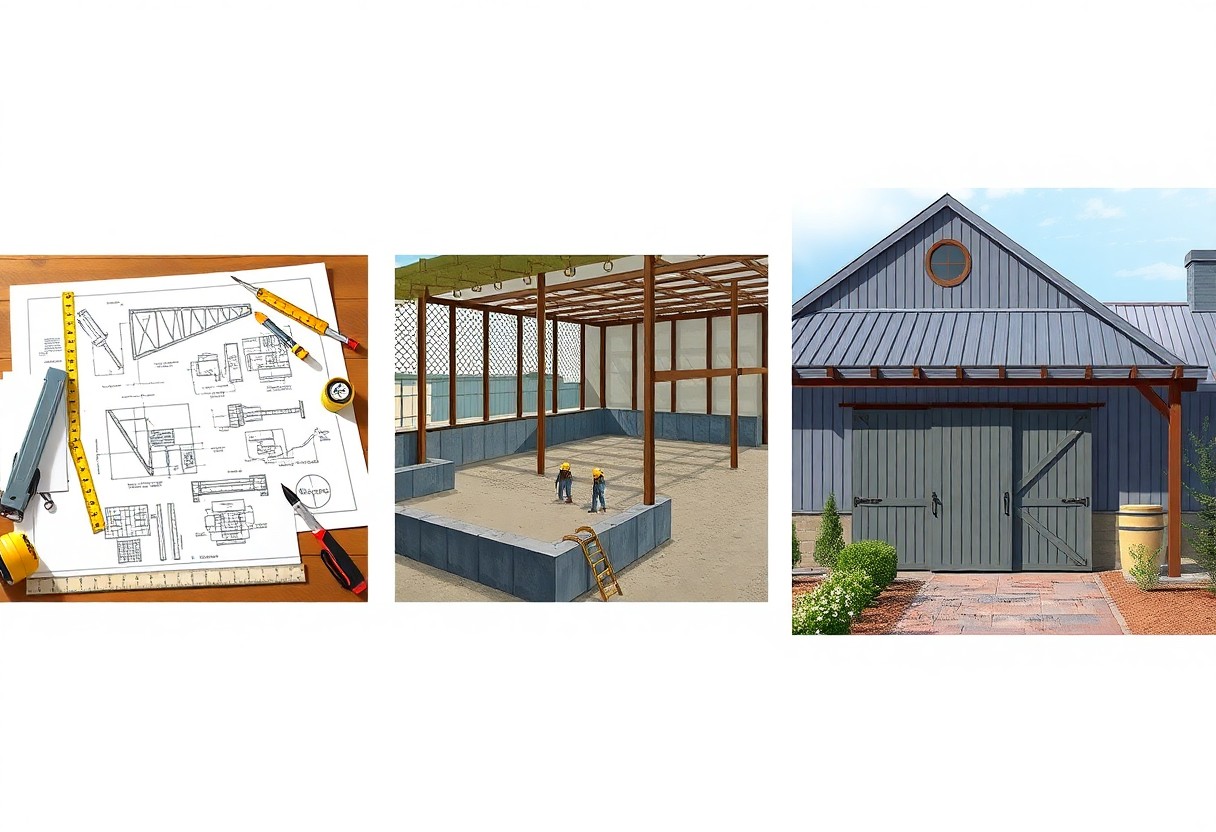
    With a solid blueprint and realistic timeline, you can navigate barndominium construction from foundation to finished living space with confidence; this guide walks you through site preparation, metal shell erection, insulation and systems installation, interior framing and finishes, and final inspections so you understand each phase, make informed decisions about materials and contractors, control costs and schedule, and ensure your build meets functional and code requirements.

    Key Takeaways:

    • Thorough planning and accurate blueprints set the scope: site selection, permits, and utility planning prevent delays and change orders.
    • Follow a clear construction sequence-foundation, metal shell erection, interior framing, systems, and finishes-to keep the project on schedule and control costs.
    • Budget and finish strategy matter: insulated shell, HVAC choices, and contractor selection determine long-term performance, timeline, and overall cost.

    Understanding Barndominiums

    You’ll see barndominiums marry a metal or post-frame agricultural shell with full residential interiors, typically between 1,200 and 3,000 sq ft; build timelines commonly fall in the 4-9 month range depending on site work and finishes. Pre‑engineered trusses and open-span framing let you add a 500-1,500 sq ft shop or garage within the same envelope, cutting both material and labor compared with separate structures.

    Definition and History

    You should know the term began as barn-to-home conversions in rural America and evolved into purpose-built residences using post‑frame or steel building systems; barn construction techniques date back decades, while the label “barndominium” gained mainstream attention in the 2010s as prefab metal shells and DIY culture made them accessible to homeowners and builders alike.

    Benefits of Barndominium Living

    You get fast construction, high durability, and flexible floor plans that accommodate combined living and workspaces-per-square-foot costs often range $70-$150 depending on finishes, and metal exteriors substantially lower long‑term maintenance. Also, the open-span structure simplifies mechanical routing and gives you efficient, highly adaptable interiors compared with typical stick-built layouts.

    For more detail, you can leverage several concrete advantages: spray-foam or insulated-panel strategies push living-space R-values into the R-20-R-38 range for good energy performance; integrating a 1,000 sq ft shop into the same thermal envelope typically saves against building two separate structures; and in many rural zones permitting and site prep reduce development time. Prepare for lender and appraisal considerations-some financing requires builder experience-but the combination of speed, lower exterior upkeep, and customization makes barndos attractive for owner-builders and contractors seeking value and versatility.

    Planning Your Barndominium

    Prioritize permitting, site work, and a realistic schedule up front: expect 4-9 months from breaking ground to move-in for most builds, with permitting and site preparation taking 2-8 weeks. Budget for unforeseen site costs-graded driveways, drainage, and utility hookups can add $5,000-$25,000 depending on distance to mains. You should also lock in a contingency of 10-15% and get engineered plans to avoid costly mid-build changes.

    Choosing the Right Location

    Evaluate zoning, access, and utilities before committing: confirm zoning allows residential and accessory shop use, run a perc test for septic, and verify power and water availability. Aim for 1-5 acres for privacy and future expansion, avoid floodplains and steep slopes that inflate site prep, and factor setback requirements (commonly 20-50 ft) plus road access-gravel driveway construction can cost $6,000-$20,000 depending on length and terrain.

    Designing Your Space

    Decide early how much of your footprint is living versus shop-typical barndos range 1,200-3,000 sq ft with shop areas from 400-1,200 sq ft-and plan ceiling heights (12-16 ft for shop bays, 8-10 ft for living). Incorporate a clear thermal strategy: aim for wall R‑values around R‑20 and roof R‑38 in cold climates or equivalent spray-foam performance, and separate HVAC zones between workshop and residence to control dust and odor.

    Drill into structural and systems choices: determine whether a clear-span steel frame or post-and-beam will suit a 30-60 ft shop bay, size mezzanines for 200-500 lb/ft2 live loads if used, and ask an engineer to spec wind and snow loads per local code (e.g., 90 mph winds or 30-50 psf snow loads in many regions). You should also plan mechanicals-estimate 20-35 BTU/sq ft for heating load sizing depending on climate-specify acoustical separation and locked entry between shop and living, and use examples from similar builds (a 2,400 sq ft barndo with 1,000 sq ft shop often allocates 35-45% of budget to finishes and MEP systems).

    Securing Financing

    You should line up financing before finalizing permits and contracts: construction loans typically require 20-25% down and carry rates about 0.5-1.5% higher than comparable mortgages. Expect lender underwriting to take 2-6 weeks and require a fixed-price contract, detailed budget, and builder approval. For a $250,000 build you’ll likely need $50k-$62.5k down plus reserves; interest-only payments during construction convert to a permanent mortgage when the project is complete.

    Budgeting for Construction

    Itemize land, site work, foundation, shell, utilities, interiors, and permits-use quotes from at least three contractors. Plan typical ranges: site prep $5k-$50k, foundation $10k-$40k, shell $25k-$60k, finishes $30k-$80k depending on quality. Set a contingency of 10-15% and track all bids in a spreadsheet to compare scope, exclusions, and change-order policies.

    Exploring Loan Options

    Compare construction-to-permanent (single-close), standalone construction, HELOCs, and cash-out/portfolio loans; construction-to-perm is popular for new barndominiums because it converts without a second closing. Lenders usually expect a 680+ credit score, DTI under ~45%, and detailed draw schedules tied to inspections.

    Construction-to-permanent loans typically disburse funds in draws based on completion milestones-common draw breakdowns are foundation 20%, framing/envelope 30%, rough trades 30%, finishes 20%. You’ll pay interest only on amounts drawn; after final inspection the loan converts to a conventional mortgage. Lenders require a signed fixed-price contract, builder’s resume/insurance, line-item budget, and often 6 months of reserves. If your build is $200,000, plan for 4-6 draws, a 20% down payment ($40,000), and interim inspections that can add $500-$1,500 in fees to the closing costs.

    Construction Process

    During construction you juggle sequencing, inspections, and contractor coordination to turn plans into a finished home: expect 1-3 weeks for site prep, 2-4 weeks to complete foundations and erect the shell, then 8-16 weeks of mechanical, insulation, and finish work depending on scope-most builds land between 4-9 months. Schedule buffer time for utility tie-ins and two to four key inspections that can pause progress if issues arise.

    Foundation and Framing

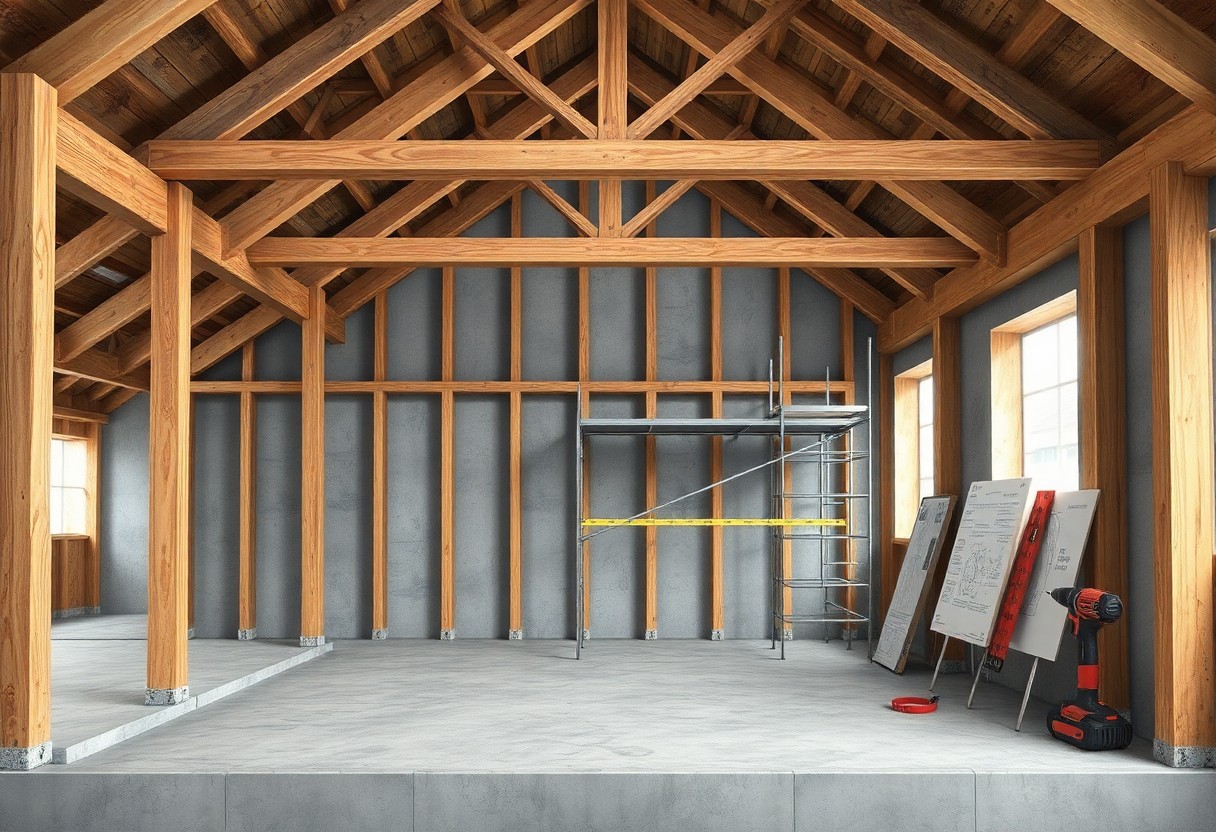
    For foundations you’ll select slab-on-grade, pier, or shallow footing systems based on soil reports and frost considerations; footings, rebar, pour, and initial cure typically take 3-7 days with a 28-day concrete cure for full strength. Framing with post-frame trusses and metal sheathing can raise the shell in 7-14 days for a 2,000-3,000 sq ft plan, while precise squaring, anchor bolt layout, and an early framing inspection prevent costly rework.

    Exterior and Interior Finishing

    Exterior work often begins with metal panels and roofing while you order windows and exterior doors to match lead times; insulation choices range from fiberglass batt (R-13-R-21 walls) to closed-cell spray foam, and attic targets are typically R-30-R-49. Inside, you’ll sequence HVAC rough-in, plumbing and electrical, then drywall, trim, and flooring-expect 4-12 weeks for finish phases depending on custom cabinetry and appliance lead times.

    In practice you should install roofing and weather barrier before interior finishes to protect work. Choosing spray foam versus batts affects installation speed and airtightness-spray foam costs roughly 2-3× more than batts but simplifies sealing and reduces cold bridging in metal frames. Plan mechanical rough-ins and inspections before drywall; drywall taping plus paint for a typical 2,400 sq ft interior takes 7-14 days, while flooring choices like polished concrete or engineered wood change final touch timelines and cost.

    Utilities and Amenities

    Bring utilities online in logical sequence: trench for water and sewer before slab work, set the 200-amp electrical service and meter pad early, and coordinate gas and broadband conduits to avoid rework. You should decide between municipal sewer, septic, or a well based on lot tests; for a 3-bedroom layout a conventional septic system often requires a 1,000-1,500 sq ft drain field. Plan dedicated lines for high-load equipment like ovens, EV chargers, and workshop tools to prevent costly panel upgrades later.

    Installing Electrical and Plumbing

    Start electrical by sizing service-200 amps is common-and locating the main panel near future living zones; include AFCI/GFCI protection and 20A kitchen circuits. For plumbing, run a 3/4″ main with 1/2″ branch lines or use a PEX manifold for simplified shutoffs. Coordinate rough-in locations with cabinet and appliance layouts, and book inspections after rough framing: many builders schedule electrical and plumbing rough inspections together to keep a 4-9 month timeline on track.

    Heating, Cooling, and Insulation

    Choose systems that match the metal-frame envelope: mini-split heat pumps (9k-36k BTU heads) are efficient for open plans, while central HVAC may suit multi-zone designs; aim for wall R-values between R-13 and R-21 and attic R-38 to R-60 depending on climate. You should include a thermal break between metal siding and interior framing and consider closed-cell spray foam (≈6-7 R per inch) at eaves to control condensation and air leakage.

    Run a Manual J load calculation before purchase: a 1,800-2,200 sq ft barndo often needs 18k-36k BTU total heating/cooling capacity depending on insulation and glazing. Also factor in ventilation-an ERV/HRV can manage humidity and bring fresh air without major energy loss-and size ductwork to keep static pressure low; sealing ducts to under 5% leakage and using MERV 13 filters improves efficiency and indoor air quality.

    Landscaping and Outdoor Spaces

    Integrate grading, drainage and topsoil placement into your timeline: grade 2-4% away from the slab, spread 4-6 inches of screened topsoil, and stage planting after final irrigation is installed. You can allocate 30-50% native plantings to cut maintenance and water use; install 1-2″ mulch beds, and plan hardscape thresholds so patios and walkways tie directly to door elevations for seamless transitions.

    Enhancing Curb Appeal

    Frame your barndominium with a defined driveway and entry: choose crushed stone for a rural look at roughly $0.50-$1.50 per sq ft or concrete/pavers for a cleaner edge; add two low-voltage path lights per 25-30 feet, place one or two 15-25 ft canopy trees at least 20 ft from the building, and use symmetrical foundation plantings 3-4 ft high to balance the metal façade.

    Functional Outdoor Areas

    Design outdoor living to match how you’ll use it: allocate a 12’x12′ (144 sq ft) dining patio or 16’x20′ (320 sq ft) multi-use patio for seating and cook stations, place a 10-15 ft service clearance behind outdoor kitchens, and confirm setback and septic-clearance rules before siting decks, sheds or detached garages to avoid rework.

    Specify materials and technology for longevity: slope hardscapes 1/4″ per foot away from the house, use permeable pavers or gravel in high-drainage zones, run a dedicated 20-amp GFCI circuit for an outdoor kitchen, and locate fire features at least 10 ft from structures; these choices cut maintenance and meet most local inspections.

    Final Words

    Summing up, you can transform a blueprint into a functional barndominium by following methodical planning, smart material choices, and clear communication with contractors; your active involvement from site prep through framing to finishes keeps the project on schedule, within budget, and true to your design goals.

    FAQ

    Q: What are the major phases from blueprint to a finished barndominium?

    A: The process typically follows these phases: design and engineering (site survey, floorplan, structural drawings), permitting and utilities (permit applications, utility hookups, septic or sewer design), site preparation and foundation (grading, soil compaction, footings or slab work), shell construction (post-frame or steel frame erection, roof and wall panels), rough-ins (electrical, plumbing, HVAC installed and inspected), insulation and interior framing (insulation strategy, interior walls, vapor management), finishes and trim (drywall, flooring, cabinetry, fixtures), final inspections and punch list, and exterior grading/landscaping. Each phase can overlap; plan lead times for engineered drawings, permit processing, and material deliveries to avoid downtime.

    Q: How do I choose between a steel-framed barndominium and a post-frame (pole) system?

    A: Steel-framed systems offer high strength, long spans, and resistance to rot and pests; they can simplify rapid enclosure and allow open interior layouts. Post-frame (timber poles) tends to be less expensive for certain spans, integrates well with conventional wood framing interiors, and can be easier to modify on site. Consider local climate, desired interior layout, insulation strategy (thermal bridging is greater with steel), available contractors with experience in each system, and long-term maintenance. Obtain cost comparisons for the exact design and factor in foundation differences and connection details for the chosen system.

    Q: What foundation types are best for barndominiums and how should the site be prepared?

    A: Common options are slab-on-grade with thickened edges and frost footings, stem wall foundations with slab infill, and pier foundations for raised floors. Site prep requires soil testing to identify bearing capacity and drainage characteristics, clearing, cut/fill and compaction, and establishing proper drainage away from the building. Frost considerations determine footing depth in cold climates. Coordinate foundation design with structural engineer and local code requirements, and include sub-slab utilities and vapor barrier planning before pouring.

    Q: Which insulation and moisture-control methods work well for metal-sided barndominiums?

    A: Closed-cell spray foam at the roof and wall cavities provides high R-value, air sealing, and moisture control but is costlier. Open-cell spray foam offers air sealing but needs a vapor management strategy in cold climates. Fiberglass batts or rigid board with an interior vapor retarder combined with a thermal break can be economical if installed correctly and if condensation risk from metal panels is mitigated. Ensure continuous roof insulation or a well-ventilated roof assembly to prevent moisture buildup. Include ventilation, proper flashing, and a drainage plane behind exterior panels to control water infiltration.

    Q: What are typical timelines, major cost drivers, and how can I manage budget overruns?

    A: A straightforward barndominium shell can be erected in a few weeks; a complete finished build commonly runs 6-12 months depending on complexity, permit delays, and subcontractor scheduling. Major cost drivers are site work (grading, utilities, septic), foundation type, shell material and thickness, insulation and HVAC design, interior finishes (flooring, cabinetry, fixtures), and specialty systems (solar, radiant heat). To manage budget: get multiple bids, set a contingency (10-20%), lock in material selections early, phase work if needed, monitor change orders closely, and hire a project manager or general contractor experienced with barndominium builds to coordinate trades and inspections.

  • DIY Small Barndominium – Easy Projects for Your Tiny Barn Home

    Over the years, you can transform your small barndominium into a stylish, highly functional home with manageable projects that maximize storage, light, and comfort; this guide provides proven DIY builds, layout strategies, and budget-friendly finishes you can tackle step-by-step to boost livability and resale value while preserving rustic charm.

    Key Takeaways:

    • Plan layout, insulation, plumbing and electrical first and secure necessary permits before starting projects.
    • Maximize functionality in tiny spaces with lofts, built-in storage and fold-down or multi-use furniture.
    • Cut costs using reclaimed materials and DIY finishes (flooring, countertops, cabinets); prioritize projects by skill level and budget.

    Benefits of a Barndominium

    You get a durable, low-maintenance shell with flexible interior space that adapts to changing needs: steel or wood frames often allow finishes to be changed without major structural work, a metal exterior can last 40-60 years, and many owners report completing basic builds in 3-6 months. You’ll also reduce long‑term upkeep and, with proper insulation and orientation, cut energy bills substantially compared with similarly sized older homes.

    Cost Efficiency

    You can build a barndominium for roughly $60-$120 per sq ft depending on finishes, often lower than conventional stick‑built costs once labor and time are accounted for. By using a pre‑engineered shell, doing interior finishes yourself, and grouping plumbing/electrical runs, you’ll shave weeks and thousands of dollars; some DIY owners report 20-35% savings versus hiring a full contractor package.

    Versatile Design Options

    You benefit from wide, open spans that let you configure living, workshop and storage areas however you want: a 30×40 shell converts easily into a 1,200 sq ft home with two bedrooms plus a loft, or into a combined garage/live space with a dedicated workshop. You can mix rustic reclaimed wood, exposed trusses, sliding barn doors and modern glass walls to match farmhouse, industrial or minimalist styles while keeping construction straightforward.

    You should plan layout moves that maximize that flexibility: place wet walls together to limit plumbing runs, use a 10-12 ft clearspan to add a 150-300 sq ft mezzanine, and specify large overhead doors if you want vehicle access. Incorporate built‑in storage, pocket doors and modular furniture so rooms can switch function-home office today, guest suite tomorrow-without costly renovations.

    Planning Your DIY Barndominium

    When mapping your build, prioritize systems and layout together: aim for R-20+ wall and R-38+ roof insulation, a 100-200 amp service with dedicated circuits for workshop tools, and plumbing runs that minimize long traces to the septic or municipal hookup. You should perform a Manual J load calc or hire an HVAC pro to right-size equipment, plan storage and loft access for a 400-1,200 sq ft shell, and place wet walls adjacent to one another to reduce piping complexity and cost.

    Choosing the Right Location

    Pick a site that balances sunlight, slope, and utility access: south-facing exposure boosts passive solar, slopes under 10% reduce grading expense, and having power/water within 200-400 ft can save thousands-running service commonly costs $3-10/ft, while well drilling ranges $5,000-15,000. You should perform a perc test for septic suitability, confirm driveway access for delivery trucks, and plan setbacks of roughly 50-100 ft from property lines if your county requires them.

    Understanding Zoning Regulations

    Zoning controls whether you can place a barndominium on a parcel, covering permitted uses (residential vs. agricultural), minimum lot sizes-often 1-5 acres in rural districts-setbacks (commonly 10-50 ft), lot coverage limits (typically 20-40%), and height caps. You should verify if an agricultural exemption, conditional use permit, or variance is needed; noncompliance can halt construction and trigger costly changes.

    Start by contacting the county planning department for a zoning verification letter and review the parcel’s recorded covenants. Expect to submit a site plan, survey, and permit application; review timelines vary widely (2-12 weeks) and fees range from roughly $100 to $2,000 depending on jurisdiction. If a variance or conditional use is required, prepare neighborhood notices and a case showing mitigation (landscaping, screening, reduced lighting) to improve approval odds.

    Essential Materials for Construction

    Stock your build with steel framing (12-14 gauge for posts, 14-16 gauge for studs), 4″ concrete slab at 3,000-4,000 psi over a polyethylene vapor barrier, galvanized fasteners and neoprene-washer screws, 24-26 gauge metal roofing, 1″-2″ polyiso or mineral wool exterior continuous insulation, Tyvek or ZIP sheathing for weather barrier, PEX for plumbing, a 100A electrical panel with GFCI/ARC protection, and quality window flashing and sealants to prevent air and water intrusion.

    Steel Frame Advantages

    Steel gives you straight, dimensionally stable members that resist rot, termites and fire; 12-14 gauge columns and cold-formed studs at 16″ o.c. let you span larger bay widths with fewer interior posts, enabling open layouts common in barndominiums. Galvanized finishes (G90) extend life in humid climates, and you install them with self-drilling screws, bolting or welding for fast, repeatable framing-many DIY builds cut framing time by 20-30% versus stick framing.

    Insulation and Weatherproofing

    Aim for your specified R-20+ walls and R-38+ roof using a mix: closed-cell spray foam (~R-6.5/in), mineral wool batts (~R-3.1/in) or fiberglass batts (~R-3.4/in) combined with 1″-2″ continuous polyiso to reduce thermal bridging. You should pair an air barrier (taped ZIP or housewrap) with proper flashing, seam tape, and sealed penetrations; use canned spray foam at window frames and through-roof penetrations to maintain airtightness and moisture control.

    For sizing, closed-cell foam needs roughly 3.1″ to hit R-20 and about 5.8″ for R-38; fiberglass batts require ~5.9″ for R-20 and ~11.2″ for R-38. Because steel studs create thermal bridges, add 1″ of polyiso (≈R-6) outside the studs or use insulated sheathing to preserve effective R-value. Seal all seams with tape and use a continuous air barrier system (ZIP/taped sheathing or taped housewrap) to prevent convective heat loss and moisture migration through the assembly.

    Design Ideas for Small Barndominiums

    Focus on layout moves that extend perceived space: orient the long axis south for passive solar gain, install 6-8 windows (24-36″ wide) on that facade, and pair metal siding with cedar accents for texture. You can add a 6-8 ft covered porch to extend living outdoors and plan a 600-900 sq ft footprint to keep mechanical and circulation runs efficient.

    Maximizing Space

    You can use a sleeping loft (120-160 sq ft) and a mezzanine to free ground-floor square footage; install a Murphy bed, 30″ deep kitchen base cabinets, and an 18″ bench with under-seat storage. Keep your main aisles at 36″ for circulation, choose pocket or barn doors, and design stairs with 12-16 cu ft built-in drawers to add storage without expanding the footprint.

    Minimalist Interior Ideas

    You should adopt a 2‑tone palette-white or soft gray walls with warm wood ceilings-and limit furnishings to multi‑use pieces like a sofa bed, nesting tables, and a 24″ deep wall‑mounted desk; favor open shelving over upper cabinets to maintain clear sightlines and reduce visual clutter.

    You can specify compact systems-24″ refrigerator, 24″ dishwasher, stacked washer‑dryer-and plan a 5‑ft kitchen run with a 30″ cooktop and 24″ prep counter. Choose 3000K LED strips under shelves for task lighting, 6-8″ wide floor planks to elongate sightlines, and limit decor to three focal elements per room so your interior stays breathable and easy to maintain.

    DIY Projects for Your Barndominium

    Tackle projects that add function and value quickly: build a 6×4′ kitchen island for $300-$1,200, install a sliding barn door for $150-$400, or create loft storage accessed by a ladder to gain 40-80 sq ft of usable space. You should prioritize projects tied to insulation and systems-keep wall R-20 and roof R-38 targets-then add built-ins, lighting upgrades, and waterproofing; many weekend projects take 6-16 hours and can raise resale appeal by 5-10% in rural markets.

    Custom Shelving Solutions

    You can maximize vertical space with floating shelves, built-ins, or ladder units using 1×10 or 2×12 boards for 12-24″ depths; anchor to studs at 16″ centers with 3/8″ lag bolts for 50-100 lb/ft load capacity. Try reclaimed barn wood for character or birch plywood for clean lines, and incorporate cubbies sized 12×12″ for baskets. For heavier loads, sister a 2×8 ledger to studs and use metal brackets rated for 200+ lbs.

    Outdoor Living Spaces

    Consider a 12×12 deck using composite decking ($8-$12/ft²) or pressure-treated pine ($3-$5/ft²) on 16″ joist centers, with a 6×6-post pergola (10×12′) for shade. You should follow local setback rules and get permits when adding structures; position a 36-44″ fire pit at least 10′ from the house and plan clearances for grills and storage. These additions expand usable living area and increase property appeal.

    For more functionality, run a dedicated 20A GFCI circuit (12/2 cable) to the deck for outlets and 120V appliances and allow 2″ clearance for through-wall transitions. Add integrated bench storage, LED step lighting, and a slight deck slope of roughly 1/8″-1/4″ per foot away from the house for drainage. Use composite hidden fasteners on 16″ joist spacing and choose footings sized to frost depth for your zone to ensure durability.

    Maintenance Tips for Your Barndominium

    Seasonal maintenance keeps your systems running and prevents costly repairs: inspect gutters twice yearly, change your HVAC filters every 90 days (or monthly if you have pets), test smoke and CO alarms quarterly, and service your furnace/AC every fall and spring. Check your foundation and slab for 1/8″ cracks and seal them, monitor moisture in gaps, and service well pumps every 2-3 years. Recognizing routine upkeep saves you from major rebuilds and preserves resale value.

    • Gutters – clean yours twice yearly and inspect for loose hangers or standing water.
    • HVAC – change filters (MERV 8-11) every 60-90 days and schedule annual tune-ups.
    • Plumbing – inspect under sinks and around appliances every 6 months for slow leaks.
    • Septic/Well – pump septic tanks every 3-5 years; test well output annually.

    Roofing and Exterior Care

    Inspect your roof at least twice a year and after storms; look for loose screws, rust, bent panels, and failing sealant around penetrations. Tighten or replace exposed 14-16 gauge fasteners as needed, touch up scratched metal with manufacturer-matched paint to prevent corrosion, and reseal vents/skylights every 5-10 years. Clean your gutters biannually and keep 2-3 feet of cleared perimeter around the shell to reduce moisture and pest entry.

    Interior Upkeep Essentials

    To keep your interior healthy, monitor humidity at 30-50% and use a 30-70 pint dehumidifier in damp climates; inspect behind appliances and under sinks every 6 months, test GFCI outlets and breakers annually, and re-caulk window and door frames every 3-5 years to maintain airtight performance and energy efficiency.

    You should swap HVAC filters (MERV 8-11) every 60-90 days and schedule duct cleaning every 3-5 years; flush your water heater annually to remove sediment and extend life by up to 30%, and pump septic tanks every 3-5 years for a family of four (shorter intervals if you use a garbage disposal). Refinish wood floors every 5-7 years with 2-3 coats of polyurethane, patch hairline drywall cracks with setting-type joint compound, and use low-expansion foam around oversized gaps-these steps often reduce drafts and can lower heating bills by 10-20% in retrofit cases.

    To wrap up

    The practical projects presented empower you to optimize your small barndominium’s layout, improve energy efficiency, and infuse personality using basic tools and affordable materials. By prioritizing insulation, modular cabinetry, lofted sleeping spaces, and multifunctional furniture, you can phase work to fit your budget and skill level. Plan each step, measure precisely, and you’ll achieve durable, stylish results that make your tiny barn home both comfortable and functional.

    FAQ

    Q: What are the easiest space-saving storage projects for a small barndominium?

    A: Use vertical space and multi-purpose builds: install floor-to-ceiling shelving anchored to studs, build a sleeping loft with storage drawers underneath, and add built-in bench seating with lift-up lids. Repurpose sliding barn doors with recessed shelving on the jamb side and mount pegboards or slatwall panels in the workshop or kitchen area for tools and utensils. For garages or work zones, add overhead racks for seasonal items and use ceiling-mounted pulleys for bulky items like kayaks. Construction tips: use 3/4″ plywood for shelves, metal brackets for heavy loads, and confirm fasteners hit studs; seal or use exterior-grade materials in damp locations. Finish with paint or clear coat for durability and label boxes for quick access.

    Q: How do I build a simple, safe loft sleeping area in a tiny barn home?

    A: Plan around ceiling height and load: ensure at least 36-40 inches of usable loft headroom if possible and design joists to carry a minimum 30-40 psf live load. Anchor a ledger to load-bearing studs or use a free-standing timber frame; use 2×8 or 2×10 joists spaced 16″ on center with plywood decking. Include a secure guardrail at least 36″ high and a fixed ladder or compact stairs with handholds-stair treads can double as storage. Provide lighting and ventilation: install LED reading lights, a skylight or vent fan, and proper insulation above the loft to control temperature. Finish with non-slip flooring, mattress platform fasteners, and test structural connections; consult local code for egress and handrail requirements if unsure.

    Q: What are practical tips for installing a compact kitchenette and vital utilities in a tiny barndominium?

    A: Choose compact appliances (24″ fridge, two-burner induction cooktop, combination microwave/convection oven) and plan a galley or single-wall layout to conserve space. Prioritize utility placement: cluster water-using fixtures near the same wall to minimize plumbing runs and place the water heater or tankless unit close to points of use. Run dedicated circuits for major appliances, add GFCI outlets where required, and size the main panel for future expansion. Install a ducted or high-quality recirculating range hood for ventilation and use moisture-resistant cabinets or open shelving. Steps: measure and sketch the layout, rough-in plumbing and electrical to code (hire licensed pros for mains and gas), install cabinets and pantry units, mount appliances, then connect and test systems. Use durable, low-maintenance surfaces like laminate, stainless, or sealed butcher block for counters to extend lifespan in a small-space kitchen.

  • 3 Bedroom Barndominium Plans – Modern Barndominium Inspirations

    Modern 3-bedroom barndominium plans blend open-concept living, efficient layouts, and durable construction to help you create a versatile, low-maintenance home that suits family life and remote work. This guide highlights layout variations, structural considerations, energy-efficient systems, and material choices so you can assess costs, customize floorplans, and select finishes with confidence. Use these modern inspirations to align your design with lifestyle and budget goals.

    Key Takeaways:

    • Modern 3-bedroom barndominiums favor open-concept living with vaulted ceilings and generous windows to maximize light while grouping bedrooms into a private wing for family-friendly flow.
    • Plans often combine living space with a workshop/garage or flexible bonus room, allowing customization for hobbies, storage, or rental income without expanding the footprint.
    • Using a metal barn shell lowers construction time and maintenance costs; builders can add insulation, efficient HVAC, and contemporary finishes to achieve energy-efficient, stylish homes.

    Overview of Barndominiums

    Definition and Features

    You’ll see barndominiums as hybrid homes combining a metal or wood-framed agricultural shell with finished living space, often featuring clear-span interiors, 12-18 ft main bay ceilings and open-concept great rooms. Many 3-bedroom plans range from about 1,200 to 2,500 sq ft, and commonly integrate a 20×30 to 30×40 workshop or garage bay. You can expect durable metal siding or board-and-batten exteriors, exposed timber or steel beams, and flexible floor layouts that simplify future additions or workspace conversions.

    Benefits of Living in a Barndominium

    You often gain cost and time savings: pre-engineered metal kits can shorten build timelines by roughly 30-50% and owners typically report 10-30% lower shell-and-labor costs versus comparable stick-built homes. Practicality shines through when you attach a 30×40 shop to a 1,800 sq ft, 3-bedroom layout for combined business or hobby use, and low-maintenance metal exteriors reduce long-term upkeep.

    Comfort and efficiency scale with the finishes you choose; for example, adding closed-cell spray foam and insulated metal panels brings thermal performance up to modern code, while installing a vaulted loft (300-600 sq ft) creates a private master suite without raising the footprint. You’ll also find strong resale demand in rural markets where acreage-plus-shop listings attract buyers seeking both living space and functional workspace.

    Essential Elements of 3 Bedroom Plans

    Your plan should balance square footage (typically 1,400-2,400 sq ft) with function: allocate 600-900 sq ft to the open living/kitchen area, size the master suite around 14×16 ft with a 6×8 ft walk-in closet, and keep secondary bedrooms near 10×12-11×12 ft. Include a 24×30 ft garage/shop option, a dedicated laundry/mudroom adjacent to the entry, and mechanicals tucked into a 50-80 sq ft utility zone to maximize usable living space.

    Spatial Layout Considerations

    Prioritize clear public/private zoning by placing bedrooms down a hallway at least 36″ wide or on a separate wing; use a split-plan when you want the master isolated. Maintain 3′ circulation around a kitchen island (island length often 8-12 ft) and opt for 9-12 ft ceiling heights in living areas to enhance volume. Orient large windows south or west for light, and consider clerestories or 6’×4′ fixed windows to boost daylight without sacrificing wall space.

    Design Aesthetics and Interior Design

    Blend industrial shell elements with warm finishes-exposed trusses, reclaimed wood, and matte-black metalwork-to create modern-rustic balance. Choose durable floors like wide-plank oak or stained concrete with radiant heat, and layer lighting: recessed ambient, task pendants over a 10 ft island spaced ~36″ apart, plus accent sconces. Limit your palette to two primary materials and one accent to keep cohesion.

    For practical application, pick a dominant material (metal or timber), a secondary surface (oak, concrete, or tile), and an accent (black steel or brass). Use example specs: 10-14 ft open-beam ceilings, 8″ plank oak flooring, concrete countertops in the kitchen with a 2-3″ edge, and matte-black fixtures for continuity. Plan 3 lighting zones per living space-ambient, task, accent-and test full-scale samples of finishes together to ensure the textures and colors work in your light conditions.

    Modern Barndominium Inspirations

    Modern barndominiums blend industrial materials with refined finishes to create highly livable homes. You’ll find steel frames, board-and-batten or corrugated metal siding, floor-to-ceiling windows, and R-30 or better insulation; many 3-bedroom plans fall between 1,400-2,400 sq ft. Designers often incorporate solar-ready roofs, exposed trusses, and generous overhangs to boost durability and curb appeal.

    Popular Architectural Styles

    Contemporary farmhouse and modern industrial dominate current preferences, offering clean lines or exposed structure respectively. You may choose gambrel roofs for 200-300 sq ft of loft space, gabled forms for classic porches, or minimalist boxes that emphasize large glazing and simple metal cladding; mixed-material facades-cedar plus steel-are common on show homes.

    Innovative Interior Layouts

    Open-concept great rooms measuring 20×24 ft and kitchen islands 8-10 ft long are standard for social living, while split-bedroom plans give you a private master (often 12×16 ft) separate from two 10×11 ft bedrooms. Designers add mudrooms, flexible home offices, and attached workshops (400-800 sq ft) with 8-10 ft roll-up doors to suit hobbyists and remote work needs.

    Consider a real example: a 1,850 sq ft 3-bedroom plan with a 24×18 ft great room, 10×8 ft kitchen island seating six, a 12×16 ft master with en suite, two 10×11 ft secondary bedrooms, and a 600 sq ft workshop with a 10 ft roll-up door. You can use pocket doors, sliding barn doors, or operable partitions to convert the loft or office into guest space while keeping circulation efficient and storage integrated.

    Customization Options

    Tailor your floor plan with options like vaulted ceilings over the great room, a combined mudroom/laundry, or a 24’×30′ attached shop; you can choose open-plan living or segregated zones for privacy. Specify 9-12 foot ceiling heights, built-in storage, and flexible guest suites to suit family size-three-bedroom plans often allocate 1,800-2,200 sq ft to balance living space and utility areas.

    Exterior Facades and Finishes

    Mix corrugated steel (standing-seam or ribbed) with board-and-batten or reclaimed barnwood accents for contrast; add a stone veneer around entries for permanence. Opt for fiber-cement siding for low-maintenance durability, or cedar for warmth requiring sealing every 3-5 years. Consider vertical metal panels to emphasize height, muted grays and tans with natural wood highlights, and oversized covered porches for weather protection.

    Energy-Efficient Features

    Upgrade your envelope with R-21 walls and R-38 to R-49 attic insulation, or use 2×6 framing plus 1-2″ continuous foam to reduce thermal bridging. Choose double-pane low-E windows, a ductless or central heat pump (COP 3-4), LED lighting, and an ERV for balanced ventilation to cut heating and cooling loads by 20-40% compared with minimal-code builds.

    For higher performance, target an airtightness of ≤3 ACH50, apply 4-6″ closed-cell spray foam (R≈6.5 per inch) at key junctions, and detail thermal breaks where steel framing meets exterior sheathing. Add a 3-6 kW solar PV array with optional 10-20 kWh battery storage to offset peak loads, and size HVAC and ERV systems to measured heat-loss calculations rather than rule-of-thumb estimates.

    Budgeting and Cost Considerations

    When planning your budget, separate costs into shell, interior finishes, site preparation, and permits since each can swing totals dramatically. You’ll typically see finished barndominiums average $80-$200 per sq ft; a 2,000 sq ft three-bedroom commonly ranges $160,000-$400,000 depending on insulation, HVAC, and finish level. Factor in foundation and utility hookups ($10k-$50k), detached or attached shop premiums, and a 10-20% contingency for unexpected site or material issues.

    Average Costs of Barndominium Construction

    Base-metal shell and basic interior finishes often run $80-$130 per sq ft, while mid to high-end finishes push $150-$220 per sq ft. For example, at $120 per sq ft a 1,800 sq ft three-bedroom totals about $216,000; upgrading to an upscale kitchen and HVAC can send the same footprint past $350,000. Land, septic, driveway and permits are typically billed separately and can add $10k-$60k.

    Financing Options

    You can pursue construction-to-permanent loans, conventional mortgages post-completion, USDA or VA loans in eligible rural areas, or owner-builder financing if you act as GC. Lenders generally require detailed plans, contractor bids, proof of builder experience, 20-25% down or equity, and a draw schedule with inspections. Disclose mixed-use spaces early, since attached shops may trigger commercial underwriting rules.

    Construction loans usually carry interest-only payments during the build and convert to a permanent mortgage after final inspection and appraisal, often within 3-12 months. Expect draw fees, inspection costs, and to maintain a 10-20% contingency reserve; for instance, a $300,000 project with 20% down needs $60,000 up front. Because some banks limit metal-building financing, seek lenders experienced with barndominiums or work with a builder who has established lender relationships.

    Frequently Asked Questions

    You can expect straightforward answers on cost, timeline, and permits: average barndominium builds run $90-$150 per sq ft, typical sizes 1,200-2,400 sq ft, and timelines of 12-20 weeks depending on finishes. Financing options include construction-to-perm loans, FHA 203(k), or conventional mortgages after final inspection. Permit scopes and utility hookup lead times vary by county, so contacting your local building department early can save weeks.

    Common Concerns about Barndominium Living

    You’ll hear questions about insulation, noise, and resale value; for metal shells aim for R-21 walls and R-38-R-49 roof assemblies or closed-cell spray foam to minimize thermal bridging and sound transfer. HVAC should be sized for open-plan volumes-typically 3-4 tons for 2,000-2,500 sq ft with high ceilings. Insurance and HOA restrictions can affect siting and exterior choices, so verify both before you finalize plans.

    Tips for First-Time Builders

    Begin with engineered plans, get three competitive bids, and prioritize contractors who’ve completed at least five similar builds with verifiable references. Lock material prices when feasible, stage purchases for long-lead items, and allow a 10-15% contingency for change orders and supply hiccups. The safest route is a fixed-price contract with a 10-15% contingency.

    • Obtain stamped structural and foundation plans
    • Compare three or more full bids (not estimates)
    • Verify contractor portfolios and local references
    • Confirm permit list and inspection schedule

    Plan a realistic schedule: slab/foundation 2-4 weeks, steel shell erection 1-3 weeks, exterior finishes 2-4 weeks, interior build-out 6-12 weeks-total 4-6 months for a 2,000 sq ft turnkey build. Decide early on slab vs. pier foundations, insulation type (closed-cell vs. cavity + continuous), and HVAC capacity; order windows and doors ahead to avoid 8-12 week lead times. The typical build-to-occupancy timeline you should plan is 4-6 months including inspections and final permits.

    • Choose foundation type (slab, pier, crawlspace)
    • Select insulation strategy and target R-values
    • Size HVAC for open-plan volumes (3-4 tons for ~2,000-2,500 sq ft)
    • Confirm utility hookup schedules and permit milestones

    Conclusion

    Hence you can confidently select a 3-bedroom barndominium plan that balances open living, smart zoning, and durable materials; prioritize flexible layouts, abundant natural light, energy-efficient systems, and built-in storage to maximize comfort and resale value. Collaborate with experienced designers and builders to adapt modern styling to local codes and your budget, ensuring a practical, long-lasting home.

    FAQ

    Q: What are typical 3-bedroom barndominium floor plan layouts and how can I optimize living space?

    A: Common layouts center on an open great room that combines kitchen, dining, and living areas for a spacious, social core. Place the master suite on one side for privacy and two guest/children’s bedrooms on the opposite wing or in a split-bedroom arrangement. Plan for at least one full and one half bathroom (or two full baths) depending on household needs. Include a dedicated laundry/mudroom with direct exterior access, a pantry or walk-in storage near the kitchen, and built-in closets to maximize usable square footage. Consider vaulted ceilings in the main area, a compact foyer to reduce heat loss, and window placement to capture natural light while preserving wall space for furniture. Typical three-bedroom barndominiums range from about 1,200 to 2,400 sq ft; choose an overall footprint that balances construction cost with desired room sizes and circulation space.

    Q: What modern design features and finishes work best for a contemporary barndominium aesthetic?

    A: Popular modern elements include a metal exterior paired with warm wood or vertical board siding accents, exposed steel or timber beams inside, and large insulated windows or sliding glass doors to blur indoor/outdoor lines. Interior finishes often mix polished concrete or engineered hardwood floors with matte cabinetry and quartz or concrete countertops. Open-concept kitchens with oversized islands, integrated appliances, and minimalist hardware create a clean look; consider a walk-in pantry for clutter control. Incorporate energy-efficient HVAC, LED lighting, smart thermostats, and high R-value insulation to improve comfort and lower operating costs. Outdoor living spaces-covered patios, porches, or a metal-roofed pergola-extend usable space and complement the modern-industrial vibe.

    Q: What should I know about permits, construction methods, timeline, and costs for building a 3-bedroom barndominium?

    A: Confirm local zoning, setback, and permitting requirements early; some rural zones favor pole-frame (post-frame) construction while urban areas may require conventional stick framing. Foundation options typically include slab-on-grade or crawlspace; slab is common for cost efficiency and thermal mass. Construction methods vary: metal building shells and kit packages speed up enclosure, while custom stick-built or hybrid approaches offer greater finish flexibility. Budget factors: site prep, utilities (septic, well, electrical), foundation, shell, finishes, and insulation. Broad cost ranges are roughly $120-$250+ per sq ft depending on finish level, with simpler builds at the low end and high-end custom finishes at the high end. Typical build timelines run 4-9 months after permitting, but weather, subcontractor availability, and change orders affect duration. Investigate builders experienced with barndominiums, obtain multiple bids, and plan contingencies of 10-20% for unforeseen expenses; explore construction loans or manufacturer financing if using kits.

  • Farmhouse Style Barndominium Plans – Rustic Charm Ideas

    Over the past decade you’ve seen barndominiums blend farmhouse warmth with modern efficiency; this guide helps you evaluate floor plans, materials, and layout strategies so your design emphasizes exposed beams, wide porches, open-concept kitchens, and durable finishes while optimizing energy performance and livability. You’ll get practical ideas for integrating rustic elements-barn doors, reclaimed wood, metal roofing-plus tips for zoning, storage, and lighting to ensure your home balances character with functionality.

    Key Takeaways:

    • Blend barn exterior with farmhouse interior: open layouts, exposed beams, reclaimed wood, and metal accents create a rustic-modern aesthetic.
    • Functional floor plans emphasize a large central kitchen, flexible living/loft areas, mudroom/boot space, and ample storage or workshop zones.
    • Affordable, sustainable options-metal building shells, repurposed materials, and energy-efficient systems-make customization and cost savings achievable.

    Understanding Barndominiums

    When you evaluate barndominiums, note they merge a structural barn-often a steel clear-span shell-with fully finished living space, letting you combine a 30-60 ft clear-span workshop and 1,500-3,000 sq ft residence under one roof. Assembly of the metal shell can take days to weeks, while interior finishes commonly determine total cost and project timeline.

    What is a Barndominium?

    Essentially, you get a hybrid dwelling that integrates a work/storage bay with residential amenities-kitchen, bedrooms, and bathrooms-inside a barn-style structure. Many use prefabricated steel frames and metal roofing for durability, while interiors employ drywall, reclaimed wood, and vaulted ceilings. Typical footprints range from 1,200 to 3,000+ sq ft depending on whether you include a 400-1,200 sq ft shop.

    Benefits of Choosing a Barndominium

    You benefit from lower shell costs, flexible open-plan layouts, and easy integration of a workshop or garage. On average, mid-range builds fall between $80-$120 per sq ft, so a 2,000 sq ft barndo might cost $160k-$240k. Durability from metal exteriors and fewer load-bearing walls gives you design freedom and quicker construction schedules.

    Additionally, you can optimize energy performance with spray-foam insulation, insulated metal panels, and radiant-floor heating to reduce operating costs and improve comfort. Financing options include construction-to-permanent loans and USDA programs in rural areas, and adding a 1,000 sq ft rentable shop can generate income that shortens payback and boosts resale appeal.

    Key Elements of Farmhouse Style

    Farmhouse elements emphasize functional details you can see and touch: open layouts with 10-12 ft ceilings, exposed timber or steel beams, wide-plank reclaimed oak floors, and board‑and‑batten or shiplap walls. You’ll often combine a metal roof and wraparound porch with interior touches like apron‑front sinks, double‑hung windows, and sliding barn doors to balance rural authenticity with modern comfort.

    Design Features

    You should prioritize an open-plan living core, clear-span bays of 20-40 ft when possible, and visible structural members-timber or painted steel-for character. Include a 6-8 ft kitchen island, pantry closet organization, and mudroom zoning to support daily life. Lighting often uses black metal lanterns or industrial pendants; window groupings of 3 or 4 units maximize daylight and cross‑ventilation in larger barndominium footprints.

    Color Schemes and Materials

    You’ll lean on a neutral palette-Benjamin Moore White Dove, Sherwin‑Williams Repose Gray, and warm creams-paired with darker accents like navy, charcoal, or matte black hardware. Materials mix reclaimed wood, shiplap, board‑and‑batten siding, galvanized metal, and honed concrete or soapstone counters; a typical split is about 70% light surfaces, 30% darker or textured accents to maintain brightness while adding depth.

    For practical specification, use 6-8″ wide reclaimed oak planks for flooring, 1×6 shiplap for interior walls, and 1×8 board‑and‑batten on exterior gables. Select matte finishes for metalwork to hide fingerprints, and low‑VOC eggshell paint on walls for durability. In a 2,200 sq ft plan you might apply light paint across 1,500 sq ft of visible wall area, reserve 400-600 sq ft for wood or stone feature walls, and place black steel window frames as focal points to anchor sightlines.

    Planning Your Barndominium Layout

    You should leverage the clear-span nature of many barndominium shells-steel frames commonly span 30-60 feet-to craft flexible footprints from 1,200 to 3,000+ sq ft. Place public rooms toward light and views, stack wet walls to reduce plumbing runs, and situate mechanicals near garages or shops. For example, a 40×60 shell yields about 2,400 sq ft and comfortably accommodates a 600 sq ft workshop plus a 3‑bed, 2‑bath living area.

    Open Floor Plans

    Design the kitchen, dining, and living core with 10-14 ft ceilings and a central island 8-10 ft long to anchor gatherings while keeping kitchen aisles 36-44 inches for efficient work triangles. Use exposed beams, a partial screen wall, or a 12×12 loft to define zones without blocking sightlines. In a 2,000 sq ft layout, orient seating toward the primary view and place the hearth on a perpendicular axis to improve acoustics and heating flow.

    Functional Spaces

    Allocate specific footprints like a 6×8 mudroom, a 6×8 to 8×10 pantry, and cluster laundry next to bedrooms to streamline daily routines. Plan for a 30×24 garage or a 200-400 sq ft workshop if you expect heavy tools or equipment, and group utilities on one wall to cut piping and wiring costs. Include a dedicated mechanical closet to isolate HVAC noise and allow future system upgrades.

    Position the mudroom between garage and kitchen with built‑in lockers and a 36-42 inch circulation path to handle comings and goings. Stack laundry appliances with a folding counter near the primary suite and keep plumbing stacks within 10-15 ft of kitchens and baths to save on installation-using a 2×6 chase simplifies servicing. Finally, add sound‑rated drywall and a vestibule buffer where workshops meet living spaces to maintain quiet.

    Rustic Charm Through Decor

    To amplify rustic charm, layer reclaimed wood, warm metals, and woven textiles across your open volumes: hang a 48-72 inch iron chandelier beneath 10-12 ft ceilings, use 8×10 braided rugs to define seating zones, and run a reclaimed-beam mantel across a 12-16 ft wall for visual weight. Combine matte black fixtures with patinated brass and expose portions of the 30-60 ft clear-span shell to celebrate barn heritage while keeping interiors comfortable and cohesive.

    Furniture and Accessories

    You can select pieces that balance scale and utility: a 96-inch linen slipcovered sofa, an 8-10 ft reclaimed dining table seating 8-10, and a 36-inch apron-front kitchen sink. Add metal-framed barstools, a 60-72 inch ceiling fan in large rooms, and pendants placed 30-36 inches above islands for task lighting. Accessorize with woven baskets, 20-24 inch textured pillows, and iron sconces to layer patina without sacrificing comfort.

    Incorporating Vintage Finds

    You’ll find the most impact from curated vintage: salvaged barn wood beams 4-12 inches wide, galvanized troughs, antique milk jugs, and 1930s-1950s farm tools create authentic texture. Source at estate sales, salvage yards, and online auctions where a restored 1930s farm scale commonly sells for $200-$800; use one bold vintage item per room to add storytelling without overcrowding sightlines.

    When you bring vintage pieces home, inspect for rot, loose nails, and lead paint; treat insect-damaged wood with borate solutions and stabilize loose joints. Refinish with Danish oil or clear matte polyurethane, reupholster chairs in performance fabrics like Crypton, and retrofit mounting hardware for safety. If you’re on a budget, scout local salvage yards where doors, windows, and trunks often range $25-$250, letting you add authentic character affordably.

    Outdoor Spaces and Landscaping

    Extend your living footprint by designing porches, patios, and yards as true outdoor rooms: a 10-12 ft deep covered porch, a 12×16 ft patio for dining, and a 6-8 ft pergola over a lounge area create layered spaces. Use reclaimed wood beams, low-maintenance composite decking, and permeable pavers to manage runoff. Incorporate task lighting (300-800 lumen pendant or string bulbs) and a 3-4 ft planting buffer to soften transitions between house and lawn.

    Creating Inviting Exteriors

    Place a wide, 8-10 ft walk and a 10×30 ft farmhouse porch to welcome guests and provide usable square footage-one Texas 2,400 sq ft build gained 300 sq ft of entertaining space this way. Anchor the entry with symmetry: pair of lantern sconces, 36-42 in shutters, and a bench or swing. Mix metal roofing accents and matte paint (white or charcoal) to highlight clean barn lines while keeping sightlines open to landscape views.

    Landscaping Ideas that Complement Farmhouse Style

    Favor layered plantings: evergreen hedges (boxwood) for structure, flowering shrubs (hydrangea, rose of Sharon) for seasonal color, and ornamental grasses or native perennials for texture. Add edible elements-4×8 ft raised beds and a small orchard of dwarf apple trees spaced 12-15 ft apart-to marry function with form. Gravel paths and crushed-stone driveways reinforce rustic character while easing maintenance.

    Plan maintenance and performance: use drip irrigation with timers and aim for roughly 1 inch of water per week during dry months; mulch beds 2-3 in deep to retain moisture. Balance hardscape to planting at about 25-35% paved area for entertaining, leaving the rest planted to absorb runoff and support biodiversity. Pick native species for your USDA zone to reduce inputs and keep seasonal interest through spring blooms and winter structure.

    Sustainable Considerations

    To lower long-term operating costs and environmental impact, prioritize airtight construction, high R-values, and passive strategies: aim for R-49 in the roof and at least R-21 in walls, target an airtightness of ACH50 ≤3, and orient glazing for winter solar gain while shading summer sun; add a 6-10 kW solar-ready roof and 1,000-2,000‑gallon rainwater capture for landscape irrigation to shave utility loads and make your barndominium perform like a modern, low-energy home.

    Energy Efficiency in Barndominiums

    You should combine continuous exterior insulation (R-10 to R-15) or closed-cell spray foam against the steel shell with thermal breaks and high-performance windows to avoid thermal bridging; install ductless heat pumps or a cold-climate air-source heat pump (COP 3-4, SEER 18-25) to cut heating bills 30-50%, use LED lighting and smart thermostats, and size a PV array (commonly 5-8 kW) with a 10-14 kWh battery for overnight resilience.

    Using Reclaimed Materials

    You can anchor rustic character with reclaimed barn wood, heavy timber beams, corrugated metal siding, or reclaimed brick; sourcing from salvage yards, deconstruction projects, and Habitat for Humanity ReStores often reduces embodied carbon and material costs, while giving you unique patina and stories that new materials can’t match-plan for inspection and grading if you intend to use structural salvaged pieces.

    When you use reclaimed structural timbers or flooring, have a structural engineer verify species, section modulus, and moisture content (ideally <15%) and require treatment for pests if needed; expect to pay more for milling, kiln-drying, and fastener prep, but many builders report 10-30% savings on raw material costs versus new specialty timber-factor in 10-25% extra labor time for cleaning, planing, and custom joinery to achieve a finished look that's both safe and authentic.

    FAQ

    Q: What design features define a farmhouse-style barndominium and how can I incorporate rustic charm?

    A: Farmhouse-style barndominiums combine simple, functional barn architecture with warm, lived-in finishes. Key exterior features include a gabled or gambrel roof (often standing-seam metal), board-and-batten or vertical metal siding with wood or stone accents, large covered porches or wraparounds, and sliding barn doors. Inside, emphasize exposed timber beams, vaulted or open truss ceilings, wide-plank wood or distressed-look floors, shiplap or reclaimed-wood accent walls, and a neutral palette of whites, creams, greys and warm wood tones. For the kitchen, choose an apron-front sink, open shelving, a mixed-material island (butcher block or stone top), matte-black or oil-rubbed-bronze hardware, and vintage-style lighting. Add layers with woven rugs, linen textiles, galvanized metal or enamel accessories, and strategically placed antiques or salvaged pieces to enhance authenticity without overwhelming the space.

    Q: How should I plan the floor layout to balance living areas, a workshop/garage, and storage in a barndominium?

    A: Start by deciding how much square footage you want for living versus shop/garage functions; common splits are 60/40 or 50/50 depending on hobby or business needs. Place the garage/shop with a separate entrance and a buffer zone (mudroom, mechanical room, or laundry) to reduce noise and dust transfer. Keep primary living spaces-kitchen, great room, and master suite-on the quieter side with good natural light and direct access to the porch. Include a dedicated mudroom with built-in storage and a wash area adjacent to the garage. Plan for lofts or mezzanine storage above the shop if headroom and structure permit. For flow and resale appeal, provide an open-plan main living area, a clear separation between work and rest spaces, at least one flexible room (office/guest room), and ample built-in storage or a pantry. Consider circulation routes for equipment, vehicle access, and future expansion when locating doors and driveways.

    Q: What materials and construction strategies deliver a rustic farmhouse look while keeping the build energy-efficient and budget-conscious?

    A: Combine durable, low-maintenance structural elements with selective visible rustic finishes. Use a metal or steel frame for cost-effective, fast construction and top it with a standing-seam metal roof for longevity; add wood or stone veneers in key areas for warmth. Insulate aggressively-spray foam or closed-cell in the shell where budget allows, with batt or blown insulation in noncritical cavities-to reduce heating and cooling loads. Choose energy-efficient double- or triple-pane windows with simple divided-lite muntins for farmhouse character. Save costs by using new materials with an aged finish (engineered reclaimed-look flooring, faux-shiplap paneling) rather than fully reclaimed pieces, which can be expensive. Simplify the roofline and keep standard window and door sizes to reduce framing and material waste. For HVAC, consider a high-efficiency heat pump, zoned systems, or radiant-floor heating in primary living zones for comfort and lower operating costs. Plan for good ventilation, durable finishes in high-traffic zones, and accessible mechanicals to keep long-term maintenance affordable.

  • DIY Barndominium Remodels – Transform Your Space Like a Pro

    You can transform a barndominium into a stylish, efficient living space by combining clear planning, prioritized tasks, and proven techniques; this guide shows you how to assess structure, allocate budgets, select materials, and tackle framing, insulation, flooring, and finishes with pro-level results. With step-by-step strategies and safety-minded tips, you’ll manage timelines and contractors to deliver lasting value and comfort to your home.

    Key Takeaways:

    • Start with a thorough structural and layout assessment-confirm foundation, framing, roof condition and involve a structural engineer for any load-bearing changes.
    • Prioritize insulation, moisture control, ventilation and properly sized HVAC to ensure year-round comfort and prevent long-term damage.
    • DIY finish work to save money, but hire licensed pros for electrical, plumbing and major structural tasks; secure permits and budget a contingency fund.

    Planning Your Barndominium Remodel

    Plan permits, structural inspections and load calculations early: hire a licensed engineer for beam and post sizing and request a Manual J HVAC load to right-size equipment. Expect 3-6 months for a shell-to-finish remodel and obtain 2-3 bids per trade so you can compare scopes. Prioritize airtightness and insulation-aim for ceiling R‑38 and walls R‑13 to R‑21-to lower your heating/cooling loads, and factor in site prep, utility hookups and local permit lead times when you schedule work.

    Setting a Budget

    Allocate your budget by system: 30-40% for structure and envelope, 20-30% for HVAC/electrical/plumbing, 15% for finishes, 5-10% for appliances/fixtures, plus a 10-15% contingency. Use per-square-foot estimates to sanity-check: remodels often range $75-$200/ft², so a 2,000 ft² remodel at $100/ft² equals about $200,000. Track every line in a spreadsheet, lock fixed-price bids for major trades when possible, and adjust allocations based on which elements you prioritize.

    Determining Your Style

    Identify a primary style and two supporting elements you’ll repeat throughout: modern farmhouse with shiplap and matte-black hardware, industrial with exposed steel and polished concrete, or rustic with reclaimed wood and leather accents. You should pick a 3-color palette and 2 main materials to maintain cohesion across 1,500-2,500 ft² plans; let lighting, flooring and cabinetry choices reinforce the look so each room reads as part of a single design story.

    You should build a mood board of 10-12 images, then order 3-5 material samples (wood, metal, tile) at $5-$50 each and test them under different light. Commit to one focal element-exposed beams, a masonry wall, or an island-and scale fixtures to it; for instance, use 18-24″ pendants over a 6-8′ island. As a case study, a homeowner transformed 2,000 ft² into modern-industrial with polished concrete and steel finishes for roughly $60,000 and achieved consistent visual cohesion across all spaces.

    Structural Considerations

    Assessing the Current Structure

    Begin by scanning foundation for cracks wider than 1/4 inch, uneven settlement, or moisture intrusion; check floor deflection against an L/360 target and note joist spacing-many barns have 2x8s at 24″ o.c. that won’t meet living loads. Inspect truss connections, metal plates, and sill plates for rot or insect damage. If you plan a loft or heavy equipment, have a structural engineer verify bearing capacities and design live loads (typically around 40 psf for residential floors).

    Necessary Upgrades and Repairs

    Address weakened framing by sistering joists with 2x10s or LVLs, installing glulam or double-LVL beams to close wide bays, and replacing decayed sill plates with pressure-treated timber or steel posts. Tie the shell to the foundation using anchor bolts or plate anchors, add shear walls or moment frames for lateral resistance, and upgrade roof connectors for increased snow or insulation loads. Always submit engineered plans and permits for major beam or foundation work.

    For example, converting a 40’×60′ barn often requires two roughly 30-foot glulam beams supported on steel columns, sistering existing 2×8 joists to 2×10 at 16″ o.c. to meet a 40 psf live load and L/360 deflection, and installing anchor bolts per the engineer’s layout; using Simpson Strong-Tie connectors and proper sill-to-footing straps prevents uplift and ties the retrofit into code-compliant detail.

    Interior Design Ideas

    Balance your barndominium’s industrial bones with warm textures and layered lighting to create five functional zones-kitchen, dining, living, workspace, and mudroom-within a typical 1,800-2,400 sq ft shell; use built‑ins, rugs and pendant grouping to define areas while keeping sightlines open.

    Open Concept Living

    Prioritize 10-12 ft ceilings and anchor the plan with an 8-10 ft kitchen island or a fireplace wall; when removing non‑loadbearing partitions, have a structural engineer size headers and beams, expose trusses as a feature, and mitigate echo using rugs, curtains and upholstered seating to improve acoustics.

    Choosing the Right Materials

    Pair insulated metal panels or SIPs with closed‑cell spray foam (≈R‑6.5/in) for airtight envelopes, specify double‑pane low‑E windows with U‑factor ≤0.30, and combine reclaimed barn wood or engineered hardwood over slab floors to add warmth while matching the barndo aesthetic.

    Match materials to climate and use: engineered hardwood tolerates 20-50% seasonal relative humidity swings better than solid planks, porcelain tile performs in mudrooms and entryways, and polished concrete over a standard residential slab (≈2,500-4,000 psi) is low‑maintenance; also verify VOC ratings, compatibility with steel framing, and manufacturer warranties before final selection.

    Utility Considerations

    When upgrading utilities, focus on capacity and routability: a 200‑amp service is common for barndominiums with workshops or EV chargers, 240‑V circuits handle dryers and welders, and water pressure should sit between 40-60 psi to protect fixtures. 1/4″ per foot drain slope prevents backups, while placing the main panel near future expansions saves conduit runs. You should also map existing septic capacity (750-1,500 gal typical) versus household demand before altering layouts.

    Electrical and Plumbing Updates

    You should plan dedicated 20‑amp circuits for kitchen small appliances, 30-50‑amp circuits for ranges and EV chargers, and AFCI/GFCI protection for bedrooms and wet zones; upgrading from 100 A to 200 A often avoids costly subpanel work. For plumbing, use PEX for long runs and easier bends, size water heaters 40-80 gallons to match household use, and verify septic drainfield sizing against bedroom count and local code.

    Energy Efficiency Tips

    Seal air leaks and prioritize insulation: aim for R‑49 in ceilings and at least R‑13 to R‑21 in walls, insulate rim joists with closed‑cell spray foam, and consider a ductless heat pump with COP ≥3.5 and SEER ≥18 to cut heating loads. LED retrofits cut lighting load by ~75%, and triple‑pane windows with U‑factor ≈0.20 improve winter performance in cold climates.

    • Upgrade to a 200‑amp main if you plan heavy tools, EV charger, or future ADD‑ons.
    • Route GFCI/AFCI circuits to kitchens, bathrooms, and workshops to meet code and reduce fire risk.
    • Use PEX for easier routing and fewer fittings on long barn runs.
    • Knowing your peak load profile (HVAC, workshop, EV) lets you right‑size service and avoid costly panel rework.

    For performance gains, combine air‑sealing with staged insulation: a blower‑door guided retrofit that reduces leakage to under 3 ACH50 can cut heating demand by 30-50%. You can pair R‑49 attic insulation with a 2-3 ton heat pump (SEER 18-20) to achieve paybacks in 3-7 years depending on local rates; check local utility rebates and federal incentives for heat pumps and insulation upgrades.

    • Install continuous ridge and soffit ventilation to protect roof assemblies while insulating.
    • Swap incandescent and CFL bulbs for LEDs to reduce lighting energy by ~75% immediately.
    • Invest in programmable thermostats or zoning for a 10-20% reduction in HVAC runtime.
    • Knowing the expected payback (for example, 3-7 years for a properly sized heat pump in many regions) helps prioritize which efficiency upgrades to fund first.

    Outdoor Spaces

    Extend your living area outdoors by planning a covered porch 8-12 ft deep, a 12×14 ft patio for an outdoor dining set, and a 10×20 ft concrete apron for equipment or RV parking. Use 1/8-1/4 in per ft slope for drainage away from the foundation, and place shade trees 20-30 ft from the shell to cut summer cooling loads by roughly 20-25%. You should prioritize durable hardscapes where you need low maintenance and high use.

    Landscaping Ideas

    Prioritize native species to reduce water and maintenance; grouping plants by water need (hydrozoning) helps you run drip irrigation that can cut water use 30-50% versus spray systems. Apply a 3 in mulch layer to retain moisture and suppress weeds, and use permeable pavers where runoff matters. For pollinators, dedicate a 50-100 sq ft garden of flowering natives that bloom across spring-fall to boost biodiversity and curb pesticide needs.

    Creating Functional Outdoor Areas

    Define zones-cooking, dining, play, storage-and size them: a six‑person dining area needs about 10×10 ft, a fire pit seating circle is typically 8-12 ft diameter. Choose materials by use: poured concrete or pavers for heavy equipment, composite decking for low maintenance seating areas. Plan electrical (20A lighting circuits, GFCI receptacles) and water access early so you avoid retrofits that add thousands of dollars.

    For utilities, allocate a dedicated 50-60A 240V circuit if you plan a hot tub, and a 30A RV outlet for hookups; position outdoor kitchens within 20-30 ft of the main house gas line or plan for a 1/2‑in gas stub to avoid long runs. Consider 3‑4 ft wide walkways for accessibility, 6-8 ft clearances around grills for safety, and LED task lighting at 300-400 lux for prep zones to make the space truly functional year‑round.

    Common Mistakes to Avoid

    Avoidable mistakes derailing projects often stem from poor budgeting, skipped permits, inadequate insulation, and improper load redistribution; in one Midwestern case a 2,400 ft² barndominium overran budget by 40% after hidden rot and electrical upgrades. You should prioritize contingency funds, phased inspections, and realistic timelines to prevent similar setbacks.

    Underestimating Costs

    You might use generic $100-$140/ft² estimates, yet full remodels often hit $150-$220/ft² once structural fixes, HVAC upsizing, and sprayed-foam insulation are included; set a 15-25% contingency, get two contractor bids, and budget for unexpected items like replacing sill plates or upgrading a 100 A panel to 200 A.

    Skipping Permits and Regulations

    Skipping permits to save time can trigger stop-work orders, fines ranging from $500 to $5,000, and insurance denials; you must pull structural, electrical, and septic permits for major changes, and plan for required inspections at footing, rough, and final stages to keep your remodel legal and insurable.

    Plan for 2-8 week plan reviews and permit fees typically $200-$2,000 depending on jurisdiction; when you alter beams or add bedrooms submit engineered drawings, have licensed trades pull trade permits, and schedule inspections for footings, framing, electrical, plumbing, and final occupancy. If you close a sale with unpermitted work the buyer’s lender or appraiser may require costly retrofits or stop the loan, so address permits upfront.

    To wrap up

    Hence you can complete a barndominium remodel like a pro by developing a clear plan, mastering important carpentry, electrical, and plumbing basics, prioritizing structural integrity and energy efficiency, budgeting for quality materials, scheduling inspections, and hiring licensed contractors for complex systems; with careful planning and disciplined execution your finished space will be functional, stylish, and built to last.

    FAQ

    Q: How do I plan a DIY barndominium remodel and secure the necessary permits?

    A: Start by defining your project scope, must-have features, and a realistic budget with a 10-20% contingency for unexpected issues. Photograph and document the existing structure, then get a basic structural assessment from a licensed inspector or engineer if you’ll alter load-bearing walls, rooflines, or foundations. Create rough drawings or a simple floor plan, then check local zoning, building codes, and permit requirements with your county or city planning department; many jurisdictions require stamped plans for structural, electrical, and plumbing changes. Submit permit applications with required drawings, pay fees, and schedule inspections at staged milestones (footing, rough-in, insulation, final). Maintain a project timeline that sequences demolition, structural work, utilities, insulation, and finishes to minimize rework. Track materials, receipts, and inspection reports to avoid delays at sign-off.

    Q: Which structural and utility tasks can I safely tackle myself, and when should I hire licensed professionals?

    A: Suitable DIY tasks: demolition (with proper safety gear), non-load interior framing, insulation, drywall hanging and finishing, painting, flooring, trim, cabinetry, basic carpentry, and installing fixtures. Minor electrical work like replacing outlets or fixtures may be DIY in some areas if you follow code, but major electrical (service upgrades, new circuits, panel work), gas lines, full plumbing rough-in and sewer work, structural alterations to beams or foundation, roof framing, and HVAC system design/installation should be handled by licensed pros. Hire an engineer for beam sizing or when altering load paths. Always pull required permits and schedule inspections for work that affects safety systems; doing otherwise can void insurance and complicate resale.

    Q: How can I achieve professional-looking finishes on a budget during a barndominium remodel?

    A: Maximize impact with thoughtful material choices and prep work: invest in a few high-visibility finishes (entry, kitchen countertops, lighting) and choose durable, cost-effective materials elsewhere (laminate, engineered hardwood, prefinished trim). Rent specialty tools (floor sanders, compactor, finish nailer) to speed work and improve results. Use prefinished or panel products for ceilings and walls to save time, and buy trim and doors in bulk to reduce cost. Prioritize proper surface prep-flat, clean, and primed surfaces lead to better paint and finish results. Learn and practice finishing techniques (caulking, feathering joint compound, sanding between coats, correct paint roller nap) to avoid contractor-level expenses. Phase upgrades to spread cost, and shop surplus, wholesale, or reclaimed-material sources for beams, barn doors, and decorative hardware that match the barndo aesthetic while saving money. Seal and insulate properly to reduce long-term energy costs and preserve finishes.

  • “The Barndominium Lifestyle – Why More Homeowners Are Choosing To Live In Barn-Style Homes”

    You will find the barndominium lifestyle blends practical, cost-effective construction with flexible, open-plan living, giving you modern comforts and rustic character while optimizing your living space in an efficient structure. With steel frames, wide spans, and adaptable interiors, barndominiums lower building costs and simplify maintenance while enabling energy-efficient systems and strong resale appeal. If you value durability, customization, and a lifestyle that prioritizes space and utility, a barn-style home offers a compelling alternative to conventional houses.

    Key Takeaways:

    • Cost-effective and highly customizable: barndominiums use simple post-frame or steel shells and open-floor plans, lowering construction costs while allowing flexible layouts for living, work, and storage.
    • Durable and energy-efficient when built right: metal exteriors and modern insulation offer low maintenance and long service life, with potential for excellent thermal performance and lower utility bills.
    • Appeals to lifestyle and resale markets: the blend of rustic character and contemporary finishes supports indoor‑outdoor living and attracts buyers seeking unique, multi‑use homes, though local zoning and permitting should be checked early.

    The Rise of Barndominiums

    Definition and Concept

    You’ll find barndominiums blend a steel or post-frame agricultural shell with finished living space, often featuring open-plan layouts, 12-20-foot ceilings and integrated workshops or garages. Builders report typical build costs range from $75-$150 per sq ft depending on finishes, letting you prioritize concrete floors and insulated metal panels or luxury interiors. In practice you get the durability of metal framing with flexible layouts that adapt to hobby, business or multi-generational living.

    Historical Background

    Origins lie in rural American practices of repurposing barns for housing, but the modern barndominium movement picked up after the 1990s when pre-engineered metal buildings became widespread and affordability concerns after 2008 pushed buyers toward alternatives. From about 2010 onward interest surged, aided by regional demand in Texas, Oklahoma and the Midwest and by media coverage showing fast, low-maintenance conversions.

    Technological and economic shifts explain the momentum: pre-engineered shells can be erected in 1-2 weeks, while post-frame methods often cut foundation costs and construction time compared with conventional builds. You’ll see manufacturers offering kits and local builders providing turnkey packages, and permit timelines of roughly 30-90 days plus rural financing options frequently determine how quickly a project moves from concept to move-in.

    Benefits of Barndomnium Living

    You benefit from lower build costs, versatile layouts, and durable low-maintenance materials that suit both family life and workshop needs; metal shells shorten build time so a 2,000 sq ft barndominium can be livable in 3-6 months, and flexible open-plan interiors let you convert bays into garages, studios, or rental units without major structural work.

    Cost-Effectiveness

    You’ll often spend less per square foot: metal building shells can run $15-$30/sq ft while finished barndominiums commonly total $70-$120/sq ft depending on finishes; for example, a 2,000 sq ft build at $80/sq ft totals $160,000, frequently 10-30% below comparable stick-built homes, plus lower long-term maintenance and simpler additions that protect your investment.

    Energy Efficiency

    You can achieve strong efficiency with proper insulation and roof choices: reflective metal roofs, spray-foam wall cavities, and tight air-sealing often cut HVAC loads by up to 15-25% versus poorly insulated structures, and integrating rooftop solar is straightforward on large, unshaded metal surfaces to further reduce monthly energy costs.

    For deeper gains you should combine closed-cell spray foam (≈R-6.5/inch) or SIPs for high R-values with continuous roof insulation and thermal breaks at metal connections; add balanced ventilation (ERV/HRV), correctly sized HVAC equipment, and a reflective or cool roof coating-projects that routinely drop peak cooling demand and improve year-round comfort while keeping utility bills predictable.

    Design Options and Customization

    You can adapt a barndominium to match almost any lifestyle, from a 1,200-3,500 sq ft weekend retreat to a full-time family home with a 3-car garage and 800+ sq ft workshop. Common choices include open-plan living, lofted sleeping areas, reclaimed-wood finishes, and energy upgrades – finishing costs typically range $100-$200 per sq ft depending on fixtures. Many owners mix steel framing for durability with warm interior materials to balance budget and barn-authentic character.

    Interior Features

    If you value spaciousness, plan for 10-16 ft ceilings and exposed trusses that let you add lofts of 200-600 sq ft for bedrooms or offices. Popular interior upgrades include polished concrete or radiant-heated floors, custom kitchen islands with 48-72″ footprints, walk-in pantries, and sliding barn doors to save space. You can also integrate built-in storage, mudrooms for rural gear, and large insulated windows to maximize daylight and efficiency.

    Exterior Styles

    When you choose exterior finishes, standing-seam metal, board-and-batten siding, or vertical cedar create distinct looks – metal roofs often last 40-60 years while cedar offers natural texture but higher maintenance. Roof forms vary from simple gable to gambrel for extra loft volume; adding a covered porch or cupola changes curb appeal and outdoor usability. Color, trim, and entry placement let you go modern, rustic, or farmhouse while keeping the barn silhouette.

    For a real-world example, consider a 2,200 sq ft barndominium that paired gray standing-seam metal with white board-and-batten accents and a 300 sq ft wraparound porch; the porch added outdoor living without significant structural change, metal lowered long-term maintenance, and cedar accents framed the entry to boost visual warmth. You can similarly mix materials to prioritize lifespan, resale appeal, or low upkeep depending on your site and budget.

    Location and Community

    When picking where to place your barndominium, prioritize zoning that allows mixed-use and parcels with 1-20 acres to give you workshop, pasture, or rental space; many owners stay within a 30-60 minute drive of a mid-size city to balance services and privacy. You should check county setback rules and septic/utility availability early-those factors often dictate site orientation, build cost, and long-term resale potential.

    Popular Areas for Barndominiums

    You’ll see the highest concentration in Texas, Oklahoma, and Tennessee, driven by affordable rural land and permissive county codes; pockets in the Midwest (Ohio, Michigan) and the Carolinas are growing too. In Texas Hill Country and around Tulsa, builders report strong demand for 2-10 acre lots, while land prices vary widely-from under $5,000 per acre in some Oklahoma counties to $30,000+ per acre near booming suburbs-so regional research matters.

    The Community Aspect

    Neighbors in barndominium areas tend to share hands-on lifestyles: you’ll find equestrian facilities, hobby farms, and workshop-minded households nearby, which fosters mutual help on equipment, fences, and emergency access. Social life often centers on seasonal barn events, local farmers markets, and cooperative tool-sharing, so if you value practical camaraderie and shared resources, these communities usually deliver.

    Beyond in-person ties, you can tap online barndominium groups and local associations to coordinate bulk materials, permitting tips, and contractor referrals; many owners form informal co-ops for gravel road maintenance or shared hay purchases. If you plan rental income, talk to neighbors about short-term rental activity and septic load expectations, since collective decisions frequently shape local ordinances and property values.

    Challenges and Considerations

    You should weigh regulatory, financing, and resale tradeoffs: some counties restrict residential use on parcels under 1-5 acres and lenders may classify barndominiums as non‑standard, often requiring 20%+ down or construction/FHA loans. Insurance premiums vary by material and location, and permit reviews commonly take 4-12 weeks in rural jurisdictions, so factor approval timelines and potential added costs into your build schedule and budget.

    Zoning and Regulations

    You’ll need to verify zoning designations because many municipalities treat barndominiums as agricultural or accessory structures, which can trigger conditional use permits, setback variances, or minimum‑acreage requirements of 1-20 acres. Check septic, well, and floodplain rules, and whether local inspectors demand IRC‑compliant plans or allow agricultural exemptions; plan on 6-12 weeks for approvals and budget $1,000-5,000 for permits and engineering in smaller jurisdictions.

    Maintenance and Longevity

    You should expect a durable envelope but ongoing maintenance: steel roofs typically last 40-70 years and post‑frame shells resist rot and pests, yet exposed wood, fasteners, and sealants need periodic care. Control condensation with proper ventilation and vapor barriers, inspect roof fasteners every 5-7 years, and plan to reseal or repaint wood trim roughly every 8-12 years depending on exposure.

    Dive deeper: in coastal or humid climates install stainless or hot‑dip galvanized fasteners and premium coatings to prevent corrosion-one Gulf Coast owner replaced corroded screws after seven years. Insulate to at least R‑30 in walls and R‑49 in attics, consider closed‑cell spray foam for rooflines to reduce condensation, and set aside about 0.5-1% of replacement value annually for routine upkeep and seasonal checks of gutters, flashing, and sealants.

    Case Studies: Successful Barndominium Conversions

    Several real-world conversions show how you can stretch a simple shell into an efficient, stylish home: budgets ranged from $95K to $420K, timelines ran 4-12 months, and owners often recouped 15-30% more on resale compared with same-sized conventional homes. These examples focus on scale, cost breakdowns, timelines, and performance so you can benchmark your own project.

    Detailed Examples and Outcomes

    Below are specific case studies with numbers, materials, and measurable outcomes you can use to plan costs, schedule, and expected benefits.

    • 1) Central Texas, 2,400 sq ft post-frame conversion – Shell purchase/erect: $38,000; interior finish & MEP: $142,000; total: $180,000. Timeline: 6 months. Upgrades: spray-foam R-20 walls, mini-split heat pumps, reclaimed oak floors. Result: 28% annual HVAC cost reduction and 18% higher resale vs. local comps.
    • 2) Upstate New York, 1,200 sq ft steel-barrel conversion – Shell repurpose: $22,000; insulation, windows, kitchen/bath: $73,000; total: $95,000. Timeline: 4 months. Outcome: short-term rental income of $2,200/month average; payback of conversion cost in ~3 years.
    • 3) Central Florida, 3,500 sq ft hybrid timber-frame build – Shell & framing: $110,000; finishes & systems: $200,000; landscaping & garage/shop: $40,000; total: $350,000. Timeline: 9 months. Energy: PV array 8 kW offsetting ~65% of annual electric; net operating cost down 45% vs. nearby stucco homes.
    • 4) Midwest farmstead, 2,800 sq ft remodel of existing barn – Structural rehab: $30,000; foundation and utilities: $60,000; interior finishes: $85,000; total: $175,000. Timeline: 7 months. Result: retained heavy timber beams for aesthetics, achieved LEED-like airtightness (0.25 ACH50) after upgrades.
    • 5) Pacific Northwest, 1,600 sq ft workshop-home combo – New post-frame shell: $48,000; high-end mechanicals & acoustic treatments: $92,000; total: $140,000. Timeline: 5 months. Benefit: combined live/work zoning increased property value 22% and reduced commute cost/time for owner-operator.
    • 6) Southern California, 4,200 sq ft luxury conversion on 5 acres – Steel shell & custom facade: $165,000; high-end finishes, HVAC, solar+battery: $255,000; total: $420,000. Timeline: 12 months. Market impact: listed 12% above comparable suburban homes and sold within 45 days due to acreage plus barn aesthetic.

    Conclusion

    As a reminder, the barndominium lifestyle gives you affordable, flexible living with open floor plans, high ceilings, and durable steel or wood construction that simplifies maintenance and lowers long-term costs. You can easily customize workspace, storage, and living areas to suit hobby, family, or income-generating needs, while enjoying efficient systems and a stronger connection to rural property-making barn-style homes a practical, modern choice for many homeowners.

    FAQ

    Q: What exactly is a barndominium and why are they becoming so popular?

    A: A barndominium is a residence built from a metal or wood-framed structure that resembles a traditional barn but is finished inside as a modern home. Popularity has grown because they combine affordable, durable shell construction with flexible, open-plan interiors-allowing owners to create combined living, workshop, and storage spaces. Faster build times, lower material costs for the shell, and the appeal of rural or semi-rural lifestyles also drive demand. Many homeowners appreciate the industrial aesthetic, large clear-span spaces for customization, and the ability to integrate income-generating elements like rental suites or home businesses.

    Q: How much does it cost to build a barndominium compared to a conventional house?

    A: Costs vary widely by region, finish level, and site conditions. Basic metal-shell kits or shells can be relatively inexpensive per square foot, while fully finished barndominiums with high-end interiors, mechanical systems, and site work can approach or exceed conventional construction costs. Typical finished costs often range from moderate to high depending on choices-budget-oriented builds might fall in the lower per-square-foot range, while premium finishes and custom mechanical systems push costs upward. Key cost drivers include foundation type, insulation and HVAC needs, interior finishes, plumbing and electrical complexity, and any special shop or garage equipment.

    Q: Are there zoning, permitting, financing, or insurance hurdles to expect?

    A: Yes-zoning and permitting vary by jurisdiction; some areas classify barndominiums as agricultural or accessory structures, which can simplify approval, while others require full residential permits and compliance with residential codes. Financing can be more complicated because some lenders and programs prefer conventional stick-built homes; construction loans and conventional mortgages are available but often require thorough appraisals and documentation. Insurance companies may require specific coverages for metal structures or mixed-use buildings. Prospective builders should consult local planning departments, lenders, and insurers early to confirm requirements and avoid costly redesigns.

    Q: How do barndominiums perform for energy efficiency, maintenance, and long-term durability?

    A: With proper design, barndominiums can be energy efficient and low-maintenance. The metal shell is durable and resists pests and fire better than some materials, but thermal performance depends on insulation strategy-spray foam, rigid board, insulated panels, or SIPs are commonly used to control air leakage and condensation. Without adequate insulation and vapor control, metal buildings can experience temperature swings and moisture issues. Routine maintenance is typically limited to roof and exterior coatings, while interior systems (HVAC, plumbing, finishes) follow typical home maintenance schedules. Prioritizing high-quality insulation, ventilation, and moisture management yields the best long-term results.

    Q: How customizable are barndominiums and what planning should homeowners do before building?

    A: Barndominiums are highly customizable in layout, scale, and function-options include open great rooms, mezzanines, integrated workshops, large garages, and separate rental units. Early planning should address desired uses (living vs. shop vs. business), structural needs for clear spans, mechanical and plumbing layouts, garage/shop loading and doors, natural light and window placement, and future expansion. Work with designers or builders experienced with metal-frame or post-frame construction to integrate insulation, acoustics, and fire separation into the design. Consider resale appeal and local market preferences when choosing unusual layouts or finishes.

  • “Choosing The Right Barndominium Builders – Questions To Ask And Red Flags To Avoid”

    Many people building a barndominium underestimate how vital thorough vetting is; you should ask about the builder’s barndominium experience, licensing, insurance, warranties, subcontractors, timelines and change-order policies, verify references and past projects, demand a detailed written contract and clear estimate, and watch for red flags like vague terms, push for large upfront payments, or poor communication.

    Key Takeaways:

    • Verify credentials and experience: confirm license, insurance, portfolio of completed barndominiums and speak with past clients or visit finished sites.
    • Insist on a detailed written contract: scope, materials, timeline, payment schedule, change-order process and warranty terms to avoid surprises.
    • Watch for red flags: vague bids, reluctance to provide references or permits, cash-only requests, pushy sales tactics or poor communication-step away if these appear.

    Understanding Barndominium Builders

    What is a Barndominium?

    You already know the basic concept: a barndominium combines a metal post-frame or steel shell with finished living space, commonly 1,200-3,000 sq ft, delivering open-plan layouts and lower per-square-foot costs than stick-built homes. Builders often use steel framing, concrete slab floors, and insulated panels; expect a shell in 4-8 weeks and full finishes in 3-6 months, with insulation levels typically between R-21 and R-30 depending on climate and system choice.

    Key Attributes of a Good Builder

    You want a licensed residential contractor with general liability and workers’ comp, 5+ years of post-frame experience and a portfolio of 15-50 completed barndominiums, plus a written structural warranty (commonly 5-10 years). They should deliver itemized bids, clear change-order policies, three client references, and demonstrated knowledge of energy systems (R-values, air sealing) and local code compliance.

    In a 2022 survey of 120 barndominium owners, builders using a formal design-build approach averaged 12% under budget and finished about three weeks faster. You should request milestone dates (footings, shell, rough-in, finish), supplier names for steel and SIPs if used, recent site photos, signed lien waivers, and sample warranty language to verify their process and post-build support.

    Essential Questions to Ask Potential Builders

    Ask pointed questions about timeline, fixed-price vs. cost-plus contracts, allowance line items, and handling of change orders; request references for at least three finished barndominiums and visit one site if possible to see workmanship. Confirm who manages permits and inspections, whether the crew is in-house or subcontracted, and what warranties-structural, roofing, HVAC-are offered, including duration (e.g., 10-year structural).

    Experience and Portfolio

    Probe for the number of barndominium projects completed-ideally 10 or more-and request floor plans, material lists, and before/after photos. Ask about adaptations to local climate, such as spray-foam insulation for cold climates or elevated slab details for flood zones, and demand client contact info to verify on-time completion, budget adherence, and responsiveness.

    Licensing and Insurance

    Require proof of a current general contractor license and ask for the exact license number so you can verify it with the state board; many states require a license for projects over $3,000. Insist on general liability ($1,000,000 per occurrence/$2,000,000 aggregate) and worker’s comp certificates that list policy numbers and expiration dates.

    Call the issuing agency and the insurer to confirm active status and coverage limits; a Certificate of Insurance can be falsified, so verify with the carrier using the policy number. Confirm the license class covers residential barndominiums, ask whether subcontractors are covered or separately insured, and require you be named as additional insured during construction and on any performance or payment bonds.

    Evaluating Builder Communication and Responsiveness

    You should assess response time, clarity, and documentation: expect initial replies within 24-48 hours, written estimates within a week, and a sample communication plan. Ask if they use a project portal, weekly status reports, or photo logs; builders who provide milestone dates and an assigned project manager reduce surprises and help keep your budget and schedule on track.

    Initial Interactions

    You should test responsiveness by requesting a detailed estimate, scope of work, and a list of subcontractors up front. Pay attention to whether they answer permitting, zoning, and timeline questions with specifics, provide sample contracts, and supply references who confirm timeliness. Early transparency on allowances and change-order handling signals how they’ll manage your project day-to-day.

    Ongoing Communication Expectations

    You should set clear expectations for frequency and channels: require weekly written updates, immediate notification of schedule or cost impacts, and a single point of contact. Prefer builders who commit to a 24-hour reply window for questions and who document decisions with dated emails or portal entries to minimize disputes and keep all trades aligned.

    For more detail, insist on a communication matrix naming superintendent, project manager, and office contact plus preferred channels-phone for emergencies, email/portal for documentation. Require photo logs and weekly reports, an RFI process with a 48-hour turnaround, and a documented change-order workflow showing cost and schedule impacts before work begins. Using platforms like Buildertrend or Procore centralizes schedules, photos, and invoices so you can monitor progress and hold the team accountable.

    Identifying Red Flags

    Watch for vague timelines, frequent crew changes, missing permit documentation, or bids that are dramatically lower than others. If change orders regularly exceed 10-15% of the original contract, or the builder refuses to show proof of insurance, licensing, or a written warranty (at least one year on workmanship is common), you should be wary. Check for evasive answers when you ask for references or recent project photos; consistent avoidance often signals deeper problems.

    Unclear Contracts and Estimates

    Insist on a line-item estimate and a fixed-price contract that spells out scope, materials, brands, finish levels, and a clear payment schedule; avoid agreements that let the price float based on vague allowances. For example, be suspicious if a contract requires more than 10-20% upfront, has no change-order process, or lacks a defined completion date with liquidated damages or milestones tied to payments.

    Negative Reviews and References

    If multiple reviews highlight the same issues-missed deadlines, unresolved punch lists, or warranty disputes-that pattern matters more than a single bad comment. You should verify online complaints against the Better Business Bureau, state licensing board records, and the builder’s submitted references to see whether problems were resolved or persist.

    When you dig deeper, ask for three recent jobs within 50 miles and call those homeowners: did the final cost exceed the estimate and by how much (ask if it was over 10%), were there repeated subcontractor changes, did the builder honor the warranty and fix issues promptly, and would they hire the builder again? Also review permit records at the county office, inspect completed sites in person for quality details (framing alignment, flashing, finish gaps), and cross-check timestamps on social media or photo logs to validate claimed timelines.

    Comparing Quotes and Value

    Comparing Quotes – What to Check

    What to compare Actionable check
    Total price Ask for line-item breakdown; investigate bids that differ by more than 10%.
    Scope & exclusions Confirm which finishes, appliances, site prep, and hookups are included versus listed as allowances.
    Material specs Verify steel gauge, insulation R‑values (e.g., R‑21 vs R‑38), and brand names when relevant.
    Timeline & penalties Require a schedule with milestones and liquidated damages or extension clauses for weather.
    Subcontractors & licenses Obtain names, proof of insurance, and recent project references for key subs.
    Change orders Document markup rates and approval process; limit owner-paid deposits for changes.
    Warranties Compare workmanship vs manufacturer warranties (typical workmanship 1 year, structural 5-10 years).
    Payment schedule Avoid large upfront payments; reasonable down payments often sit at 10-15% with progress draws.
    Permits & inspections Clarify who pulls permits and provides inspection records to avoid surprises at closing.

    Cost vs. Quality

    You should weigh whether a low bid reflects lean efficiency or omitted items: materials and finishes commonly swing project cost by 20-50%, while labor often accounts for 30-40% of the total. Ask for samples or manufacturer specs, compare warranties, and get two-to-three comparable estimates; if one bid is 15% below the others, require a line-by-line clarification before assuming it’s the best value.

    Understanding the Fine Print

    You must read contract clauses on change orders, allowance caps, indemnity, and delay causes; vague language about “standard materials” or open-ended allowances frequently leads to costly add-ons. Require definitions for start/finish dates, scope of concealed-condition responsibilities, and a clear dispute-resolution path such as mediation before litigation.

    Examine payment triggers and retention terms closely: avoid contracts that demand more than 10-15% upfront or full payment at key milestone without verified lien releases. Also verify who is responsible for permit fees, utility connections, and soil tests-examples show owners paying unexpected $3,000-$8,000 fees when contracts leave those items ambiguous. Insist on written change-order pricing and a cap on subcontractor markup to control escalation.

    Final Checklist Before Choosing a Builder

    Before you sign, verify the license number with your state board, confirm active general liability (commonly $1M+) and workers’ comp coverage, review three recent barndominium projects, compare written warranty terms (e.g., 1-year workmanship, 10-year structural), and ensure the contract spells out timeline milestones, payment schedule, and permit responsibilities.

    Confirming Qualifications

    Verify the builder’s license status and insurance certificates, request a portfolio of at least 5 completed barndominiums or similar metal/post-frame projects, ask for three client references with contactable information, confirm the lead carpenter’s tenure (ideally 5+ years), and check for any liens or unresolved complaints on public records or the Better Business Bureau.

    Last Minute Questions to Ask

    Ask direct, written questions about deposit limits (typically ≤10-15%), payment milestones tied to measurable completions, how change orders are priced (flat fee vs. % markup, often 10-20%), who is your on-site superintendent, the procedure for permits and inspections, expected warranty response times (24-72 hours), and whether you’ll receive lien waivers at each payment.

    Phrase questions concretely: “What is the exact deposit and when is it refundable?”, “Can you provide a milestone schedule with dates?”, and “Show me a sample change-order form and hourly rates for extras.” Insist on written answers in the contract, obtain subcontractor names and insurance certificates, and log any verbal commitments in writing before proceeding.

    Conclusion

    Hence you should vet builders by asking about experience, portfolios, timelines, warranties and subcontractor use, checking references and permits, and insisting on clear contracts; walk away if they avoid specifics, pressure you, lack insurance, or give vague cost breakdowns-doing this protects your investment and ensures your barndominium is built to your standards.

    FAQ

    Q: What should I ask about a builder’s barndominium experience and portfolio?

    A: Ask how many barndominiums they’ve completed, request a portfolio with photos and floor plans, and ask for at least three recent references you can contact. Request to tour a finished project or an active job site if possible, and ask how they handle site-specific challenges like slab-on-grade vs. pier foundations, local zoning, and rural utility hookups.

    Q: How do I verify a builder’s licensing, insurance, and permitting practices?

    A: Request their contractor license number and verify it with the state or local licensing board. Ask for current certificates of general liability insurance and workers’ compensation, and confirm the insurer directly if necessary. Clarify who is responsible for pulling permits and scheduling inspections, and ask to see permit records for past projects to confirm compliance.

    Q: What contract terms, payment schedule, and warranties should I require?

    A: Insist on a detailed written contract that defines scope of work, materials, allowances, finish standards, start and completion dates, and a clear change-order process. Use a payment schedule tied to measurable milestones rather than large upfront sums. Require warranties for structural work and a list of manufacturer warranties for major systems; include lien-release clauses and a dispute-resolution method.

    Q: What questions about materials, systems, and customization help control cost and quality?

    A: Ask which structural systems they use (post-frame, steel frame, timber), the R-value and installation method for insulation, roofing and siding materials, window and door brands, and energy-system options (HVAC sizing, heat pumps, solar readiness). Request line-item estimates for upgrades and lead times for specialty items to avoid schedule delays. Ask how they handle finish selections and allowances to avoid surprise costs.

    Q: What red flags should disqualify a prospective builder?

    A: Watch for vague or overly low bids without a detailed scope, refusal to provide references or a portfolio, lack of current insurance or licensing, insistence on large upfront deposits, unwillingness to put terms in writing, poor communication or missed appointments, consistently negative online reviews, and high crew turnover or no clear project supervisor. Any attempt to bypass permits or pressure you to accept undocumented changes is a major warning sign.

  • “Barndominium Maintenance Made Easy – How To Keep Your Home Looking Great For Years”

    Home maintenance for your barndominium becomes manageable when you use a seasonal checklist that helps you catch problems early and protect finishes, structure, and systems. By performing simple inspections, timely touch-ups, and regular system servicing you keep your home safe, efficient, and attractive for years, and you minimize costly repairs. This guide gives practical, step-by-step tasks so you can maintain value and curb appeal with confidence.

    Key Takeaways:

    • Establish a seasonal maintenance plan: inspect roof, siding, gutters, seals, and perform touch-up painting and caulking to block moisture intrusion.
    • Service mechanical systems regularly: HVAC tune-ups, plumbing and septic checks, smoke/CO detector tests, and timely filter replacements keep systems reliable.
    • Keep up with simple, consistent chores: clear debris, maintain ventilation, control humidity, and handle minor repairs promptly to avoid larger expenses.

    Understanding Barndominium Materials

    Materials in your barndominium drive maintenance frequency and lifespan: steel framing with 24-26 gauge siding and roofing resists pests and fire, while wood accents, SIPs, or spray foam influence insulation and indoor moisture control. You should factor roof coatings (PVDF paints often last 20-40+ years), concrete specs (4″ slab, 3,000-4,000 psi typical), and sheathing choice (OSB vs. plywood) to match local climate and usage, cutting repair cycles and lowering long‑term costs.

    Factors to Consider for Longevity

    You should evaluate exposure, structural loads, finish quality, and maintenance access when choosing materials. Coastal locations need higher zinc coatings and marine‑grade fasteners; snowy zones demand stronger gauges and steeper roof pitches. Pay attention to galvanic compatibility between metals, vapor control for cold climates, and manufacturer warranty terms. Any selection should factor in exposure, maintenance budget, and realistic replacement intervals.

    • Climate and exposure (salt spray, humidity, UV)
    • Structural loads (snow, wind, seismic)
    • Coatings and metal gauge (PVDF finish; 24 vs 26 ga)
    • Fasteners, flashings, and galvanic compatibility
    • Maintenance access and replacement intervals

    How-to Choose the Right Materials

    Start by auditing your site, local code loads, and long‑term budget: prioritize materials with proven life cycles-metal roofs (often 40-70 years) over 20-30 year asphalt where feasible, pressure‑treated posts for ground contact, and insulated slabs with at least 4″ thickness. You should compare upfront cost to annualized lifecycle cost and pick components that minimize repair frequency for your climate.

    Drill into lifecycle math and compatibility: a good painted steel roof on a 2,000 sq ft footprint might run ~$8,000 and last 50 years (~$160/yr), while a 30‑year shingle system at ~$6,000 equates to ~$200/yr-use those figures to justify higher upfront spend. Also use neoprene‑sealed, self‑drilling fasteners, avoid mixing dissimilar metals to prevent corrosion, and target wall R‑values around R‑13-R‑21 and roof R‑30-R‑49 depending on climate. If unsure, reference manufacturer load tables and have an engineer sign off for your plans.

    Routine Exterior Maintenance

    Keep a seasonal routine: inspect your roof, gutters, siding, trim, seals and foundation twice a year-spring and fall-and after major storms. Check fasteners and seam seals on 24-26 gauge steel, note paint fading or bubbling, clear debris from eaves and vents, and schedule power-washing annually with paint touch-ups every 5-7 years to extend surface life.

    Tips for Exterior Cleaning

    You can streamline cleaning with targeted methods:

    • Pressure-wash concrete at 1,500-2,500 psi; use ≤1,200 psi for painted steel to avoid stripping finish.
    • Apply a 1:10 bleach-to-water mix or a commercial soft-wash for mold and mildew, then rinse thoroughly.
    • Clear gutters twice yearly and keep vegetation trimmed at least 6 ft from siding to reduce moisture transfer.

    Any harsh chemicals should be rinsed and tested on an inconspicuous spot first.

    How-to Inspect and Repair Common Issues

    You should inspect twice yearly and after storms, starting at the roofline and working down: look for loose or missing screws, rust spots, cracked or missing caulk, paint failure, sagging gutters, and hairline foundation cracks. Use a 10-12 ft ladder, binoculars for high areas, a flashlight for seams, and photograph defects so you can track repairs and share details with contractors.

    For repairs, tighten or replace loose fasteners and damaged neoprene washers on roof screws; treat rust by wire-brushing to bare metal, applying a rust converter, then primer and touch-up paint matched to your siding. Reseal gaps larger than 1/8″ with polyurethane caulk; use backer rod for joints over 1/4″. Recoat paint every 5-7 years on exposed steel. Fix gutter pitch (about 1/4″ drop per 10 ft) to prevent standing water, and replace flashing that shows separation greater than 1/8″ to avoid leaks-address water-entry risks within 30 days to prevent rot and mold.

    Interior Care and Upkeep

    Maintain indoor systems and finishes on a predictable schedule: vacuum and dust monthly, replace HVAC filters every 1-3 months, service HVAC annually, reseal concrete and epoxy floors every 3-5 years, and refinish or reseal hardwood every 5-10 years depending on traffic. You should check caulking and grout yearly, touch up paint in high-use zones every 2-3 years, and monitor humidity at 40-50% to prevent mold and wood movement.

    Factors Affecting Interior Maintenance

    Humidity, occupancy, pets, and the types of interior finishes you chose determine wear rates: for example, a busy family room will need paint touch-ups and floor care twice as often as a guest bedroom, and coastal or humid climates accelerate mold risk and metal corrosion. You should track use patterns, ventilation effectiveness, and local climate data to set maintenance intervals that match real-world conditions.

    • Climate and humidity – coastal or humid regions increase mold, metal corrosion, and wood cupping risks.
    • Occupancy and usage – a workshop-style barndominium area needs tougher floor protection than a formal living room.
    • Material choices – epoxy, concrete, hardwood, and tile each have specific reseal and cleaning schedules.
    • Assume that scheduled mechanical service (HVAC yearly, ducts every 3-5 years) and regular filter changes will cut repair costs long-term.

    How-to Maintain and Refresh Interior Spaces

    Create a simple maintenance calendar: weekly dusting, monthly vacuuming and filter checks, quarterly inspections of caulk and grout, and annual deep cleans for upholstery and ducts. You should plan floor resealing on a 3-10 year cadence depending on material, spot-touch paint as needed, and keep a dehumidifier in humid seasons to hold RH near 45%.

    Use microfiber cloths and pH-neutral cleaners to protect finishes; test any cleaner in an inconspicuous spot first. For hardwood, use water-based polyurethane for easier recoats and lower VOCs; for concrete, apply a silane/siloxane or acrylic sealer with reapplication every 3-5 years. In epoxy bays, buff and recoat worn sections rather than full replacement to save 60-80% of costs. Schedule professional HVAC tune-ups annually and deep duct cleaning every 3-5 years to maintain air quality and system efficiency.

    Landscaping and Surroundings

    Position plants and grade soil to control moisture and pest entry: slope ground away at 1 inch per foot for 6-10 feet, keep mulch 2-3 inches deep, and site shrubs 3-4 feet from siding (smaller plants 18-24 inches) to allow airflow. Install a 6-12 inch crushed-rock perimeter to reduce splashback, maintain a 3-inch gravel buffer along driveways for drainage, and mow turf to about 3 inches to limit weeds and soil compaction.

    Tips for Curb Appeal

    Swap your wide lawn for mixed beds to cut mowing and choose native perennials like echinacea, yarrow, and prairie dropseed for year-round structure and low water demand. Add LED path lights spaced 12-18 feet apart, mount a painted metal address plaque for visibility, and plan trim and door repainting every 5-7 years on steel siding to keep finishes looking sharp; these updates can boost rural resale appeal by roughly 5-7%.

    • Prune shrubs twice a year (spring and late summer) to maintain shape and improve airflow.
    • Pressure-wash siding annually or every 18 months to remove pollen and grime.
    • Clear gutters at least twice a year to prevent overflow and foundation issues.
    • Refresh gravel driveways and walkways every 2-3 years to preserve drainage and appearance.
    • Any seasonal checklist should include irrigation, downspouts, and foundation inspection.

    How-to Create a Low-Maintenance Yard

    Design hydrozones so plants with similar water needs are grouped, aim for roughly 30% turf and 70% planted/gravel areas, and install drip irrigation with 1-2 gph emitters on timers. Use drought-tolerant natives such as sedum, Russian sage, and ornamental grasses, lay decomposed granite paths at 2-3 inches depth, and apply 2-3 inches of mulch-this strategy can cut landscape water use by up to 50% versus traditional turf.

    For irrigation, set drip runs 15-30 minutes twice weekly in summer and reduce in cooler months; space perennials 18-36 inches apart, amend beds with 2-3 inches of compost worked into the top 6 inches, and renew mulch every 12-18 months to suppress weeds. In a 2,000 sq ft retrofit homeowners cut mowing from 3 hours/week to 30 minutes and trimmed outdoor water use by about 40%, so you can expect similar gains when you follow these steps.

    Seasonal Maintenance Checklist

    Important Seasonal Factors

    Seasonal swings hit your barndominium through temperature shifts, moisture, UV exposure and pest pressure. For example, freeze-thaw cycles below 32°F can crack concrete and sealants, summer UV fades 24-26 gauge steel paint often requiring repainting every 7-10 years, and sustained humidity above 60% raises mold risk; coastal sites also face accelerated corrosion from salt. Assume that you inspect after each season and log dates, photos and measurements to spot trends.

    • Winter: wrap exposed pipes with 1/2″ foam and set thermostat ≥55°F; drain exterior hoses.
    • Spring: clean gutters twice, regrade to 1″ per foot for 6-10 ft, check for foundation hairline (≈1/4″) cracks.
    • Summer: service HVAC in May, change filters every 90 days, touch up metal coatings as needed.
    • Fall: remove leaves within 3 ft of foundation, seal penetrations with polyurethane or elastomeric caulk, tighten roof fasteners.

    How-to Prepare Your Barndominium for Each Season

    You should build a seasonal calendar-winterize Oct-Nov, spring tune-up Mar-Apr, summer prep May-Jun, fall sealing Sep-Oct-and schedule tasks like insulating pipes, moving combustibles 3 ft from exterior walls, servicing HVAC, and cleaning gutters; set reminders for filter changes every 90 days and biannual gutter cleanings.

    During winter you should insulate the attic to at least R-38, wrap vulnerable pipe runs with foam sleeves and heat tape, and keep your thermostat steady to prevent freeze. In spring you should pressure-wash siding, inspect door and window seals every six months, and test the sump pump under load. For summer you should maintain 2 ft clearance around outdoor AC units, touch up paint where coatings flake, and monitor attic temps that exceed 150°F. In fall you should service the furnace, replace filters, and seal gaps larger than 1/4 inch around penetrations.

    Energy Efficiency and Upgrades

    You can extend the life and comfort of your barndominium while lowering bills by focusing on targeted efficiency upgrades – start with airtightness, insulation, efficient HVAC, and LED lighting, then phase in renewable generation; many owners cut annual energy use 10-30% within the first year after upgrades by combining measures.

    Tips for Maximizing Energy Efficiency

    You should prioritize high-impact, low-cost measures and plan larger upgrades around payback periods:

    • LEDs use ~75% less energy than incandescent bulbs
    • Seal gaps with caulk or spray foam to reduce heat loss 10-20%
    • Insulate attic to R-49-R-60 in cold climates for best results

    Perceiving small gains as cumulative helps you sequence projects effectively.

    How-to Implement Eco-Friendly Upgrades

    You can start by swapping to ENERGY STAR appliances, installing a 3-5 ton high-efficiency heat pump for typical 2,000-3,000 sq ft layouts, and adding a 5-8 kW rooftop solar array to offset most electric usage in sunny regions; track warranties and local incentives to improve ROI.

    When scaling upgrades, perform an energy audit first (blower-door and infrared scan), then bundle measures with overlapping benefits: air sealing before insulation, duct sealing before HVAC replacement, and solar sized to post-efficiency load; with incentives, payback for combined packages often falls to 5-10 years.

    Conclusion

    The best way to extend the life and appearance of your barndominium is to adopt a simple, regular maintenance routine: inspect roofing, siding, and seals seasonally, clean gutters and vents, service mechanical systems, touch up paint and finishes, and manage drainage and vegetation around the foundation; by keeping records and addressing small issues promptly you prevent larger repairs and protect resale value, ensuring your home looks great for years with manageable effort.

    FAQ

    Q: What regular inspection schedule should I follow to keep a barndominium in top condition?

    A: Regular inspections should be performed quarterly for visible exterior elements and semiannually for systems. Quarterly: check roof for loose fasteners, flashing, and debris; inspect gutters and downspouts for clogs or damage; scan siding for dents, corrosion, or sealant failures around penetrations. Semiannually: test HVAC, inspect attic and crawlspaces for moisture or pests, verify window and door seals, and examine foundations for cracks or settling. Perform a full winter prep in autumn and a spring moisture check after thawing. Keep a written log with dates, findings, and photos to track trends and prioritize repairs.

    Q: How do I maintain metal siding and roofing to prevent rust and leaks?

    A: Clean metal surfaces annually with mild detergent and water to remove dirt, pollen, and salt deposits; rinse thoroughly. Tighten or replace loose or missing fasteners and inspect sealants around roof penetrations and seams; reseal with compatible polyurethane or silicone where gaps appear. Treat minor rust by sanding to bare metal, applying a corrosion-inhibiting primer, and repainting with a coating specified for metal. For larger corrosion or panel damage, replace the affected panels and check underlying sheathing. Follow manufacturer maintenance guidelines to preserve paint warranties.

    Q: What steps prevent moisture problems and condensation inside a barndominium?

    A: Control moisture by ensuring proper ventilation, continuous insulation, and effective vapor management. Install adequate attic and ridge vents or powered ventilation to move humid air out; ventilate garage/shop areas separately from living spaces. Use vapor retarders on the warm-in-winter side of walls if recommended for your climate. Grade soil away from the foundation and maintain functioning gutters and downspouts to divert water. In damp climates or finished basements, use a dehumidifier and inspect for plumbing leaks regularly. Address any signs of mold or persistent dampness immediately.

    Q: What seasonal maintenance should I perform for snow, ice, and landscaping near a barndominium?

    A: Before winter, clear gutters and downspouts, inspect roof load capacity, and consider roof de-icing cables in vulnerable areas. Trim trees and large limbs away from the structure to reduce snow-shedding damage and falling-branch risk. After heavy snow, remove excess accumulation safely from low-slope roofs using a roof rake or hire professionals for steep roofs. In spring, check for ice-dam damage, clear debris from drains, and reseed or regrade landscaping that directs water toward the foundation. Keep mulch and planting beds a few feet from metal siding to avoid moisture and pest issues.

    Q: When should I DIY repairs versus hire a professional, and how can I save on long-term maintenance costs?

    A: DIY is appropriate for routine tasks: cleaning gutters, tightening fasteners, sealing small gaps, repainting panels, and basic inspections. Hire a professional for structural repairs, major roof or foundation work, complex HVAC and electrical tasks, and any situation requiring scaffolding or specialized equipment. To save long-term: perform preventive maintenance on schedule, invest in quality gutters and flashing, maintain proper drainage, and choose durable finishes. Keep warranties and service records organized and negotiate maintenance contracts for HVAC and roofing to spread costs and avoid larger emergency expenses.