Barndominium floor plans balance barn-style openness with residential comfort, and this guide gives you practical strategies to design a layout that fits your lifestyle. You’ll learn how to prioritize functional zones, optimize circulation and storage, configure flexible living and workspaces, and plan for insulation, natural light, and future expansion. Use these design principles to make informed choices about room placement, materials, and budget so your barndominium performs beautifully for years.
Key Takeaways:
- Design around how you live: define clear zones (living, work, sleep), plan circulation, and use flexible rooms to support daily routines.
- Leverage the barndominium’s structure: optimize open layouts, lofts, and ceiling heights while coordinating insulation, utilities, and budget-driven construction choices.
- Personalize for longevity: incorporate garage/workshop space, accessibility features, energy-efficient systems, and adaptable layouts for future needs.
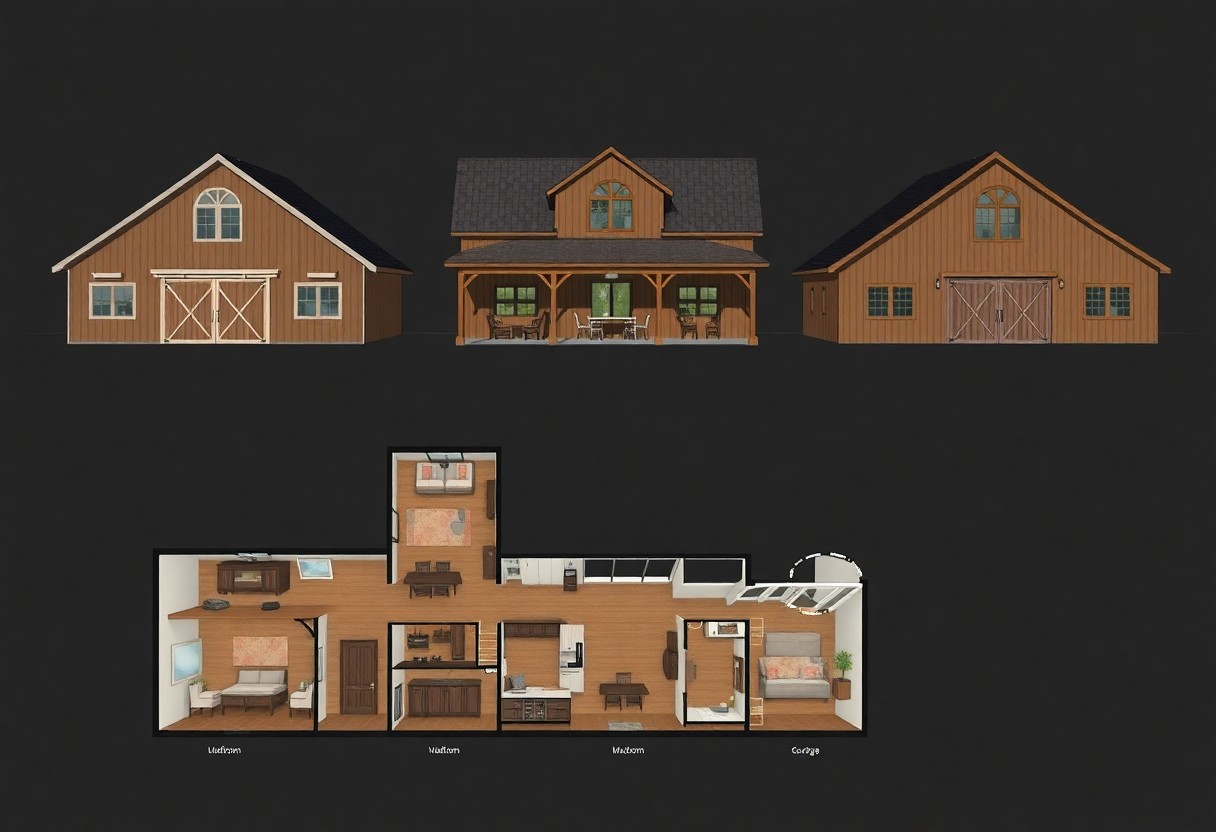
Understanding Barndominium Types
When evaluating types, you should match structure to use: living-first, shop-first, or mixed-use layouts each shift square footage and budget priorities. For example, living-focused plans often run 1,200-2,400 sq ft with 9-12 ft vaulted ceilings, while shop-first builds allocate 40-60% of the footprint to workspace. Cost per square foot typically ranges $70-$160 depending on finishes and site work. You can reduce long-term energy bills by choosing higher R-value insulation and strategic glazing.
| Traditional Barndominium | Open post-frame, exposed timber, 1,200-2,400 sq ft, economical shell |
| Modern Barndominium | Metal/glass facades, flat or low-pitch roofs, 1,500-3,000 sq ft, high-efficiency systems |
| Hybrid (Residential + Shop) | Split-floor plans, 30-60% shop area, drive-through bays, concrete floors |
| Workshop/Commercial-First | Heavy-gauge steel frames, 12-24 ft clear heights, crane-ready options |
| Luxury/Custom | High-end finishes, 2,000+ sq ft, HVAC zoned, integrated smart home systems |
- Traditional Barndominiums – classic timber or metal shells with open interiors
- Modern Barndominiums – sleek materials, minimalist layouts, energy focus
- Hybrid Layouts – combined living and significant shop/garage space
- Workshop-First Builds – engineered for heavy-duty operations and storage
- Luxury/Custom – designer finishes, multiple zones, higher per‑sq‑ft cost
Traditional Barndominiums
You’ll find traditional barndominiums emphasize exposed post-and-beam character with wide open spans and minimal interior partitions, often in the 1,200-2,400 sq ft range. Many owners choose galvanized metal roofing and board-and-batten siding for durability, and use simple 24×36 or 30×40 footprints to keep costs near the lower end of the $70-$100 per sq ft spectrum when finishes stay basic.
Modern Barndominium Designs
You can adopt modern designs that blend metal shell efficiency with large glazed facades, flat or low-pitch roofs, and clean-lined interiors; typical modern builds fall between 1,500 and 3,000 sq ft. These plans often prioritize insulation upgrades (R-30 to R-50 walls), mechanical zoning, and features like open kitchen islands and clerestory windows to bring daylight deep into the plan.
In practice, a contemporary project might use structural insulated panels (SIPs) to achieve airtightness and R-values that cut heating demand by 20-40% compared with conventional framing; owners frequently pair triple-glazed windows and heat-pump HVAC to reach net-zero-ready performance. You should budget an extra 10-25% for premium glazing and facade details versus a basic metal-shell build, but you gain resale appeal and lower operating costs. Knowing how materials, insulation, and window placement affect energy use lets you optimize cost and comfort.
Key Factors to Consider
When planning your barndominium, weigh practical items that shape layout, budget, and long-term use:
- Budget & timeline – construction typically $100-$200/ft² depending on finishes
- Site & soil – septic/well can run $3k-$15k; slope affects foundation
- Utilities & distance – power/water extensions often add $10k-$30k
- Zoning, permits & setbacks – county rules and HOA covenants vary
- Layout & future needs – workshop, garage, or multi‑gen space
- Climate & insulation – R‑values and roofing affect energy use
- Resale & function – flexible spaces improve marketability
This helps you prioritize tradeoffs and avoid expensive post-build changes.
Budget and Cost Estimation
You should set a budget using per‑square‑foot benchmarks – typically $100-$200/ft²; for example, a 2,000 ft² barndo at $120/ft² equals $240,000. Add 10-20% for soft costs (design, permits, engineering) and a 10-15% contingency for site surprises. Factor specialty items – oversized HVAC, exposed steel, or high-end finishes – which can push costs toward the upper range. Get at least three line‑item bids to compare labor, materials, and allowances.
Location and Site Selection
You’ll need to verify zoning, floodplain designation, and utility access before buying; county permit turnaround can be 4-12 weeks. A failed perc test usually forces a mound system, adding $5k-$20k, while well drilling commonly costs $5k-$15k. If power runs more than ~200 ft, expect $10k-$30k to extend service, and driveway grading or culverts can add several thousand dollars.
Order a topographic survey and soil/perc tests early – high clay, shallow bedrock, or poor bearing capacity raises foundation costs and may require piers or a deep footing, and steep lots often demand grading or retaining walls that can add $10k-$50k. Confirm heavy‑equipment access to avoid mobilization surcharges, check FEMA flood maps for insurance implications, and review HOA or county material restrictions that could affect exterior finishes and placement.
Essential Tips for Designing Your Space
Evaluate flow by mapping daily routes-kitchen to entry, mudroom to garage-and keep hallways at least 36 inches wide; zone noisy activities away from sleeping areas. Use a central vaulted volume of 12-16 feet to increase daylight and allow loft storage access with a 6-8 foot ladder. Assume that you allocate 20-30% of your build budget for mechanicals and finishes to avoid late compromises.
- Map traffic flows so you maintain comfortable 36″ circulation paths.
- Consolidate wet walls to reduce plumbing runs and save 10-20%.
- Plan lofts and built-ins to add 100-400 sq ft of usable space without expanding the footprint.
Maximizing Space and Functionality
When you maximize space, prioritize multifunctional elements: a 4’x8′ island with built-in pantry, a 10′ mudroom with lockers, and under-stair storage that adds 40-80 sq ft of usable area. Use sliding doors to save 3-4 sq ft per doorway and align work zones within 10-15 feet of each other; consider 12-16 ft communal ceilings to allow lofted storage and bring natural light deep into a 1,200-2,500 sq ft plan.
Choosing the Right Materials
Select durable exteriors like 26-24 gauge galvalume or painted steel and a standing-seam roof for 30-50 year service life; pair with a 4-6 inch, 4,000 psi concrete slab and R-20-R-30 wall insulation to meet energy targets. Use engineered beams for long spans and stainless fasteners in coastal climates to prevent corrosion.
You should compare life-cycle costs: metal siding may run roughly $3-6 per sq ft while standing‑seam roofing commands a higher upfront price but lowers maintenance; closed‑cell spray foam offers higher R‑value per inch and air-sealing benefits, whereas batt insulation reduces initial expense. Specify breathable wall assemblies in humid areas, detail thermal-bridge mitigation, and pick finishes backed by 20-50 year warranties when possible.
Step-by-Step Guide to Create a Floor Plan
|
Initial Planning and Drafting
Start by sketching a bubble diagram of functions and select a footprint-common barndo sizes are 30×40 or 40×60. You should allocate square footage (example: 35-45% living/kitchen, 25-35% shop/garage, 20-30% bedrooms) and set target room dimensions (bedrooms 120-150 sq ft, master 200-250 sq ft). Use graph paper or SketchUp to test flow, and place plumbing stacks within ~20 feet to lower plumbing costs. |
Finalizing Your Design
Coordinate final drawings with a structural engineer and builder, and confirm code items like egress, fire separation, and ADA clearances if needed. You should specify mechanicals (200-amp service typical, HVAC sizing ~3-4 tons for 1,800-2,400 sq ft), insulation targets (walls R-20, roof R-38), and realistic cost ranges-$80-$150 per sq ft depending on finishes-before submitting permit-ready plans. |
Initial Planning and Drafting
When you draft, prioritize a centerline for circulation and position the shop near an exterior bay-common shop depths are 24-36 feet to fit vehicles or equipment. You should draw at least three iterations: compact (1,200-1,500 sq ft), mid (1,800-2,400 sq ft), and expanded (2,500+ sq ft), then test sunlight, prevailing winds, and roof overhangs; these iterations reveal trade-offs between open-plan living and private bedrooms.
Finalizing Your Design
Before permits, have your builder produce a materials schedule and load calculations for post spacing (often 8-12 feet) and roof snow/wind loads specific to your county; those numbers drive beam sizes and truss specifications. You should lock in window/door sizes, slab thickness (4″ for living areas, 6″ for heavy-shop areas), and a 10-15% contingency for subcontractor estimates to avoid budget overruns.
In final coordination you must sequence lead times and inspections: order specialty items (HVAC, custom doors, trusses) 6-12 weeks out, schedule footing and slab inspections early, and confirm local permit timelines (often 2-6 weeks). You should also finalize exterior grading and drainage elevations, verify utility hookups, and create a two-week critical-path schedule for foundation-to-framing to minimize downtime and contractor hold-ups.
Pros and Cons of Barndominium Living
You’ll gain faster builds and lower shell costs-many barndominium shells go up in days and finished builds commonly range $100-$200 per sq ft-but you may face financing quirks, insurance nuances, and market acceptance issues depending on location and finish level.
| Pros | Cons |
| Lower initial shell cost – metal framing and panelized systems often reduce structural expenses by 20-40% versus comparable stick-frame shells. | Financing complexity – some lenders treat barndominiums as non‑standard homes, requiring higher down payments or specialty construction loans. |
| Faster construction – pre‑engineered shells can be erected in days; typical complete builds finish in 3-9 months depending on finishes. | Finish costs add up – high-end interiors, custom kitchens, and HVAC for large open spaces can push per‑square‑foot costs above traditional homes. |
| Flexible layouts – open spans let you combine a 1,500-3,000 sq ft shop with living quarters or convert space as needs change. | Resale variability – local buyers may prefer conventional homes, so resale value depends heavily on neighborhood and finish quality. |
| Durability and low maintenance – steel shells resist rot and pests better than wood framing in many climates. | Thermal and acoustic challenges – metal shells require proper insulation and thermal breaks; without them you’ll face condensation and noise issues. |
| Cost-effective for mixed use – if you need workshop/storage, combining functions often saves compared to separate buildings. | Zoning and code hurdles – some rural or suburban zones restrict mixed-use or have building code interpretations that complicate permits. |
| Design freedom – large clear spans support unique mezzanines, vaulted spaces, and custom garage layouts. | Trade familiarity – some contractors and subcontractors have limited barndo experience, which can affect quality and timelines. |
| Energy performance potential – with proper insulation (spray foam or high‑R batts) you can achieve efficiency comparable to framed homes. | HVAC sizing complexity – large open volumes often require zoned systems and higher upfront HVAC investment for comfort control. |
Advantages of Barndominiums
You can merge living and workspace efficiently, often fitting a 1,200-2,500 sq ft residence with a 1,500+ sq ft shop on one footprint, which reduces site prep and utility runs; plus steel shells cut framing time dramatically and lower long‑term maintenance compared with wood structures.
Disadvantages and Challenges
You’ll need to plan carefully for insulation, condensation control, and sound treatment-improper detailing leads to moisture, high heating/cooling loads, and echo; also expect lender and insurance scrutiny that can add upfront hurdles.
To mitigate these issues you should specify continuous insulation, thermal breaks, and targeted ventilation: aim for wall and roof assemblies equivalent to R‑30+ walls and R‑38+ ceilings, use closed‑cell spray foam or a warm‑roof system in cold climates, and install mechanical ventilation with dehumidification in humid regions. Investigate local lenders experienced with metal‑building residential projects and get multiple insurance quotes-doing so often saves time and prevents costly retrofit fixes later.
Additional Resources for Planning
Gather targeted resources to streamline permits, budgeting, and design decisions: consult your local building department for zoning and permit timelines (often 2-12 weeks), use online cost estimators to benchmark per-square-foot costs, and join owner forums where builders share case studies of 1,200-2,500 sq ft barndominiums to see real budgets, timelines, and common pitfalls.
Floor Plan Software Recommendations
Use SketchUp (free web version and paid Pro) for quick 3D massing, Chief Architect or Revit for permit-ready construction documents, and RoomSketcher or Floorplanner for fast furniture layouts; AutoCAD LT works for precise 2D CAD drafting if you need DWG exports. For example, modeling a 1,800 sq ft mixed-use barndo in SketchUp revealed roof overhang conflicts before framing, saving change orders.
Professionals to Consult
You should hire an architect or designer for code-compliant plans, a structural engineer to verify snow/wind loads and steel connections, and a contractor experienced with metal shell systems; add an MEP (mechanical/electrical/plumbing) consultant and an HVAC specialist for efficient systems. Architects often charge 5-15% of construction cost, while engineering and MEP fees vary by project complexity.
Vet prospects by asking for 3-5 barndominium or metal-building references, proof of licensing and insurance, and examples of stamped structural drawings for your county. Confirm they’ve worked with local inspectors and can produce energy calculations or Blower Door results if you pursue insulation upgrades; expect design to take 4-8 weeks and engineering 2-6 weeks once site data is provided.
Final Words
Drawing together the principles and examples in this guide, you can confidently choose and tailor a barndominium floor plan that aligns with your lifestyle and budget. Focus on circulation, multifunctional rooms, and long-term adaptability, evaluate structural and code requirements, and plan systems early so your design supports daily routines, entertaining, and future needs without compromising comfort or resale value.
FAQ
Q: What is a barndominium and what are common floor plan layouts?
A: A barndominium is a metal- or wood-framed building that combines living quarters with open shop or storage space. Common layouts include single-level open plans with combined kitchen/living/dining, loft-style sleeping areas above a shop, split-plan designs that separate a finished living wing from a workshop, and attached or detached garage/workshop configurations. Each layout emphasizes flexibility, durable finishes, and often higher ceilings or mezzanines for storage and work areas.
Q: How do I choose a floor plan that fits my daily lifestyle and future needs?
A: Start by listing primary activities (workshop, entertaining, remote work, multi-generational living) and the number of bedrooms and bathrooms needed now and later. Prioritize flow: place public spaces together and bedrooms apart for privacy, allocate dedicated zones for noisy or dusty activities, and design multipurpose rooms that can convert as needs change. Consider site orientation, natural light, access to utilities, and whether easy expansion or modular additions will be required.
Q: What design considerations are important when combining a workshop or garage with living space?
A: Ensure physical and acoustic separation between shop and living areas with insulated walls, solid fire-rated doors, and separate HVAC systems or zoning. Plan for ventilation, dust control, durable flooring, adequate lighting, heavy-duty electrical service, and proper drainage and slopes for vehicle washes. Add transition zones such as mudrooms or utility corridors to keep contaminants out of living spaces and to provide storage for tools and gear.
Q: How can open-plan barndominiums be made energy-efficient and comfortable year-round?
A: Use a continuous thermal envelope: high R-value insulation in walls and roof, sealed vapor barriers, and thermal breaks at framing connections. Install appropriate HVAC sizing with zoning or ductless mini-splits for large-volume spaces, add ceiling fans and operable windows for passive cooling, and include insulated doors and storm-rated windows. Consider radiant barriers or spray foam for metal roofs and use interior partitions, curtains, or sliding doors to reduce conditioned volume when needed.
Q: What customization options and cost drivers should I plan for when designing a barndominium floor plan?
A: Popular customizations include mezzanines or lofts, oversized porches, shop mezzanine storage, upgraded insulation, high-end kitchens and baths, and specialty garage lifts or hoists. Major cost drivers are building footprint and height, foundation/site preparation, insulation and HVAC upgrades, utility hookups, structural modifications for large openings, and finish selection. Prioritize foundation, envelope, and mechanical reliability before luxury finishes to protect long-term value and performance.
Leave a Reply