Over the past decade barndominiums have grown in popularity, and when you consider one as your next home, you should weigh design flexibility, zoning and building codes, insulation and energy efficiency, resale value, and contractor experience; understanding cost breakdowns, financing options, and maintenance needs will help you make informed choices so your barndominium meets lifestyle, budget, and long-term investment goals.
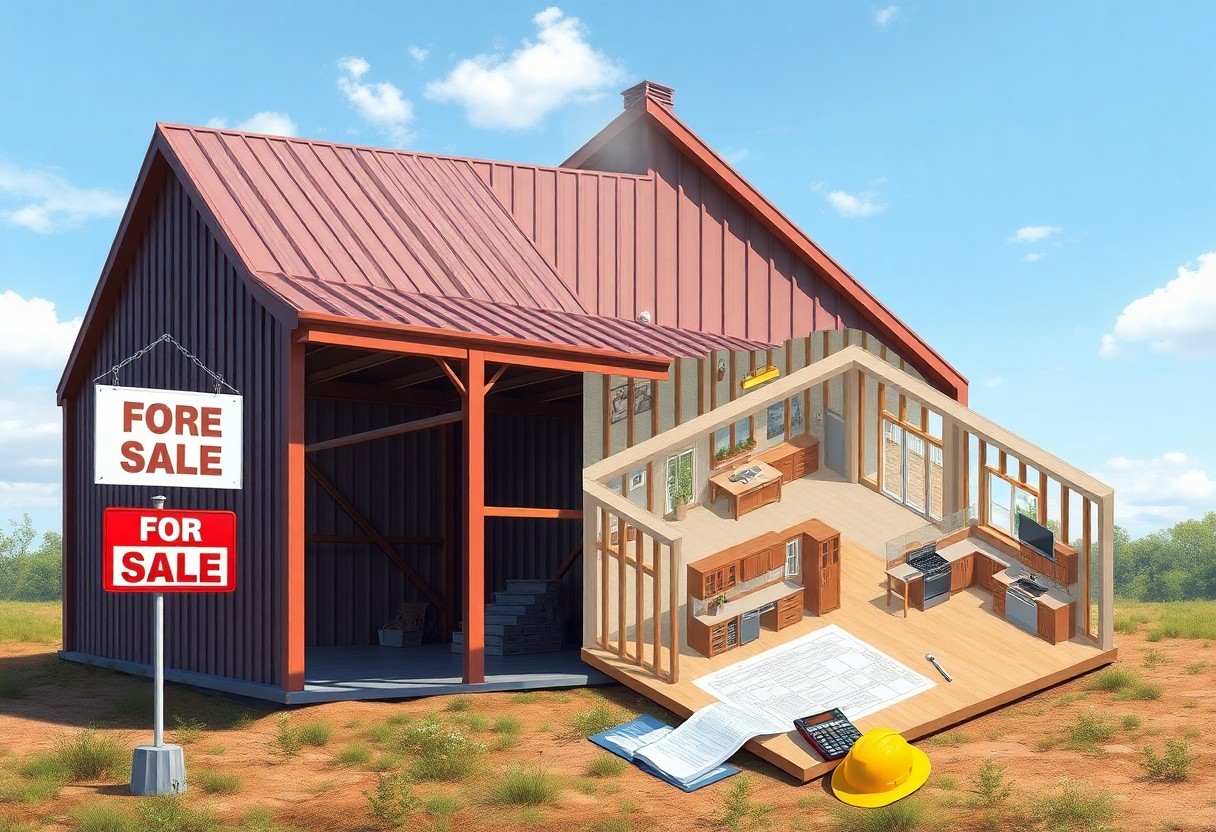
Key Takeaways:
- Confirm zoning, setback, floodplain and other local code requirements; secure permits and verify septic/well and foundation/site-prep needs before buying.
- Know the build type and true costs: metal shell lowers framing expense but finish-out, insulation, HVAC, moisture control and insurance drive the final budget.
- Plan financing and resale: lenders often treat barndominiums as custom homes-use experienced builders, a detailed contract, realistic appraisal expectations and a contingency fund.
Understanding Barndominiums
You should evaluate how construction type, site prep, and intended use interact-post-frame or steel shells change foundation needs, clear-span interiors affect HVAC design, and attached workshops influence electrical capacity; typical build windows run 2-6 months and finish levels drive costs more than the shell itself, so plan budgets and utility hookups early to avoid surprises.
Definition and Features
You’ll find a barndominium blends a barn’s structural system with full-time living space: metal siding/roof, concrete slab or crawlspace, open clear spans often 30-60 ft, large overhead doors, and flexible loft or mezzanine layouts; finishes range from basic drywall to high-end kitchens, and many use post-frame construction for faster, lower-cost shells.
Advantages Over Traditional Homes
You can save time and money because shells are simpler and often cheaper per square foot-typical ranges are roughly $60-$150/ft² depending on finishes-and build schedules of 2-6 months beat many stick-frame projects; durability of metal roofing and siding also reduces maintenance and long-term replacement costs.
You’ll also gain versatility: combining living space with a 1,000-2,000 ft² workshop eliminates the need for separate outbuildings, cutting land-use and utility extension costs; for example, a 2,000 ft² shell at $80/ft² can cost about $160,000 before finishes, whereas adding similar detached shops can push total project costs 20-40% higher and lengthen permitting and inspection timelines.
Financing a Barndominium
Financing a barndominium demands that you match lender type to build method: post-frame or steel-shell builds often qualify for construction-to-permanent loans, while modular or non-permanent structures may force chattel loans. Expect lenders to request detailed plans, a builder contract, and an itemized budget; typical construction loan underwriting asks for 20-30% down if land isn’t fully paid, and appraisal-based loan amounts usually cover 65-80% of combined land plus projected construction costs.
Mortgage Options
You can pursue a single-close construction-to-permanent loan (one closing, converts to a 15-30 year mortgage), a stand-alone construction loan (interest-only during build, then refinance), or specialty programs like VA or USDA if you qualify and the property meets occupancy and site rules. Draw schedules fund work in stages, lenders inspect at major milestones, and rates on construction loans typically run 0.5-1.5% higher than permanent mortgages; chattel loans exist if your build is classified as personal property.
Budgeting for Construction
Plan per-square-foot costs conservatively: lower-end barndo shells start around $100-$130/sq ft for basic finishes, typical mid-range builds run $130-$200/sq ft, and high-end finishes exceed $200/sq ft. You should also budget $5k-$50k for site prep (septic, well, grading), $1k-$5k for permits, and include a contingency of 10-20% to cover change orders and unforeseen site issues.
For example, a 2,000 sq ft mid-range barndominium at $140/sq ft equals $280,000 for construction; add $30,000 site work, $20,000 foundation and utilities, and $3,000 permits. With a 15% contingency ($47,000) your project estimate totals about $380,000. Track costs against draw schedules, require lien waivers, and plan for 5-10% retainage on each draw to ensure punch-list completion before final conversion to the permanent mortgage.
Choosing the Right Location
Prioritize parcels with good site access, stable soils, and minimal flood risk to control build and insurance costs; aim for locations within a 30-45 minute commute if proximity to schools and jobs matters. You should map topography, solar exposure for passive/heating design, and existing driveways-steep grades above 15% will increase excavation and foundation costs substantially. Investigate nearby development plans and ask local planners about future road or utility projects that could affect value and construction timing.
Zoning and Land Restrictions
Check zoning maps and county ordinances for permitted residential uses, minimum lot sizes (often 1-5 acres in rural districts), setback rules (commonly 20-50 ft), and accessory building limits; agricultural or mixed-use zoning can restrict primary residences or require a conditional use permit, which often takes 30-90 days to approve. You should also verify HOA covenants and deed restrictions that may prohibit metal exteriors, certain rooflines, or short-term rentals, since compliance affects design and resale.
Access to Utilities and Services
Verify availability of electric service, municipal water/sewer, broadband, and emergency response times before buying: many rural barndominium sites require a percolation test for septic and a drilled well (typical domestic wells are 100-400 ft deep); expect septic installs generally in the $3,000-$10,000 range for conventional systems. You should contact local utilities to confirm nearest pole/pipe location and any line-extension fees that will factor into your budget and timeline.
If utilities aren’t nearby, get written line-extension estimates from the utility company-extension costs commonly range widely (roughly $20-$100 per linear foot depending on terrain and permits), so running service 1,000 ft can be tens of thousands of dollars. You should also explore alternatives like engineered septic systems ($10,000-$25,000 for complex sites), drilled wells, or off-grid packages (solar plus batteries often $15,000-$40,000) and obtain county health and utility approvals before closing to avoid surprise costs or delays.
Designing Your Barndominium
You’ll want to treat the metal shell as a flexible canvas: plan for open sightlines, 10-14 ft ceiling heights, and strategic placement of plumbing and electrical to cut retrofit costs. Use common footprints like 30×40 or 40×60 to control material pricing, orient living spaces to maximize southern light, and specify insulation targets (walls R-19, attic R-38) to get predictable comfort and energy bills. Prioritize durable finishes in high-use zones to keep long-term maintenance low.
Layout Considerations
Start by zoning: allocate roughly 40% of square footage to living/kitchen, 30% to bedrooms, 15% to garage/shop and 15% to utilities and circulation to balance function and cost. Group wet areas (kitchen, baths, laundry) to shorten plumbing runs and reduce labor. Consider a loft or mezzanine for flexible space, 3-4′ overhangs for weather protection, and egress/ADA needs when siting bedrooms and entries for resale and daily use.
Customization Options
You can add exposed timber trusses, a mezzanine, or a 20×20 shop bay with a 10-12 ft roll-up door to tailor the shell to lifestyle and work needs. Finish choices-from board-and-batten siding to quartz countertops-drive cost and durability; adding a 20×20 garage bay typically increases build cost by roughly $10,000-$30,000 depending on finishes. Choose systems (radiant floor, mini-split heat pumps) that match your climate and open-plan layout.
For deeper customization, pick systems and materials that align with performance goals: ductless mini-split heat pumps (12,000-36,000 BTU) suit open volumes, while insulated concrete slabs with hydronic radiant heat improve winter comfort in colder zones. Specify window U-values ≤0.30 for energy savings, and consider pre-plumbing for future baths or an in-law suite to increase flexibility; one 40×60 conversion produced 2,200 sq ft living plus an 800 sq ft shop, maximizing resale and utility.
Building Process Overview
When you sequence the build, start with site prep and a compacted gravel pad or engineered slab-site work often runs 5-10% of total costs. Next, the metal shell or post-frame frame goes up; shells can be erected in days to weeks and typically account for 30-40% of the budget. After that, rough-ins for electrical, plumbing, and HVAC precede insulation and interior finishes, which usually consume the remaining 40-50% and determine final habitability and resale value.
Hiring Contractors vs. DIY
You can save 10-30% by doing specialized tasks yourself, but licensed contractors reduce risk: expect general contractor fees of 10-20% plus subcontractor labor that often represents 40-60% of project cost. For a $200,000 build, hiring professionals might add $20k-$40k in markup but brings permits, inspections, warranties and faster timelines; DIY works if you have trade skills, time, and willingness to assume code and liability responsibilities.
Timeline Expectations
You should plan for a wide range: simple shell-first builds can close the envelope in 4-12 weeks, while fully finished barndominiums commonly take 4-9 months from permit to move-in. Weather, permit turnaround, and material lead times (HVAC units often 4-8 weeks) are frequent sources of delay, so build buffers into your schedule and budget.
Breaking timelines into phases helps: permitting 2-8 weeks, site prep and foundation 1-4 weeks (concrete cure adds time), shell erection 1-3 weeks, rough-ins 2-6 weeks, insulation/drywall 2-4 weeks, and finishes 4-12 weeks. For example, a 2,400 sq ft Texas barndominium I referenced finished in 26 weeks largely because of a two-week concrete cure and a six-week HVAC lead time; pre-ordering long-lead items and coordinating one GC can shave weeks off delivery.
Inspection and Maintenance
Importance of Inspections
You should schedule a full structural and pest inspection at least once a year and spot-check the roof and mechanicals every six months; typical inspection fees run $300-$500. Metal panels, sealants, fasteners and any wood framing where moisture accumulates need focused attention for rust, loose screws, rot or termites-catching issues early can prevent $5,000+ repairs down the road.
Routine Maintenance Tips
Perform quarterly walk-arounds to spot loose screws, sealant gaps, and gutter blockages; clean gutters twice yearly and service HVAC every 6-12 months. Replace damaged neoprene-washered fasteners and touch up exterior coatings every 5-7 years based on sun exposure. Use stainless or hot-dipped galvanized fasteners in coastal or high-humidity areas to reduce corrosion.
- Retorque and replace missing panel fasteners every 3 months.
- Clear gutters and downspouts in spring and fall to avoid water infiltration.
- After five years, schedule a professional roof-coating inspection to preserve paint and warranty coverage.
For example, a homeowner in central Texas documented quarterly checks and replaced 24 corroded clips within two years, preventing a leaking ridge line that would have cost about $8,000 to repair; you should keep dated photos and maintenance logs, retain manufacturer manuals, and use 12-14 gauge stainless or galvanized screws in exposed locations.
- Service HVAC, change filters, and inspect duct seals every 6-12 months.
- Treat perimeter wood and perform termite inspections annually in high-risk regions.
- After each major storm, walk the perimeter and check for displaced panels, loose fasteners, or standing water around the foundation.
Conclusion
With these considerations in mind, you can confidently assess whether a barndominium fits your lifestyle and budget; evaluate zoning, insulation, and resale potential; plan for contractor selection, warranties, and realistic timelines; and prioritize energy efficiency and long‑term maintenance. By doing due diligence and asking targeted questions, you protect your investment and ensure the finished home meets your needs and expectations.
FAQ
Q: What exactly is a barndominium and how do financing and insurance differ from a conventional house?
A: A barndominium combines residential living areas with a metal- or post-frame barn structure and can be a new build or a conversion of an existing agricultural building. Financing options vary: conventional mortgage lenders will often require the structure to be classified as residential, on a permanent foundation, and appraised like a house; some buyers need construction-to-permanent loans, owner-builder loans, or specialty lenders familiar with post-frame construction. Down payments and terms can be stricter if the property is classified as agricultural or commercial. For insurance, policies must reflect metal-frame construction and use (living plus workshop/garage); obtain a homeowner policy that covers replacement cost, detached-shop exposures, and liabilities for business use if applicable. Provide lenders and insurers with engineering reports, foundation details, and a certificate of occupancy to secure standard residential terms and adequate coverage.
Q: What inspections, code checks, and permits should I prioritize before buying or converting a barndominium?
A: Prioritize a structural inspection by someone experienced with metal or post-frame buildings to assess framing, connections, anchor bolts, roof trusses, and mezzanine/support systems. Have a qualified electrician and plumber inspect systems for code compliance, proper grounding, panel capacity, and plumbing vent/septic/well integrity. Confirm insulation type and vapor control to avoid condensation issues, and check for moisture, rust, and pest damage. Verify permits and approvals: building permits for conversion or new construction, zoning confirmation (residential vs. agricultural), septic/well permits, floodplain setbacks, and any local agricultural exemptions that affect habitability. Obtain a soils report for foundation suitability and, if planning modifications, an engineer’s stamped plans. Ensure certificate of occupancy or equivalent documentation is available before closing.
Q: How do customization, energy efficiency, maintenance, and resale prospects affect my decision to buy a barndominium?
A: Customization is a major appeal-open layouts, high ceilings, and integrated shop space-but finish quality affects long-term value; higher-end interior finishes and a permanent foundation increase marketability. For energy performance, choose continuous insulation strategies (insulated metal panels, spray foam, or properly detailed cavity insulation with thermal break) and address thermal bridging at steel framing; size HVAC for the combined open space and consider zoning. Maintenance differs from conventional homes: metal exterior care (corrosion protection, sealants, fastener checks), roof seam inspections, condensation management, and routine mechanical servicing are important. Resale depends on location, permitted use, documented permits/warranties, and the perceived permanence of construction-homes that look and are documented as residential typically appraise and sell more predictably than structures labeled agricultural or commercial.
Leave a Reply