Modern 3-bedroom barndominium plans blend open-concept living, efficient layouts, and durable construction to help you create a versatile, low-maintenance home that suits family life and remote work. This guide highlights layout variations, structural considerations, energy-efficient systems, and material choices so you can assess costs, customize floorplans, and select finishes with confidence. Use these modern inspirations to align your design with lifestyle and budget goals.
Key Takeaways:
- Modern 3-bedroom barndominiums favor open-concept living with vaulted ceilings and generous windows to maximize light while grouping bedrooms into a private wing for family-friendly flow.
- Plans often combine living space with a workshop/garage or flexible bonus room, allowing customization for hobbies, storage, or rental income without expanding the footprint.
- Using a metal barn shell lowers construction time and maintenance costs; builders can add insulation, efficient HVAC, and contemporary finishes to achieve energy-efficient, stylish homes.
Overview of Barndominiums
Definition and Features
You’ll see barndominiums as hybrid homes combining a metal or wood-framed agricultural shell with finished living space, often featuring clear-span interiors, 12-18 ft main bay ceilings and open-concept great rooms. Many 3-bedroom plans range from about 1,200 to 2,500 sq ft, and commonly integrate a 20×30 to 30×40 workshop or garage bay. You can expect durable metal siding or board-and-batten exteriors, exposed timber or steel beams, and flexible floor layouts that simplify future additions or workspace conversions.
Benefits of Living in a Barndominium
You often gain cost and time savings: pre-engineered metal kits can shorten build timelines by roughly 30-50% and owners typically report 10-30% lower shell-and-labor costs versus comparable stick-built homes. Practicality shines through when you attach a 30×40 shop to a 1,800 sq ft, 3-bedroom layout for combined business or hobby use, and low-maintenance metal exteriors reduce long-term upkeep.
Comfort and efficiency scale with the finishes you choose; for example, adding closed-cell spray foam and insulated metal panels brings thermal performance up to modern code, while installing a vaulted loft (300-600 sq ft) creates a private master suite without raising the footprint. You’ll also find strong resale demand in rural markets where acreage-plus-shop listings attract buyers seeking both living space and functional workspace.
Essential Elements of 3 Bedroom Plans
Your plan should balance square footage (typically 1,400-2,400 sq ft) with function: allocate 600-900 sq ft to the open living/kitchen area, size the master suite around 14×16 ft with a 6×8 ft walk-in closet, and keep secondary bedrooms near 10×12-11×12 ft. Include a 24×30 ft garage/shop option, a dedicated laundry/mudroom adjacent to the entry, and mechanicals tucked into a 50-80 sq ft utility zone to maximize usable living space.
Spatial Layout Considerations
Prioritize clear public/private zoning by placing bedrooms down a hallway at least 36″ wide or on a separate wing; use a split-plan when you want the master isolated. Maintain 3′ circulation around a kitchen island (island length often 8-12 ft) and opt for 9-12 ft ceiling heights in living areas to enhance volume. Orient large windows south or west for light, and consider clerestories or 6’×4′ fixed windows to boost daylight without sacrificing wall space.
Design Aesthetics and Interior Design
Blend industrial shell elements with warm finishes-exposed trusses, reclaimed wood, and matte-black metalwork-to create modern-rustic balance. Choose durable floors like wide-plank oak or stained concrete with radiant heat, and layer lighting: recessed ambient, task pendants over a 10 ft island spaced ~36″ apart, plus accent sconces. Limit your palette to two primary materials and one accent to keep cohesion.
For practical application, pick a dominant material (metal or timber), a secondary surface (oak, concrete, or tile), and an accent (black steel or brass). Use example specs: 10-14 ft open-beam ceilings, 8″ plank oak flooring, concrete countertops in the kitchen with a 2-3″ edge, and matte-black fixtures for continuity. Plan 3 lighting zones per living space-ambient, task, accent-and test full-scale samples of finishes together to ensure the textures and colors work in your light conditions.
Modern Barndominium Inspirations
Modern barndominiums blend industrial materials with refined finishes to create highly livable homes. You’ll find steel frames, board-and-batten or corrugated metal siding, floor-to-ceiling windows, and R-30 or better insulation; many 3-bedroom plans fall between 1,400-2,400 sq ft. Designers often incorporate solar-ready roofs, exposed trusses, and generous overhangs to boost durability and curb appeal.
Popular Architectural Styles
Contemporary farmhouse and modern industrial dominate current preferences, offering clean lines or exposed structure respectively. You may choose gambrel roofs for 200-300 sq ft of loft space, gabled forms for classic porches, or minimalist boxes that emphasize large glazing and simple metal cladding; mixed-material facades-cedar plus steel-are common on show homes.
Innovative Interior Layouts
Open-concept great rooms measuring 20×24 ft and kitchen islands 8-10 ft long are standard for social living, while split-bedroom plans give you a private master (often 12×16 ft) separate from two 10×11 ft bedrooms. Designers add mudrooms, flexible home offices, and attached workshops (400-800 sq ft) with 8-10 ft roll-up doors to suit hobbyists and remote work needs.
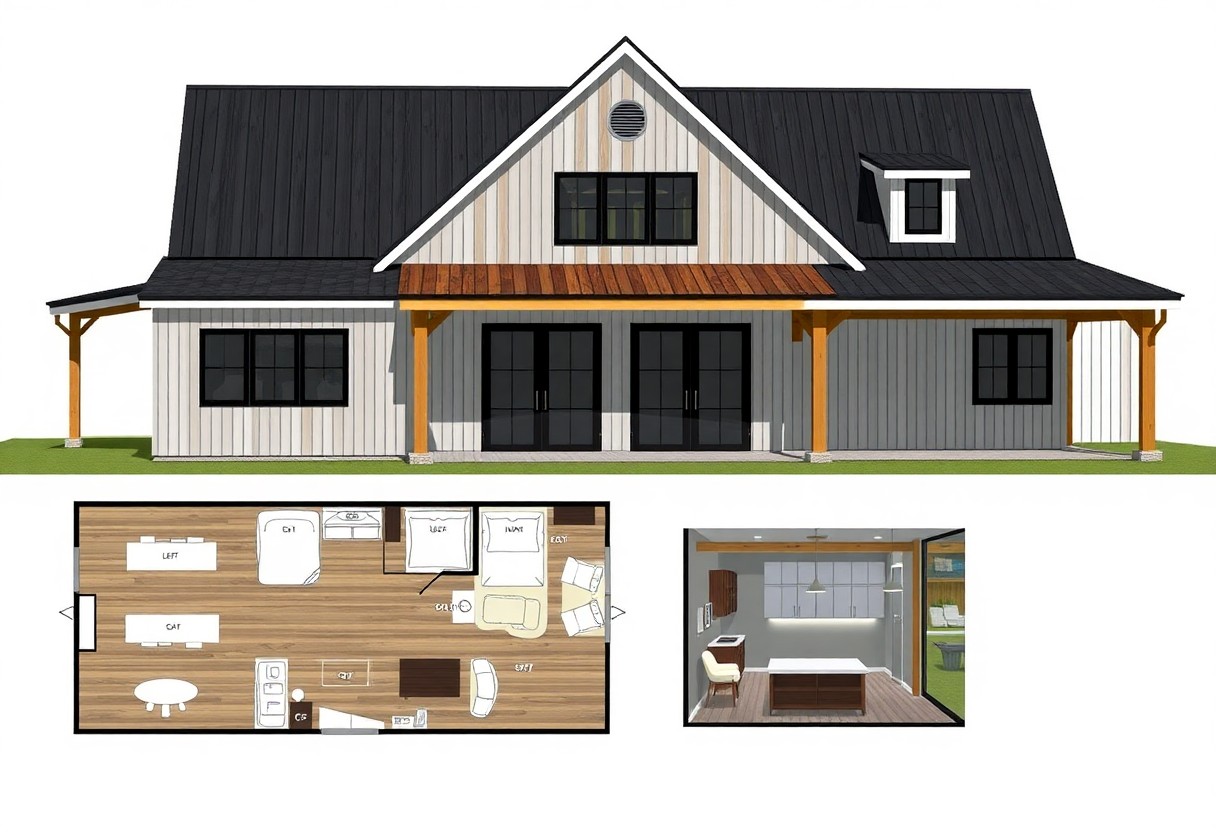
Consider a real example: a 1,850 sq ft 3-bedroom plan with a 24×18 ft great room, 10×8 ft kitchen island seating six, a 12×16 ft master with en suite, two 10×11 ft secondary bedrooms, and a 600 sq ft workshop with a 10 ft roll-up door. You can use pocket doors, sliding barn doors, or operable partitions to convert the loft or office into guest space while keeping circulation efficient and storage integrated.
Customization Options
Tailor your floor plan with options like vaulted ceilings over the great room, a combined mudroom/laundry, or a 24’×30′ attached shop; you can choose open-plan living or segregated zones for privacy. Specify 9-12 foot ceiling heights, built-in storage, and flexible guest suites to suit family size-three-bedroom plans often allocate 1,800-2,200 sq ft to balance living space and utility areas.
Exterior Facades and Finishes
Mix corrugated steel (standing-seam or ribbed) with board-and-batten or reclaimed barnwood accents for contrast; add a stone veneer around entries for permanence. Opt for fiber-cement siding for low-maintenance durability, or cedar for warmth requiring sealing every 3-5 years. Consider vertical metal panels to emphasize height, muted grays and tans with natural wood highlights, and oversized covered porches for weather protection.
Energy-Efficient Features
Upgrade your envelope with R-21 walls and R-38 to R-49 attic insulation, or use 2×6 framing plus 1-2″ continuous foam to reduce thermal bridging. Choose double-pane low-E windows, a ductless or central heat pump (COP 3-4), LED lighting, and an ERV for balanced ventilation to cut heating and cooling loads by 20-40% compared with minimal-code builds.
For higher performance, target an airtightness of ≤3 ACH50, apply 4-6″ closed-cell spray foam (R≈6.5 per inch) at key junctions, and detail thermal breaks where steel framing meets exterior sheathing. Add a 3-6 kW solar PV array with optional 10-20 kWh battery storage to offset peak loads, and size HVAC and ERV systems to measured heat-loss calculations rather than rule-of-thumb estimates.
Budgeting and Cost Considerations
When planning your budget, separate costs into shell, interior finishes, site preparation, and permits since each can swing totals dramatically. You’ll typically see finished barndominiums average $80-$200 per sq ft; a 2,000 sq ft three-bedroom commonly ranges $160,000-$400,000 depending on insulation, HVAC, and finish level. Factor in foundation and utility hookups ($10k-$50k), detached or attached shop premiums, and a 10-20% contingency for unexpected site or material issues.
Average Costs of Barndominium Construction
Base-metal shell and basic interior finishes often run $80-$130 per sq ft, while mid to high-end finishes push $150-$220 per sq ft. For example, at $120 per sq ft a 1,800 sq ft three-bedroom totals about $216,000; upgrading to an upscale kitchen and HVAC can send the same footprint past $350,000. Land, septic, driveway and permits are typically billed separately and can add $10k-$60k.
Financing Options
You can pursue construction-to-permanent loans, conventional mortgages post-completion, USDA or VA loans in eligible rural areas, or owner-builder financing if you act as GC. Lenders generally require detailed plans, contractor bids, proof of builder experience, 20-25% down or equity, and a draw schedule with inspections. Disclose mixed-use spaces early, since attached shops may trigger commercial underwriting rules.
Construction loans usually carry interest-only payments during the build and convert to a permanent mortgage after final inspection and appraisal, often within 3-12 months. Expect draw fees, inspection costs, and to maintain a 10-20% contingency reserve; for instance, a $300,000 project with 20% down needs $60,000 up front. Because some banks limit metal-building financing, seek lenders experienced with barndominiums or work with a builder who has established lender relationships.
Frequently Asked Questions
You can expect straightforward answers on cost, timeline, and permits: average barndominium builds run $90-$150 per sq ft, typical sizes 1,200-2,400 sq ft, and timelines of 12-20 weeks depending on finishes. Financing options include construction-to-perm loans, FHA 203(k), or conventional mortgages after final inspection. Permit scopes and utility hookup lead times vary by county, so contacting your local building department early can save weeks.
Common Concerns about Barndominium Living
You’ll hear questions about insulation, noise, and resale value; for metal shells aim for R-21 walls and R-38-R-49 roof assemblies or closed-cell spray foam to minimize thermal bridging and sound transfer. HVAC should be sized for open-plan volumes-typically 3-4 tons for 2,000-2,500 sq ft with high ceilings. Insurance and HOA restrictions can affect siting and exterior choices, so verify both before you finalize plans.
Tips for First-Time Builders
Begin with engineered plans, get three competitive bids, and prioritize contractors who’ve completed at least five similar builds with verifiable references. Lock material prices when feasible, stage purchases for long-lead items, and allow a 10-15% contingency for change orders and supply hiccups. The safest route is a fixed-price contract with a 10-15% contingency.
- Obtain stamped structural and foundation plans
- Compare three or more full bids (not estimates)
- Verify contractor portfolios and local references
- Confirm permit list and inspection schedule
Plan a realistic schedule: slab/foundation 2-4 weeks, steel shell erection 1-3 weeks, exterior finishes 2-4 weeks, interior build-out 6-12 weeks-total 4-6 months for a 2,000 sq ft turnkey build. Decide early on slab vs. pier foundations, insulation type (closed-cell vs. cavity + continuous), and HVAC capacity; order windows and doors ahead to avoid 8-12 week lead times. The typical build-to-occupancy timeline you should plan is 4-6 months including inspections and final permits.
- Choose foundation type (slab, pier, crawlspace)
- Select insulation strategy and target R-values
- Size HVAC for open-plan volumes (3-4 tons for ~2,000-2,500 sq ft)
- Confirm utility hookup schedules and permit milestones
Conclusion
Hence you can confidently select a 3-bedroom barndominium plan that balances open living, smart zoning, and durable materials; prioritize flexible layouts, abundant natural light, energy-efficient systems, and built-in storage to maximize comfort and resale value. Collaborate with experienced designers and builders to adapt modern styling to local codes and your budget, ensuring a practical, long-lasting home.
FAQ
Q: What are typical 3-bedroom barndominium floor plan layouts and how can I optimize living space?
A: Common layouts center on an open great room that combines kitchen, dining, and living areas for a spacious, social core. Place the master suite on one side for privacy and two guest/children’s bedrooms on the opposite wing or in a split-bedroom arrangement. Plan for at least one full and one half bathroom (or two full baths) depending on household needs. Include a dedicated laundry/mudroom with direct exterior access, a pantry or walk-in storage near the kitchen, and built-in closets to maximize usable square footage. Consider vaulted ceilings in the main area, a compact foyer to reduce heat loss, and window placement to capture natural light while preserving wall space for furniture. Typical three-bedroom barndominiums range from about 1,200 to 2,400 sq ft; choose an overall footprint that balances construction cost with desired room sizes and circulation space.
Q: What modern design features and finishes work best for a contemporary barndominium aesthetic?
A: Popular modern elements include a metal exterior paired with warm wood or vertical board siding accents, exposed steel or timber beams inside, and large insulated windows or sliding glass doors to blur indoor/outdoor lines. Interior finishes often mix polished concrete or engineered hardwood floors with matte cabinetry and quartz or concrete countertops. Open-concept kitchens with oversized islands, integrated appliances, and minimalist hardware create a clean look; consider a walk-in pantry for clutter control. Incorporate energy-efficient HVAC, LED lighting, smart thermostats, and high R-value insulation to improve comfort and lower operating costs. Outdoor living spaces-covered patios, porches, or a metal-roofed pergola-extend usable space and complement the modern-industrial vibe.
Q: What should I know about permits, construction methods, timeline, and costs for building a 3-bedroom barndominium?
A: Confirm local zoning, setback, and permitting requirements early; some rural zones favor pole-frame (post-frame) construction while urban areas may require conventional stick framing. Foundation options typically include slab-on-grade or crawlspace; slab is common for cost efficiency and thermal mass. Construction methods vary: metal building shells and kit packages speed up enclosure, while custom stick-built or hybrid approaches offer greater finish flexibility. Budget factors: site prep, utilities (septic, well, electrical), foundation, shell, finishes, and insulation. Broad cost ranges are roughly $120-$250+ per sq ft depending on finish level, with simpler builds at the low end and high-end custom finishes at the high end. Typical build timelines run 4-9 months after permitting, but weather, subcontractor availability, and change orders affect duration. Investigate builders experienced with barndominiums, obtain multiple bids, and plan contingencies of 10-20% for unforeseen expenses; explore construction loans or manufacturer financing if using kits.
Leave a Reply